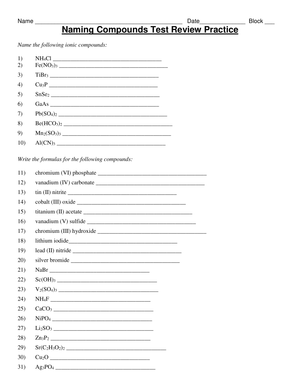
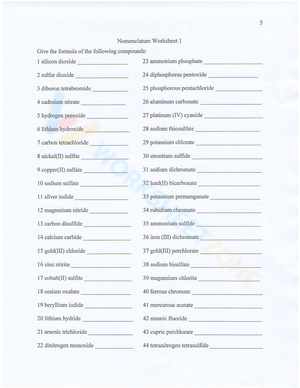
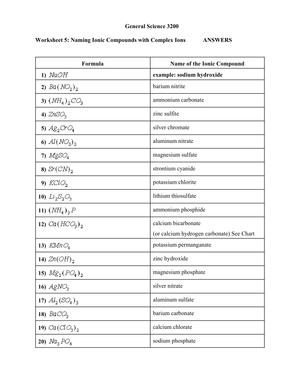
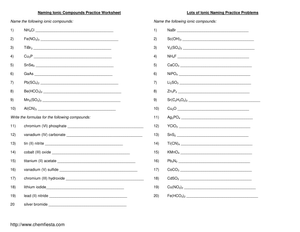
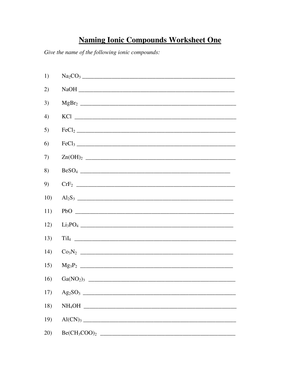
These 9th grade naming ionic compounds printable worksheets cover the full naming sequence chemistry teachers introduce in a first-year course — binary compounds, transition metal compounds, and polyatomic ion compounds — giving teachers a set of resources they can pull from at any point in the unit without rewriting problems or hunting for supplemental materials. Each worksheet is self-contained and ready to assign for guided practice, independent work, homework, or pre-quiz review.
What Each Worksheet Targets
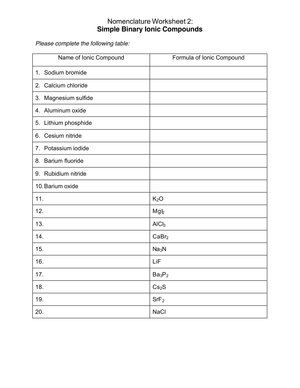
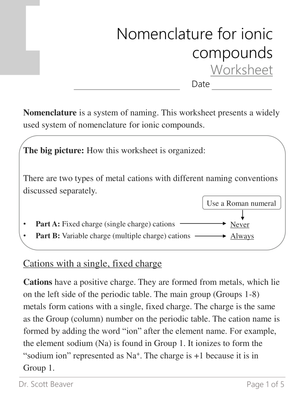
The naming sequence builds in three recognizable layers, and the worksheets follow that same progression. Binary ionic compounds come first — students write the cation name unchanged and shift the monatomic anion to an -ide ending. That rule looks mechanical, but students need enough repetitions to execute it automatically before transition metal problems appear and the charge reasoning becomes more demanding.
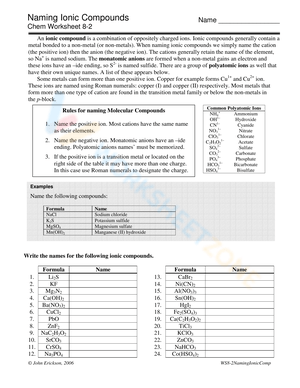
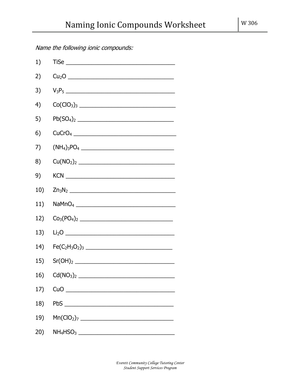
Transition metal compounds require students to infer the metal's charge from the anion charge and the neutral total, then record that charge using a Roman numeral in the compound name. Students who skip the calculation step — writing "iron chloride" when the formula is FeCl₃ — are working on automatic naming habits that collapse when they encounter an unfamiliar compound. Each worksheet in the transition metal section asks students to show the charge derivation before committing to a name.
Polyatomic ion compounds introduce a different challenge: the ion name doesn't change. Sulfate stays sulfate. Nitrate stays nitrate. A student who has internalized the -ide rule for monatomic anions will sometimes apply the same pattern here and produce something like "sulfateide," which tells you immediately that two distinct rules have been conflated. The set includes enough polyatomic examples — hydroxide, carbonate, phosphate, and ammonium alongside sulfate and nitrate — to move students out of that reflex before they hit the mixed-review worksheet.
Problems also run in both directions: students name compounds from formulas and write formulas from names. That two-way structure matters because the cognitive demand is genuinely different. Formula-to-name requires recognition; name-to-formula requires recall plus charge balancing. The 9th grade naming ionic compounds printable worksheets include both directions in sufficient quantity to build real fluency, not just the recognition half of the skill.
Mistakes Students Repeat That Teachers Need to See Coming
Charge blindness is the most persistent error. A student writes FeCl₃ as "iron chloride" instead of "iron(III) chloride" because they applied the binary naming rule without checking whether iron has a fixed or variable charge. The Roman numeral step feels optional — nothing in the formula forces students to look up the charge if they already know the metal's name. These worksheets are sequenced so transition metal problems cannot be solved by guessing the cation name alone; the anion charge must be used to derive the Roman numeral.
Prefix contamination from molecular naming is a second predictable problem. After students spend time on compounds like N₂O₄ and PCl₃, a subset will write "diiron trisulfate" for Fe₂(SO₄)₃ instead of "iron(III) sulfate." These aren't careless errors. They reflect a student trying to apply a recently learned rule to a new context. That pattern in student work is actually informative: it tells you the boundary between ionic and molecular naming hasn't been drawn clearly enough yet.
Ion order reversal also shows up consistently. Students write "chloride sodium" instead of "sodium chloride" because they read the formula left to right without knowing that the convention puts the cation name first. One worksheet in the set isolates this step explicitly — students identify and label the cation and anion before writing any name, making the decision conscious rather than automatic.
Building These Worksheets Into Your Chemistry Unit
The most effective rollout runs across two or three class sessions rather than concentrating all naming practice in one period. On the first day, use the binary compounds worksheet during guided instruction — model one problem, have students complete the next two with a partner while talking through the naming steps aloud, then finish the rest independently. That gradual release works better than assigning the full worksheet cold, especially for students who freeze when the compound type shifts without warning.
The transition metal worksheet fits naturally as a mid-unit practice block once students have a reference list of variable-charge metals in front of them. Assign 10 to 12 problems and ask students to write the charge calculation in the margin before writing the compound name. That annotation step — metal charge plus anion charge equals zero — turns an invisible reasoning process into something readable and correctable. When students skip the annotation and get the Roman numeral wrong, you know the issue is calculation avoidance rather than ignorance of the rule.
For the days immediately before a naming quiz, the mixed-review worksheet is the strongest diagnostic tool in the set. It requires students to identify the compound type before writing any name, which is exactly what the quiz demands. Students who label compound types correctly but still write wrong names have a rule-execution problem. Students who mislabel types have a categorization problem. Those two findings call for different responses in class, and the mixed-review worksheet makes the distinction visible without requiring a separate assessment.
Tailoring the Set for Students at Different Readiness Levels
For students who need more support, pair each worksheet with an ion reference chart during initial practice — not as a permanent crutch, but as a resource while rules are still being internalized. A three-step annotation routine also helps:
- Circle the metal to identify the cation.
- Underline the anion or polyatomic ion group.
- Calculate the charge before writing the compound name.
That visible process gives students something concrete to follow when they freeze on an unfamiliar compound and gives teachers something to read and correct when checking work.
For students who move through problems quickly, remove the reference chart and shift the balance toward name-to-formula items. You can also ask them to write three ionic compound formulas of their own, swap with a partner, and name each other's compounds — an open-ended task that reveals whether students understand charge relationships or are pattern-matching from familiar examples. The 9th grade naming ionic compounds printable worksheets include enough variety across compound types and problem directions that advanced students aren't simply racing through identical items at higher speed.
Standard Alignment
These worksheets align with NGSS disciplinary core idea PS1.A (Structure and Properties of Matter), which addresses how atoms and ions form bonds and how the resulting compounds are structured and named. In Grade 9 chemistry, PS1.A is typically introduced before reaction types and stoichiometry, making naming accuracy foundational — students who cannot name compounds reliably struggle to read and write chemical equations at every subsequent stage of the course. Many state chemistry frameworks also connect naming tasks to CCSS RST.9-10.3, which asks students to follow a complex multistep procedure while attending to special cases and exceptions. Ionic compound naming is exactly that kind of procedure: a conditional rule sequence where each step depends on a decision about compound type.
Frequently Asked Questions
Do students need to memorize polyatomic ion names before starting these worksheets?
Students should have encountered the most common polyatomic ions — sulfate, nitrate, carbonate, phosphate, hydroxide, and ammonium — at least once before working independently. Early worksheets in the set allow a reference list; later ones expect recall without prompting. That progression matches the typical classroom arc: recognition precedes memory, and memory is built through repeated low-stakes practice rather than front-loaded memorization.
How do the worksheets handle metals with fixed charges, like zinc and silver?
Fixed-charge metals appear in the transition metal worksheet alongside variable-charge metals like iron and copper. The answer key indicates which problems require a Roman numeral and which don't. Students who write "zinc(II) sulfate" instead of "zinc sulfate" are making a rule error — they haven't yet distinguished which metals have variable charges. Seeing that mistake repeated across a set of student papers is a clear signal that a short whole-class clarification is needed before independent practice continues.
Can individual worksheets be used out of sequence if the textbook follows a different order?
Yes. Because each worksheet targets one compound type before mixing types, teachers can insert individual worksheets wherever they fit in an existing unit. The binary ionic worksheet assumes no knowledge of transition metals; the mixed-review worksheet assumes all three compound types have been taught. These 9th grade naming ionic compounds printable worksheets work alongside any standard chemistry text without requiring teachers to restructure their unit around the resource.