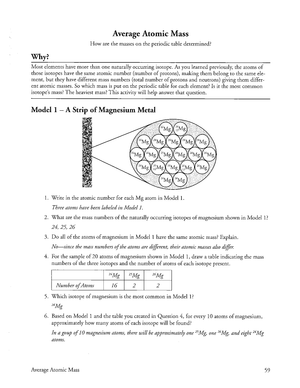
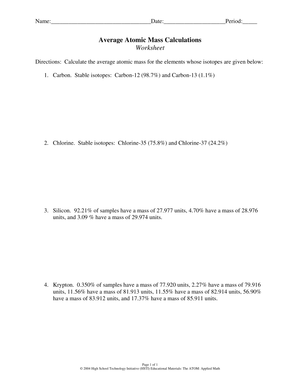
Calculating average atomic mass printable worksheets for 9th grade give chemistry teachers a direct path through one of the trickiest conceptual handoffs in introductory physical science: the moment students must stop thinking of atoms as identical objects and start treating isotopic variation as something measurable and mathematical. This set covers weighted-average calculations from the ground up — establishing what fractional abundance means, walking through the multiply-then-sum procedure, and eventually asking students to work backward from a known average atomic mass to find a missing abundance value. The resources range from two-isotope problems with clean percentage values to three-isotope problems drawn from real IUPAC data.
The Specific Skills Each Worksheet Builds
The calculation has a short but non-obvious sequence: convert percent abundance to a decimal, multiply each isotope's mass by that decimal, then add the products. Early worksheets keep the setup simple — two isotopes, clean percentages like 75 and 25 — so students can focus on mastering the procedure without managing a long data table. Later worksheets introduce elements with three or more naturally occurring isotopes (magnesium, silicon, and tin appear throughout the set), which require students to track more rows without losing the logic of what they're doing. These calculating average atomic mass printable worksheets for 9th grade also include a final tier of reverse problems: students are given the average atomic mass and all but one isotope's abundance, then must set up an algebraic equation to find the missing value. That type of problem is a reliable diagnostic — students who can structure it correctly understand the formula as a relationship between quantities, not just a calculation recipe.
Student Errors Worth Anticipating Before You Assign
The single most predictable mistake in this unit: students leave the percent sign attached and multiply a mass by 75 rather than 0.75. The resulting answer for copper lands somewhere above 4,000 amu — a number that should trigger immediate skepticism in any student with a sense of atomic scale, but often doesn't. A practical correction is requiring students to write a brief estimate before starting the math: "The most abundant isotope is Cu-63 at roughly 69%, so my final answer must fall between 63 and 65, much closer to 63." When the arithmetic produces 4,000-something, that prediction note is sitting right there on the paper, creating the kind of cognitive friction that produces genuine self-correction rather than a teacher-corrected fix after the fact.
A second pattern worth watching: students who treat all isotopes as equally weighted — adding the masses and dividing by the number of isotopes as though it were a standard average. The error is easy to miss because the answer looks plausible. Chlorine is the best diagnostic case: the simple average of 35 and 37 is exactly 36.0, but the weighted result sits near 35.45. That gap becomes visible the moment students compare their answer to the periodic table value, which is exactly the cross-check habit every worksheet in the set reinforces at the end of each problem.
How to Fit These Resources Into Your Lesson Plans
The most natural entry point is the class period immediately after introducing isotope notation. Students have seen the superscript-subscript format, they understand that Cl-35 and Cl-37 are both chlorine — they just don't yet know what the 35.45 on the periodic table represents. Projecting the first worksheet and working through the chlorine problem live, narrating the decimal conversion step explicitly, gives students a clear procedural template before they attempt anything independently. Those first two problems become guided practice; the remaining problems on that worksheet are independent work while the teacher circulates.
These calculating average atomic mass printable worksheets for 9th grade work equally well as the opening ten minutes of the second class period in the unit. Brief independent work followed by partner comparison — where students identify the exact step where their numbers diverged — surfaces the decimal-conversion error faster than a teacher walking the room ever will. The reverse-engineering worksheets earn their place as a Friday challenge or an extension for early finishers, not as core instruction; they require algebraic thinking that a portion of ninth graders isn't ready for during initial exposure to the concept.
Standard Alignment
These worksheets align with NGSS PS1.A (Structure and Properties of Matter), which at the high school level calls on students to use mathematical representations to describe properties of matter, including how isotopic composition determines average atomic mass. The calculation sits at the intersection of PS1.A's content standard and the NGSS science and engineering practice of using mathematics and computational thinking. In most district pacing guides, PS1.A appears during the first or second unit of ninth-grade chemistry or physical science — typically within the four to six weeks on atomic structure before the course moves into chemical bonding and molecular geometry. The reverse-problem worksheets also connect to the mathematical modeling practice, which is worth noting for teachers whose students will eventually encounter AP Chemistry.
Adapting the Worksheets Across Different Ability Levels
Students who stall on the decimal-conversion step — a math prerequisite that belongs to middle school, not chemistry class — benefit from a simple reference strip listing common percentages and their decimal equivalents: 25% = 0.25, 33.3% = 0.333, 75% = 0.75. Removing that arithmetic friction lets them direct their working memory toward the chemistry logic: which isotope's mass gets which decimal, and whether the final sum should land closer to the heavier or lighter isotope based on relative abundance. The chemistry demand stays fully intact; the math bottleneck is cleared without pretending the underlying conversion skill isn't worth developing separately.
Students who finish the forward-calculation problems accurately and quickly are ready for the algebraic reversal problems without any modification. A more demanding push for that group: provide the NIST isotopic data for an unfamiliar element — indium or thallium, something not typically used in textbook examples — and ask them to derive the average atomic mass from scratch, then confirm against the periodic table. These calculating average atomic mass printable worksheets for 9th grade include enough open-ended data problems that teachers can pull that kind of extension without building anything new from scratch.
Frequently Asked Questions
Why does the periodic table list atomic mass as a decimal rather than a whole number?
Every element exists in nature as a mixture of isotopes — atoms with the same proton count but different neutron counts. The value on the periodic table is the weighted average of those isotopes based on how frequently each one appears in naturally occurring samples. Because no isotope makes up 100% of any real-world sample (with rare exceptions), the weighted average almost never falls on a whole number. Carbon's 12.011 reflects the small but real presence of C-13 alongside the dominant C-12.
Do students need prior instruction in significant figures before starting these worksheets?
No. Most problems supply abundance data to four significant figures and ask students to report answers to two or three decimal places, which matches the precision of a standard classroom periodic table without introducing a rules debate mid-lesson. Teachers who have already covered significant figures can require formal application; teachers who haven't can specify a rounding convention directly on the worksheet and move on without a conceptual conflict.
What is the difference between mass number and average atomic mass?
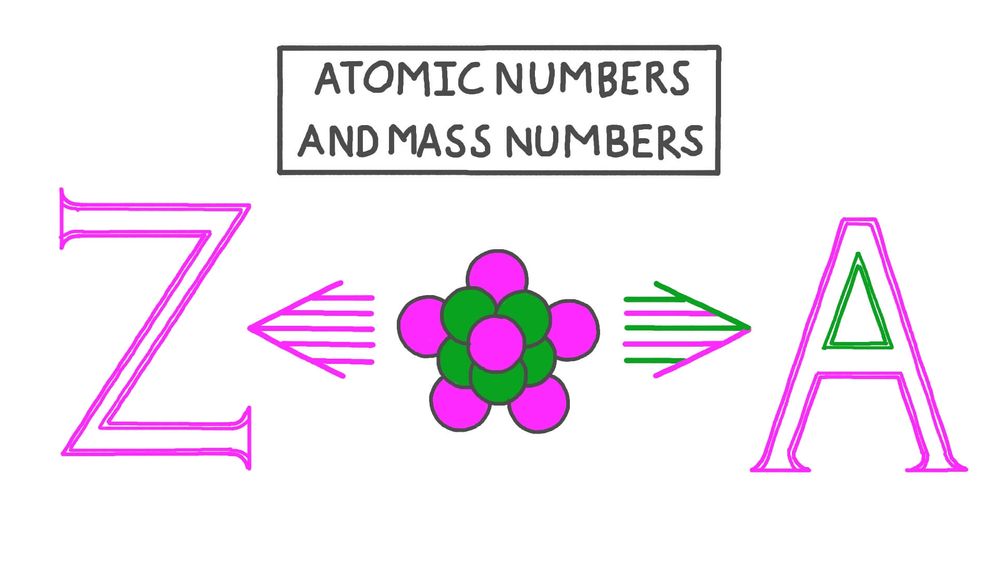
Mass number is a whole-number count of protons and neutrons in one specific isotope. It always applies to a single atom type and is always an integer. Average atomic mass is a calculated decimal representing the weighted average across all naturally occurring isotopes of an element. Students who confuse the two typically report 35 as the atomic mass of chlorine — correct for the mass number of Cl-35, but meaningfully off from the periodic table's 35.45, which weights Cl-35 at roughly 75% and Cl-37 at roughly 25%.
Can these worksheets be used before the mole concept has been taught?
Yes. Average atomic mass falls earlier in the standard chemistry sequence than Avogadro's number and molar mass, and the problems stay within that boundary. The only prerequisite knowledge is basic atomic structure — what protons and neutrons are, and how to read isotope notation. No conversion between grams and moles appears anywhere in the set.