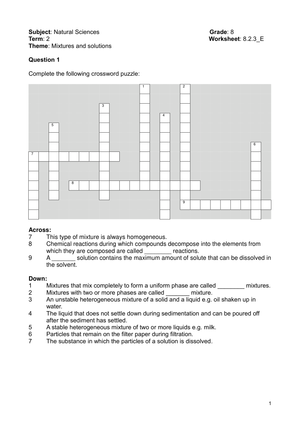
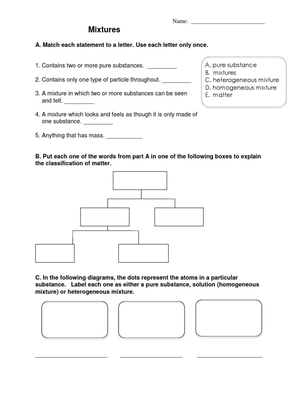
These 9th grade mixtures and solutions worksheets downloads give chemistry teachers print-ready practice for one of the most concept-dense units in the first year of high school science. The set covers classification of matter, solubility interpretation, concentration calculations, and separation techniques — the four pillars of this unit in most state-aligned curricula. Each worksheet stands alone, so teachers can pull individual pieces into a lesson sequence without committing to the full set.
What Each Worksheet Targets
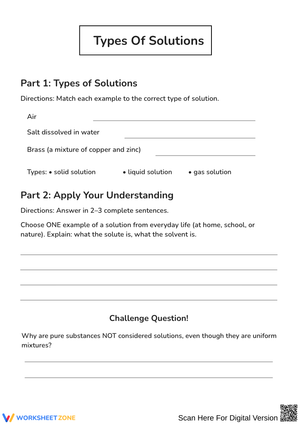
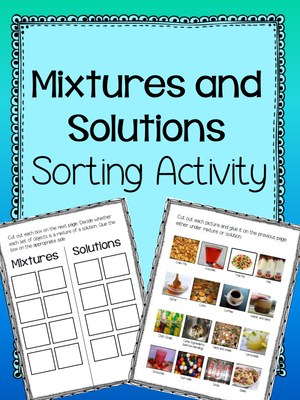
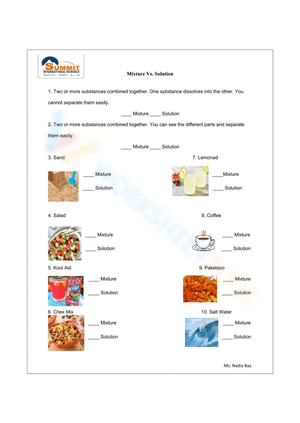
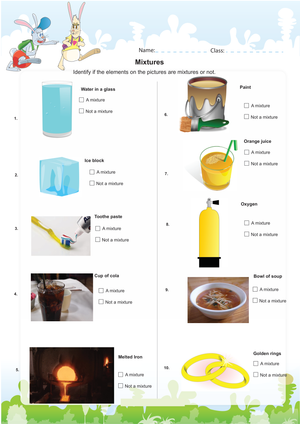
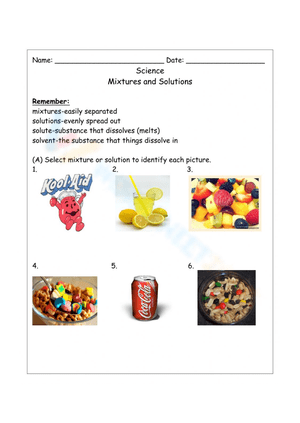
The classification worksheets ask students to sort examples of matter into homogeneous mixtures, heterogeneous suspensions, and colloids — then justify their reasoning using particle size and light-scattering behavior. Identification work comes before calculation work in the sequence, because students who can't reliably distinguish a colloid from a solution will make nonsense errors when they reach concentration problems.
Concentration worksheets move between two calculation types: mass percent and molarity. Students set up the formula, substitute given values, and carry units through the computation. The worksheets keep these two calculation types separate by design — students work through mass percent problems as a group before molarity appears. Ninth graders who are seeing quantitative chemistry for the first time need room to stabilize one procedure before a second one is introduced.
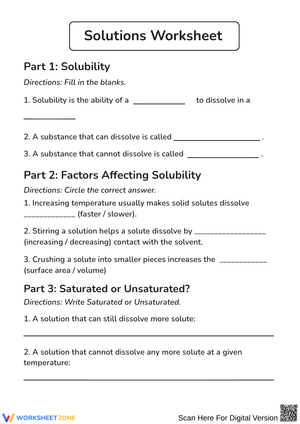
Solubility curve worksheets present a populated graph and ask students to classify solutions as unsaturated, saturated, or supersaturated at specified temperatures, then predict what happens when temperature shifts. A separate question block addresses the reversal that trips up almost every class: gaseous solutes become less soluble as temperature increases, opposite to most solid solutes.
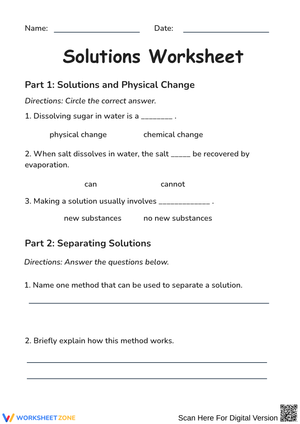
The separation techniques worksheets present real-world mixture scenarios and require students to select and explain the appropriate method — filtration, distillation, evaporation, or chromatography. Students write out their reasoning rather than circling an answer, because the explanation is where the understanding actually lives.
Where Students Go Wrong — And What to Watch For
The most durable error in this unit is conflating "saturated" with "highly concentrated." Students assume a saturated solution must contain a large amount of dissolved solute, so they're genuinely puzzled when told that a saturated solution of calcium carbonate holds only about 0.013 grams per liter. The solubility curve worksheets surface this misunderstanding directly, because students must identify a point well below the curve as unsaturated — and some will resist that answer even after checking their work.
In molarity calculations, the recurring mistake is unit conversion: students plug 250 into the denominator instead of 0.250 when the problem gives volume in milliliters. The worksheets address this by requiring students to write out a unit conversion step before setting up the molarity equation. That extra line catches the error before the arithmetic begins.
Mass percent produces a different problem. Students routinely divide the mass of the solute by the mass of the solvent rather than the total solution mass. The error is predictable enough that each worksheet includes a labeled diagram showing the relationship — solute mass, solvent mass, solution mass — directly above the first problem set, then removes it for the second set to check for genuine retention rather than reference-copying.
Standard Alignment
These worksheets connect most directly to NGSS HS-PS1-1, which asks students to use models and evidence to describe the structure and properties of matter. Classifying homogeneous and heterogeneous mixtures falls squarely in that standard's scope. NGSS HS-PS1-7 addresses mathematical representations of chemical phenomena, and the molarity and mass percent problems in this set meet that standard's quantitative reasoning expectation.
Most state-level chemistry frameworks place mixture and solution content in the first semester of 9th grade physical science, immediately after atomic structure and before stoichiometry. That placement matters for sequencing: students are just beginning to think quantitatively about matter, so the concentration calculations here serve as their first real practice applying algebraic reasoning inside a chemistry context. Teachers using the College Board's AP Chemistry course description as a benchmark will recognize that the foundational vocabulary in these worksheets — particularly around solution types and solubility factors — reappears in AP Unit 3.
Fitting These Worksheets Into Your Lesson Sequence
The classification worksheets work well as Monday warm-ups at the start of a mixtures unit, when the goal is activating prior knowledge before instruction moves to new quantitative content. Keep that segment to eight minutes — enough to surface what students already know about the difference between saltwater and muddy river water without burning the first half of the period.
The strongest use of the separation techniques worksheet is as a pre-lab planning document. Before students touch any equipment, have them work through the scenario on the worksheet and write out a proposed separation procedure in sequence. This is the point where students reveal whether they understand that you can't distill sand out of a mixture — and catching that misunderstanding on paper is more efficient than catching it at the lab bench. The 9th grade mixtures and solutions worksheets format means every student arrives at the lab station with identical planning materials, which simplifies the whole-class debrief.
Solubility curve worksheets function effectively as formative exit tickets. A two-question slip at the end of class — identify whether this solution is saturated, predict what happens when you raise the temperature — gives a fast read on who has the concept and who needs a different approach the next day.
Adjusting the Work for a Range of Chemistry Learners
For students who are still building number sense alongside chemistry content, the concentration worksheets can be introduced with a partially completed formula structure already in place. Students identify which given value belongs in each position — mass of solute here, volume of solution there — before they calculate. That approach separates the chemistry thinking from the algebraic execution, so neither skill overwhelms the other. The 9th grade mixtures and solutions worksheets resources also print well at a slightly larger font or with wider margins for students who need more workspace to show their steps.
Students who are moving quickly through the standard problems benefit from extension questions that introduce dilution: if you have a 2.0 M stock solution and need 500 mL of a 0.50 M working solution, how much stock do you dilute? That question doesn't require new vocabulary — it uses the molarity concept they've already practiced — but it demands a more flexible understanding of how concentration and volume interact.
For multilingual learners, the classification worksheets that rely on visual identification rather than text-heavy scenarios reduce language demand without reducing cognitive demand. Pairing those worksheets with a bilingual word wall for key terms — soluto/solute, solvente/solvent, suspensión/suspension — lets students access the content while academic vocabulary develops in parallel.
Frequently Asked Questions
What is the difference between a suspension, a colloid, and a solution?
The distinction comes down to particle size and what that size means for stability. In a true solution, dissolved particles are smaller than 1 nanometer — they don't scatter light and they don't settle. A suspension holds particles larger than 1,000 nanometers; those particles settle if the mixture sits undisturbed. A colloid falls in between, with particles large enough to scatter a beam of light (the Tyndall effect) but small enough to remain dispersed indefinitely. Milk, fog, and gelatin are colloids. Muddy water is a suspension. Saltwater is a solution.
How do students calculate mass percent correctly?
Mass percent equals the mass of the solute divided by the total mass of the solution, then multiplied by 100. The critical detail is the denominator: it must be the mass of the entire solution — solute plus solvent combined — not the mass of the solvent alone. If 5 grams of salt dissolves in 95 grams of water, the solution mass is 100 grams and the mass percent is 5%. Most student errors on these problems trace back to using 95 in the denominator instead of 100, a mistake that the error-checking section of each worksheet is specifically built to catch.
What physical properties make separation techniques work?
Each technique exploits a specific difference between components. Filtration separates by particle size — solid particles too large to pass through filter paper are captured while the liquid moves through. Distillation separates by boiling point — the component with the lower boiling point vaporizes first and is collected separately. Chromatography separates components by how strongly each is attracted to the stationary phase versus the mobile phase, which is closely related to polarity. Evaporation removes a liquid solvent entirely, leaving a solid solute behind; this works when the solute has no meaningful vapor pressure at the temperature used.
Why does temperature affect the solubility of gases differently than solids?
For most solid solutes, higher temperature increases solubility — the added kinetic energy of water molecules allows more solid to break apart and dissolve. For dissolved gases, higher temperature has the opposite effect: gas molecules gain enough energy to escape the solution, so solubility drops. This is why warm carbonated water goes flat quickly and why rivers with elevated water temperatures carry less dissolved oxygen — a consequence that shows up in ecological data and in the 9th grade mixtures and solutions worksheets solubility curve problems where students trace and compare the opposing trends on the same graph.












 Interactive Worksheet Maker
 Quiz Maker
 Word Search Maker
 Crossword Puzzle Maker
 Word Scramble Generator
 Sentence Scramble Generator
 Handwriting Worksheet Generator
 Name Tracing Generator
 Fill In The Blank Generator