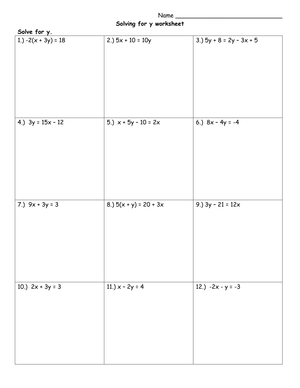
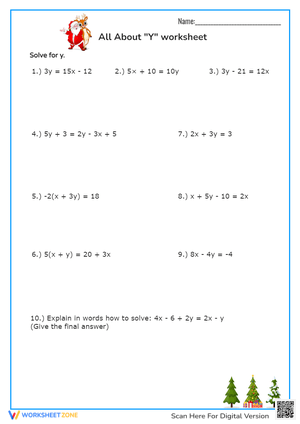
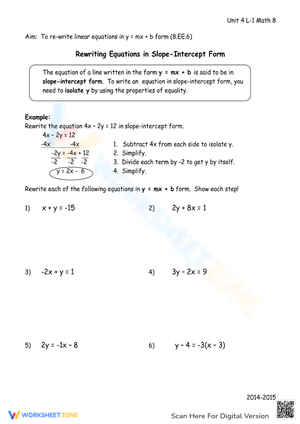
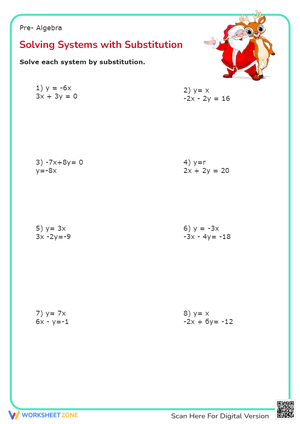
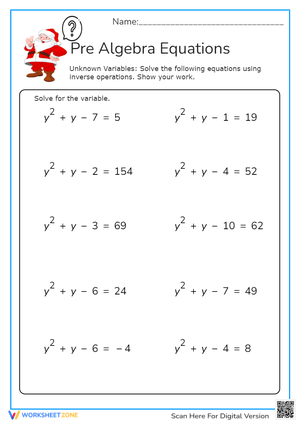
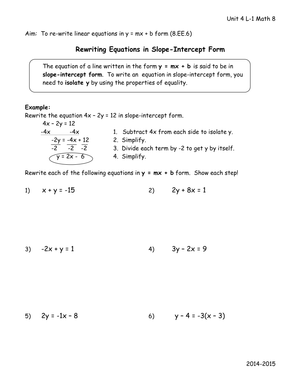
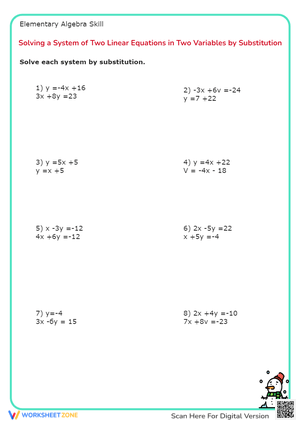
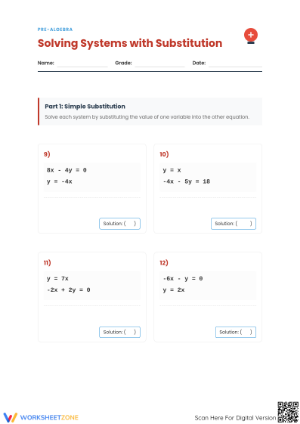
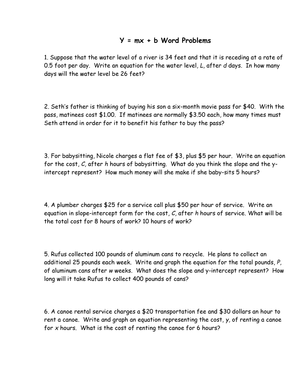
These 9th grade solving for y worksheets resources give Algebra 1 teachers focused, print-ready practice for one of the course's pivotal procedural skills — rearranging standard form equations into slope-intercept form. Students who can isolate y fluently read slope and y-intercept directly from any equation, which makes graphing linear functions far more intuitive and positions them for systems of equations work later in the year. The set covers the full range of difficulty that appears in a standard Algebra 1 unit, from single-step isolation to equations with fractional coefficients and literal equation extensions.
The Algebra Each Worksheet Targets
Across the 9th grade solving for y worksheets set, each worksheet targets a distinct level of procedural complexity. Early worksheets ask students to isolate y when the coefficient is already 1 and the only task is moving the x-term to the other side — these build accurate habits before the steps multiply. Later worksheets introduce integer coefficients that require a division step, then fractional coefficients that call for multiplying by a reciprocal. One worksheet focuses on literal equations, where students solve for y inside formulas like P = 2l + 2w or d = rt, applying the same inverse-operation logic to non-graphing contexts. A final error-analysis worksheet presents pre-solved problems with deliberate mistakes for students to locate and correct.
Skills across the set include:
- Applying inverse operations in the correct sequence — subtracting the x-term before dividing by the y-coefficient
- Dividing every term on the right side by the y-coefficient, not only the x-term
- Handling negative y-coefficients, which require dividing by a negative and adjusting all signs throughout the equation
- Multiplying by the reciprocal to clear fractional coefficients
- Identifying and correcting procedural errors in worked examples
Error Patterns to Watch For Across the Set
The most persistent error is a sign mistake in the very first step. When converting 2x + y = 10, students regularly write y = 2x + 10 rather than y = -2x + 10. They execute the subtraction conceptually — they know to move the x-term — but drop the negative because the operation happens in their heads rather than explicitly on paper. A close variant appears with negative y-coefficients: in 3x - 4y = 12, after dividing both sides by -4, many students produce y = (3/4)x - 3 instead of y = -(3/4)x + 3, because they apply the sign change to the y-term but not to the constant.
The second major pattern shows up during division. Students divide the y-side correctly but apply the operation only to the x-term on the opposite side, leaving the constant untouched. In 3x + 6y = 18, a student will produce y = (1/2)x + 18 rather than y = (1/2)x + 3. The answer looks plausible — the slope is right — so students rarely catch it on their own before checking against a graph. The error-analysis worksheet in this 9th grade solving for y worksheets set targets both of these patterns directly, presenting pre-solved equations with one deliberate mistake and asking students to identify where the algebra broke down and rewrite the correct solution.
Getting the Most From These Worksheets in Your Planning
The single-step worksheets work well as a warm-up at the start of a graphing unit. Three or four problems take about eight minutes and prime students for slope-intercept form before you introduce graphing from a table. The two-step integer worksheets are solid independent practice for the second or third day of the unit, after a guided lesson where students watch the two-step procedure modeled and attempt a few problems with you in the room. The error-analysis worksheet is most effective placed midway through the unit, before the first quiz — give students fifteen minutes with it in pairs. Watching two students debate whether a peer's imaginary algebra is correct tells you more about conceptual understanding than a stack of correctly executed drill problems.
Mini-whiteboard checks pair naturally with this set. Project a single standard-form equation, give students thirty seconds to isolate y on their boards, and scan the room. You will spot the division error immediately — a handful of students will show the correct slope but a wrong y-intercept — and you can address it before anyone carries that mistake into a graded assignment. The literal-equation worksheet fits best at the close of the unit, when you want to show students that variable isolation extends beyond graphing and into the kind of formula manipulation they will encounter in science coursework.
Standard Alignment
These worksheets align with CCSS.MATH.CONTENT.HSA-CED.A.4, which requires students to rearrange formulas to highlight a quantity of interest, and with CCSS.MATH.CONTENT.HSA-REI.B.3, which covers solving linear equations in one variable. In Algebra 1 pacing, A-CED.A.4 typically lands in the linear functions unit — after students can identify slope and y-intercept from a graph but before they work with systems of equations. Teachers often treat this standard as a one-day procedural stop. What student work actually shows is that the sign and division errors described above are persistent enough to warrant practice spread across multiple sessions rather than concentrated in a single lesson block.
Meeting Different Learners With the Same Set
Students who struggle with integer operations will stall at the two-step worksheets if they have to hold the full procedure in working memory while also managing arithmetic. A reference card showing the two-step sequence — move the x-term first, then divide by the y-coefficient — reduces that cognitive load enough that students can focus on executing each step rather than tracking the overall procedure. For the fractional-coefficient worksheet, assign it after a brief review of multiplying fractions by their reciprocals. The algebra itself is no harder at that level — it's the fraction arithmetic that stalls students, and separating the two skills by even a single lesson significantly reduces the number who abandon a problem halfway through.
Advanced students benefit most from the literal-equation worksheet combined with a verification task: substitute a coordinate pair back into the original standard form equation to confirm that the rearranged version represents the same line. That step turns a procedural exercise into a reasoning task. You can also use the error-analysis worksheet as an independent diagnostic for those students — their written explanations of why each mistake is wrong reveal whether they are operating from a memorized rule or from genuine understanding of equality. The 9th grade solving for y worksheets set gives you enough differentiated material to run all three tracks simultaneously without building separate resources from scratch.
Frequently Asked Questions
What equation forms do these worksheets cover?
The worksheets cover standard form equations with positive and negative integer coefficients, equations with fractional coefficients, and basic literal equations. Linear inequalities are not part of this set — that work appears in a separate resource.
How should I approach the fractional-coefficient worksheet if students haven't worked with fractions recently?
Spend five minutes before assigning it on one specific task: multiplying a fraction by its reciprocal. Students who know that (2/3) times (3/2) equals 1 move through the isolation step cleanly. Students who don't will stall at a step that has nothing to do with the algebra itself, and they often interpret that confusion as not understanding the concept rather than recognizing it as a gap in fraction fluency.
Do the worksheets come with answer keys?
Yes. Each worksheet includes a full answer key. The error-analysis worksheet includes annotations explaining why each planted mistake is wrong — not just the corrected answer — which makes it useful for projecting during a whole-class debrief.
Where does solving for y fit in a typical Algebra 1 course sequence?
Most Algebra 1 courses introduce solving for y in the second or third unit, after students can solve single-variable equations and have been introduced to the coordinate plane. It comes before graphing from slope-intercept form and before systems of equations — both of which depend on reliable variable isolation. Moving past this skill too quickly is one of the reasons students struggle when graphing systems later in the year.














 Interactive Worksheet Maker
 Quiz Maker
 Word Search Maker
 Crossword Puzzle Maker
 Word Scramble Generator
 Sentence Scramble Generator
 Handwriting Worksheet Generator
 Name Tracing Generator
 Fill In The Blank Generator




 BACK TOSCHOOL