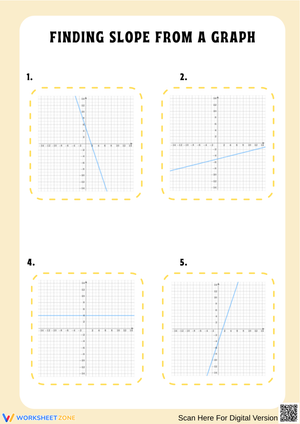
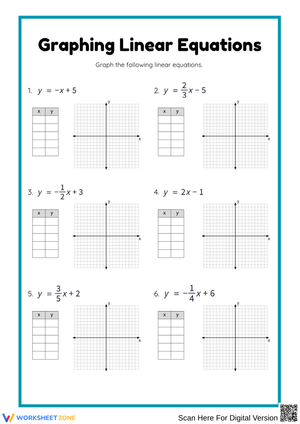
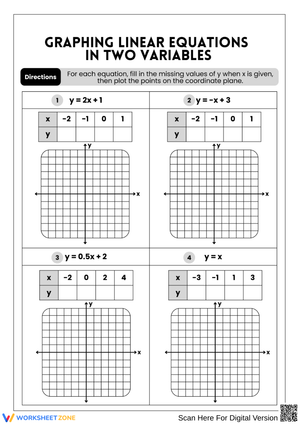
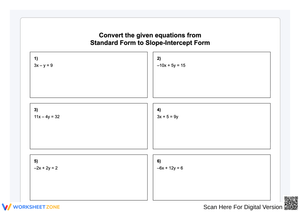
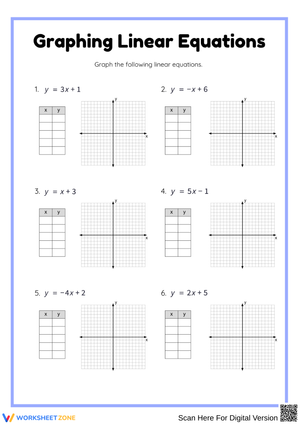
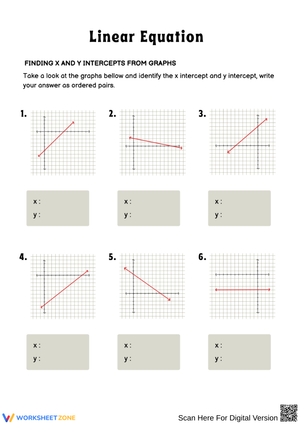
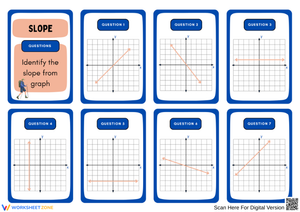
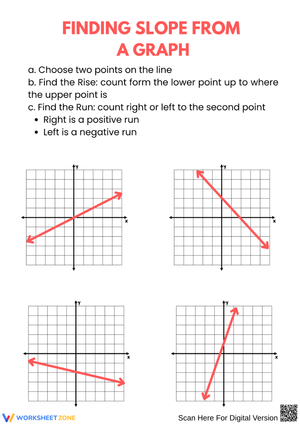
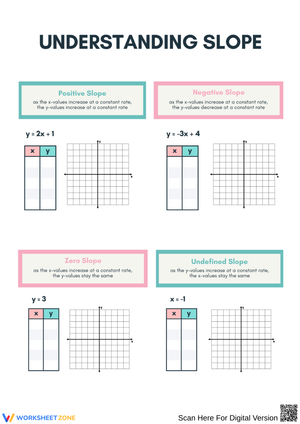
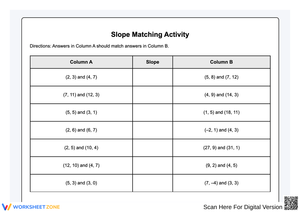
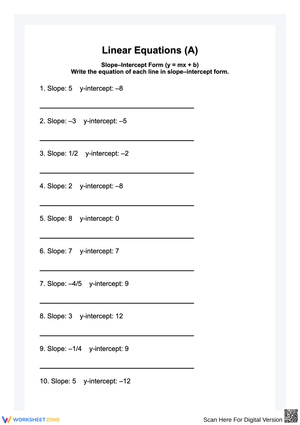
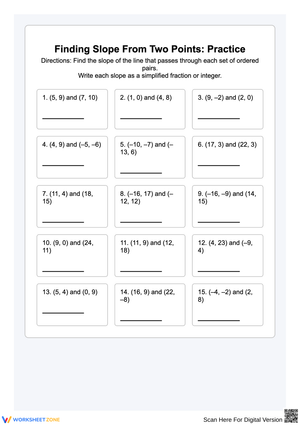
These linear equations printable worksheets for 9th grade give algebra teachers a ready set of targeted practice materials organized around the specific moves students actually struggle to execute: distributing a negative coefficient correctly, combining like terms before touching the variable, and clearing fractions before isolating anything. The resources cover the full first-semester algebra sequence, from two-step equations through multi-step problems with variables on both sides, including special-case equations that produce no solution or infinitely many solutions.
The Algebraic Moves Each Worksheet Targets
Each worksheet isolates a specific procedural layer of equation solving rather than mixing every skill from the start. Early worksheets work inverse operations in isolation — addition and subtraction only, then multiplication and division only — so students build automatic fluency before complexity stacks up. That sequencing matters because 9th graders arriving from 8th grade often carry a brittle understanding: they can solve 2x + 3 = 11 but freeze when they encounter 3(2x - 4) = 2x + 8.
- Two-step equations using inverse operations
- Applying the distributive property, including cases with a leading negative coefficient
- Combining like terms on one or both sides before isolating the variable
- Collecting variable terms from both sides to produce a single-variable equation
- Clearing fractions by multiplying every term by the least common denominator
- Identifying no-solution and infinite-solution cases from the simplified form
- Translating word problems into equations and solving for a contextually meaningful answer
- Error analysis exercises where students locate and correct a wrong step in a worked example
Mistakes Students Make That These Worksheets Help Surface
The most persistent error at this level isn't arithmetic — it's sign handling during distribution. When students encounter something like -2(3x - 5), they reliably distribute the 2 and write -6x - 10 instead of -6x + 10. The negative sign belongs to both terms inside the parentheses, but students consistently treat it as applying only to the coefficient in front. The error analysis worksheets present exactly this mistake and ask students to annotate where the sign error occurs, then rewrite each step correctly.
A second problem surfaces when students attempt to clear fractions. The move — multiplying every term by the LCD — breaks down when students apply it only to the fractional terms and leave whole-number terms untouched. After a class period where this happens, the worksheet that requires students to show the multiplication step explicitly on every term catches it immediately. Students also tend to conflate "multiply to clear" with "move the denominator," which produces a different error that's harder to reverse once it's embedded in a student's procedure.
The no-solution and infinite-solution cases generate their own confusion. Students who arrive at 0 = 4 assume they made an arithmetic mistake and restart, sometimes more than once. These worksheets include a short annotation prompt beneath those problem types asking students to write one sentence explaining what the resulting constant statement means. That writing step forces the conceptual recognition rather than leaving students stuck in a procedural loop.
Fitting These Worksheets Into the Daily Lesson Plan
The two-step and distributive-property worksheets run well as guided practice immediately after direct instruction, while the modeled steps are still on the board. That window — usually the first 12 to 15 minutes of independent work time — is where students internalize procedural sequence most reliably, and a worksheet that mirrors the example format makes the jump from watching to doing much smoother. Save the mixed-review worksheets for the end of a unit rather than mid-lesson, because they require students to diagnose each problem's type before choosing a strategy, and that metacognitive step needs a procedural foundation first.
Error analysis worksheets work differently and shouldn't run during that same window. They're most effective as a collaborative warm-up early in the second week of multi-step equations, once students have enough footing to reason about wrong steps rather than just follow correct ones. Pairs or small groups work best — one student identifies the line where the error begins, the other writes the corrected version, and both have to reach agreement before moving on. The verbal negotiation those pairs go through produces mathematical vocabulary that individual silent work rarely surfaces.
As exit tickets, the single-skill worksheets — one worksheet per solving technique — give teachers usable data without eating into the last ten minutes of the period. Three or four problems is enough to see the pattern across the class. If students working with linear equations printable worksheets for 9th grade as exit tickets consistently miss the fraction-clearing step or drop a negative during distribution, that tells the teacher exactly where to open the next day's lesson before the gap compounds.
Standard Alignment
These worksheets align to CCSS.MATH.CONTENT.HSA.REI.B.3, which requires students to solve linear equations and inequalities in one variable, including equations with coefficients represented by letters. In classroom terms, that standard spans the full procedural range covered here — from straightforward inverse-operation problems to multi-step equations requiring distribution and fraction clearing. The word-problem worksheets also address HSA.CED.A.1, which asks students to create equations in one variable and use them to solve problems, not simply solve equations handed to them. That distinction matters: the translation worksheets in the set require students to read a scenario, name the unknown, write the equation, and solve it — all four moves the standard calls for, and the move most commonly skipped when teachers assign only computational practice.
Adjusting the Set for Different Levels in the Same Class
Students who are still shaky on integer operations benefit from extended time on the two-step inverse-operation worksheets before moving to anything involving the distributive property. Integer fluency resurfaces at every step of equation solving, and rushing students into multi-step problems before their integer sense is solid creates compounding errors that are genuinely hard to untangle mid-unit. Keeping those students on simpler work longer than feels comfortable is the right call.
For students who move through the standard sequence quickly, the word-problem and error-analysis worksheets provide meaningful extension without simply adding more repetition of the same procedure. Asking a student who has solved 30 equations correctly to instead analyze someone else's wrong work and explain the error in writing engages a different cognitive layer — they have to hold the correct procedure in mind while simultaneously identifying where a different approach went wrong. The linear equations printable worksheets for 9th grade in the error-analysis category work particularly well as extension tasks because they require mathematical argument, not just calculation, and they reveal whether a student understands the why behind each step in a way that a stack of correct answers does not.
Frequently Asked Questions
What types of equations appear across the set?
The worksheets move from two-step equations through multi-step problems, covering distribution, like-term combination, variables on both sides, fraction-clearing, and special-case equations with no solution or infinitely many solutions. Word problems requiring students to write their own equations are kept separate from the pure solving practice so teachers can assign them independently when the class is ready for that step.
How do students know when to clear fractions versus solve with fractions in place?
Either approach reaches a correct answer, but clearing fractions first — multiplying every term by the LCD — cuts down on arithmetic errors significantly for most 9th graders because it removes the need to add or subtract fractions mid-problem. These worksheets present clearance as the standard first move, with a dedicated step prompting students to show the multiplication across every term before simplifying. Students who are confident with fraction arithmetic can skip the clearance step on later worksheets, but teaching it as a default keeps class-wide error rates lower during the unit.
Can these worksheets serve as a diagnostic at the start of the unit?
Yes. Using two or three of these linear equations printable worksheets for 9th grade as a pre-assessment surfaces gaps quickly: a student who distributes a negative incorrectly on the second problem, or who adds the constant to both sides without undoing multiplication first, is revealing exactly where instruction needs to begin. That's faster and more targeted than a formal written test, and it gives teachers a problem-level picture of where individual students are sitting before the unit starts rather than after the first quiz.
Do the worksheets include answer keys?
Each worksheet includes a full answer key with solution steps shown, not just the final value. For error analysis worksheets, the key identifies both the location of the error and the correctly reworked solution, which lets teachers use them for self-correction or peer review without preparing a separate guide.














 Interactive Worksheet Maker
 Quiz Maker
 Word Search Maker
 Crossword Puzzle Maker
 Word Scramble Generator
 Sentence Scramble Generator
 Handwriting Worksheet Generator
 Name Tracing Generator
 Fill In The Blank Generator




 BACK TOSCHOOL