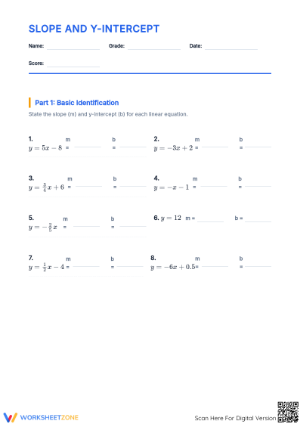
These 9th grade key slope intercept form worksheets cover the full range of tasks Algebra 1 students need before a class moves into systems of equations — from identifying m and b in a given equation to deriving slope-intercept form from two points and interpreting linear models in real-world contexts. Each worksheet isolates a specific stage of the work, which makes it easier to see exactly where a student's understanding breaks down.
The Skills These Worksheets Target
Across the set, students practice five distinct operations that together form the core of a ninth-grade linear equations unit:
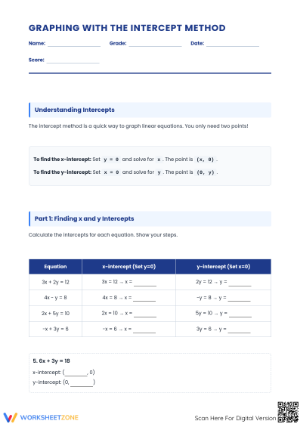
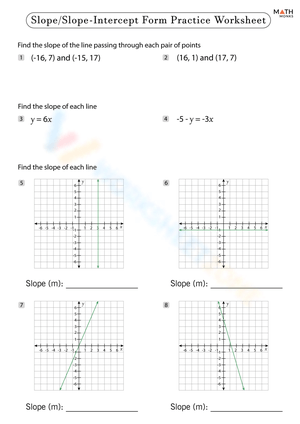
- Identifying slope and y-intercept from equations already written in slope-intercept form
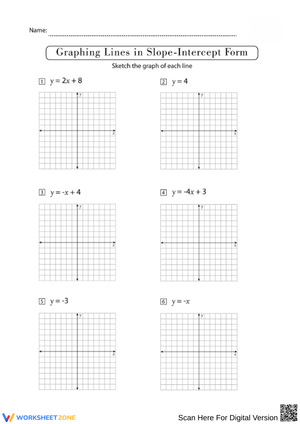
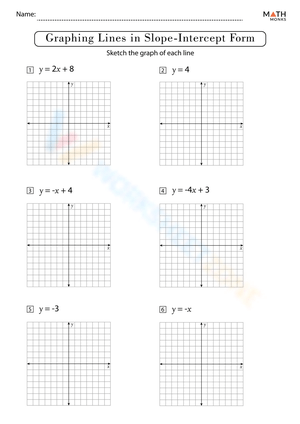
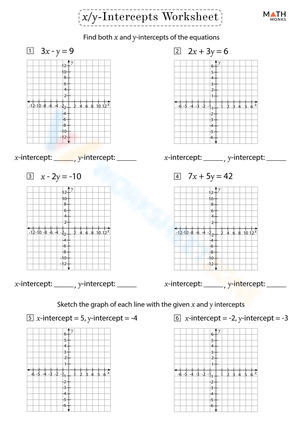
- Graphing by plotting the y-intercept first, then applying rise over run to find additional points
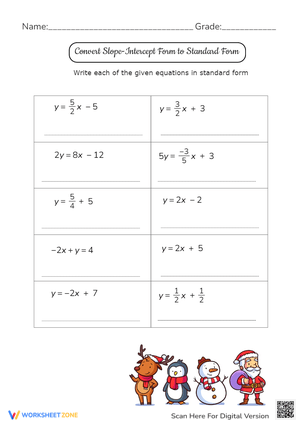
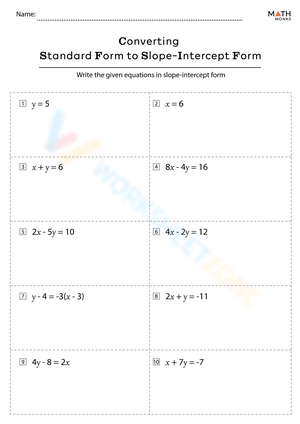
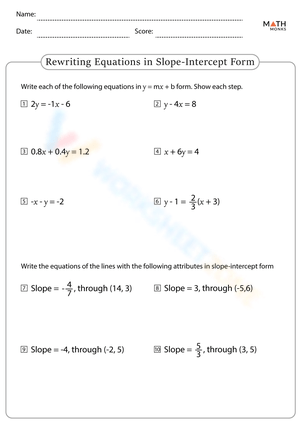
- Converting from standard form (Ax + By = C) to y = mx + b by isolating the y-variable
- Writing equations when given a slope and a single point
- Writing equations from two points, with no slope provided
The two-point equation-writing task is where the cognitive demand peaks. Students calculate slope, substitute that value and one set of coordinates into y = mx + b, solve for b, and write the complete equation — all in a single problem. That sequence requires holding multiple values in working memory while executing a substitution step, which is a meaningfully different demand than reading m and b off a given equation.
Mistakes Students Make That These Worksheets Help You Catch
Negative slopes produce the most persistent graphing errors in this unit. Students who learn positive slopes first internalize "up and right" as the default movement. When they encounter m = -2, they often reverse both directions and move "down and left" — which generates a line with a positive slope, not a negative one. The graph looks plausible; the steepness feels right. The correct application of m = -2 is either down 2 and right 1, or up 2 and left 1. Students rarely catch this error on their own because the line still looks like a line. Having them verify a second point against the original equation after graphing is the most reliable way to surface it.
The conversion tasks expose a different pattern. When rewriting 3x - 4y = 12, students subtract 3x correctly and reach -4y = -3x + 12, but then divide only the variable terms by -4, writing y = (3/4)x + 12 instead of y = (3/4)x - 3. The constant gets treated as though it is exempt from division. A separate issue surfaces with zero intercepts: students encounter y = (5/2)x and interpret it as an incomplete equation rather than recognizing the line crosses at the origin. Both patterns show up consistently enough in student work that they are worth addressing explicitly — not as exceptions but as expected stages in learning this material.
Standard Alignment
The identification and graphing tasks align to CCSS.MATH.CONTENT.HSF-IF.C.7a, which requires students to graph linear functions and show intercepts. The conversion and equation-writing tasks connect to CCSS.MATH.CONTENT.HSA-CED.A.2 (create equations in two variables to represent relationships between quantities) and CCSS.MATH.CONTENT.HSA-REI.D.10 (understand that the graph of an equation in two variables represents all of its solutions as plotted points).
In a standard Algebra 1 scope and sequence, slope-intercept form appears after students have worked with proportional relationships and rate-of-change reasoning, and before they encounter point-slope form and standard form as alternatives. Teachers who place the 9th grade key slope intercept form worksheets at that position are reinforcing new learning during the unit itself — not revisiting material from a prior year — which changes both the pacing expectation and the standard for mastery.
How to Build These Worksheets Into Your Lesson Plans
The identification and graphing worksheets run well as warm-ups early in the unit — five to eight minutes at the start of class, right after morning announcements, while students are settling. Students who can locate m and b and plot a line in that window are ready for the day's next instruction. Students who are still recounting rise over run from scratch are signaling they need another round of guided examples before the conversion work begins.
The conversion worksheet belongs after a whole-class worked example, not before it. Walk through 3x - 4y = 12 step by step on the board, leave those steps visible, and then release students to the worksheet. That sequence lets students practice the procedure while the model is still in view, which keeps cognitive load manageable at the stage when the mechanics should be building toward automaticity — rather than competing with memory retrieval.
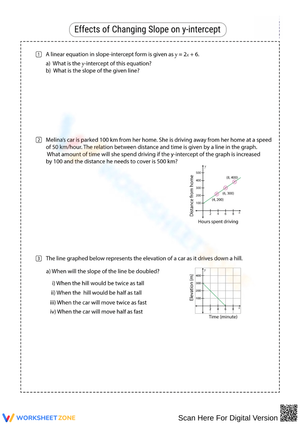
The real-world context problems — identifying what slope and y-intercept represent in a cost or growth scenario — make clean exit tickets at the close of a lesson on linear models. Students take about 90 seconds to write a response, and the results tell you immediately whether they are interpreting meaning or simply executing algebra without understanding what the numbers actually describe.
Adjusting the Worksheets for a Range of Learners
Students who consistently mix up the numerator and denominator in a fraction slope benefit from one added step: require them to write every slope as a fraction before graphing, even when it is a whole number. Writing m = 3 as 3/1 makes the numerator-as-rise, denominator-as-run structure explicit. The step takes an extra ten seconds per problem and almost always corrects the confusion without further explanation.
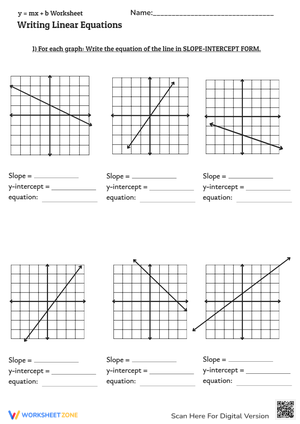
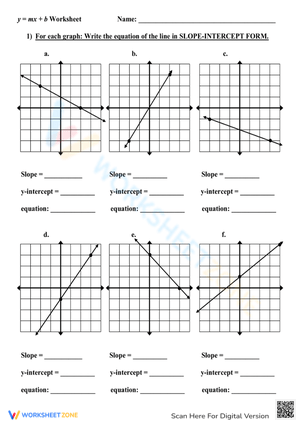
Students who are ready to go further benefit from reversals: given a graph, write the equation. Or, given two equations, determine without graphing whether the lines are parallel, perpendicular, or neither. These extensions press students to apply slope-intercept logic analytically rather than procedurally, and they attach naturally to existing worksheets as bonus problems without requiring separate materials.
Frequently Asked Questions
Are these worksheets appropriate for students who haven't been taught slope yet?
No. The 9th grade key slope intercept form worksheets in this set assume students can already calculate slope from two points using (y2 - y1) / (x2 - x1) and have seen at least one graphing example worked through in full. Teachers who need to introduce slope before working with y = mx + b should complete that instruction first. These resources build on existing knowledge of slope rather than establishing it.
How are zero y-intercepts handled across the set?
Several problems include equations like y = (-3/2)x where b = 0 and the line passes through the origin. These are included deliberately. Students who skip the y-intercept step — because there is no visible constant — produce lines with the right slope but the wrong position on the grid. Having those cases appear alongside a reminder to always check for a y-intercept before applying rise over run addresses that habit before it settles in as routine.
Do these worksheets include answer keys?
Yes. Each worksheet in the 9th grade key slope intercept form worksheets set comes with a complete answer key, including graphs drawn on coordinate grids and worked-out steps for all conversion and equation-writing problems. The step-by-step keys make independent student correction possible and reduce the grading load during a unit that typically generates a lot of graphical output to review.














 Interactive Worksheet Maker
 Quiz Maker
 Word Search Maker
 Crossword Puzzle Maker
 Word Scramble Generator
 Sentence Scramble Generator
 Handwriting Worksheet Generator
 Name Tracing Generator
 Fill In The Blank Generator




 BACK TOSCHOOL