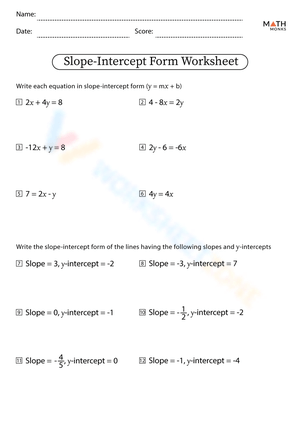
These slope intercept form worksheets for 9th grade cover the full skill arc from reading y = mx + b to building equations from real-world word problems, giving algebra teachers a targeted set of practice materials for one of the most heavily tested topics in the first semester of high school math. Each worksheet addresses a distinct task — identification, graphing, converting from standard form, or interpreting context — so teachers can assign them selectively rather than working through the set in order. The files print cleanly and need no additional preparation before class.
The Specific Skills Each Worksheet Builds
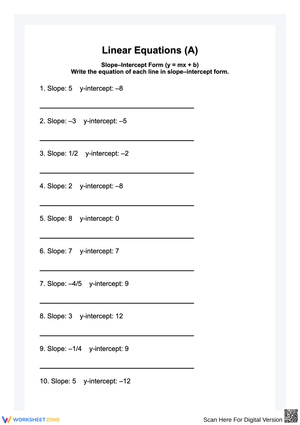
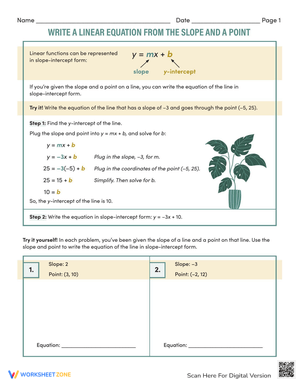
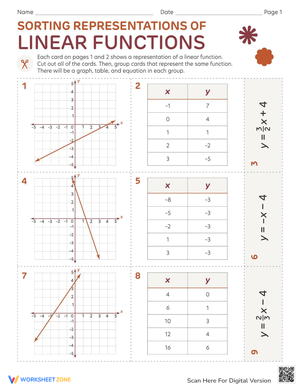
The set opens with identification work: students read equations in y = mx + b form and name the slope and y-intercept for each. Slowing students down on identification before they touch a coordinate plane matters — many ninth graders who can eventually graph a line still swap m and b when answering a direct question, and catching that confusion early saves time later in the unit.
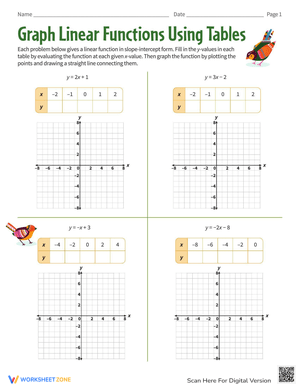
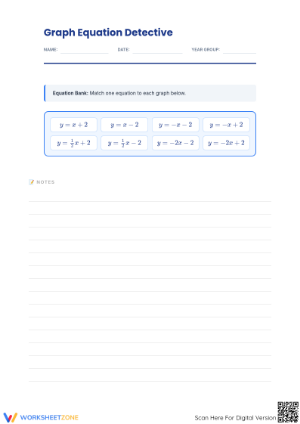
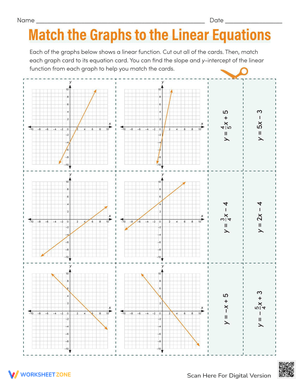
Graphing worksheets follow, with problems covering whole-number slopes, positive and negative fractions, and equations where the slope is zero. Students plot the y-intercept first, then apply the slope ratio to locate a second point. Some worksheets include pre-drawn, labeled coordinate grids; others leave the axis labels off so students practice setting their own scale — a small but meaningful shift in cognitive demand.
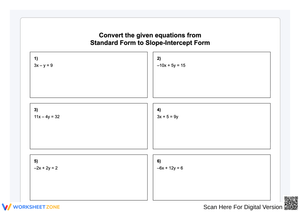
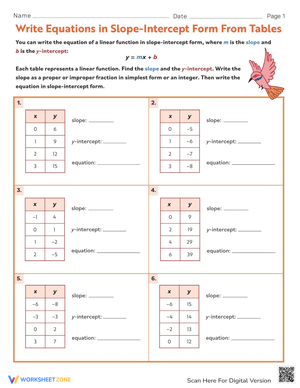
Later in the set, the work moves into algebraic manipulation and application. Converting equations from standard form (Ax + By = C) into slope-intercept form requires students to isolate y through multi-step work. This appears as standalone practice here before it reappears embedded in systems-of-equations problems later in the year. The final worksheets present word problems where students extract a rate of change and a starting value from a described situation, write the corresponding equation, and graph it. Contexts vary — phone plan costs, distance-time relationships, temperature changes — so students cannot pattern-match their way through.
Errors to Anticipate When Students Work with y = mx + b
The most persistent mistake is misidentifying which value is the slope and which is the y-intercept. Students who get it right on a direct question will still mark the wrong value when an equation appears embedded in a word problem or after a conversion from standard form — the additional steps interrupt the visual pattern they have learned to rely on. Asking students to circle m and b in every equation before doing anything else, every time, interrupts the autopilot and forces a deliberate read.
The second error to watch is graphing from the origin rather than from the y-intercept. Students who memorized a graphing procedure without deeply connecting it to the equation will plot the slope starting from (0,0) regardless of what b says. This produces a line with the correct slope but the wrong position — it looks almost right, which means it often goes uncorrected through an entire worksheet. A check-in that simply asks "where did you place your first point?" catches this faster than reviewing full graphs.
With fractional slopes, students frequently invert the ratio. Given a slope of 2/3, they move 2 units horizontally and 3 vertically instead of 3 horizontally and 2 vertically. When converting from standard form, a separate error appears: students divide only the y-term by its coefficient and leave the other terms unchanged, producing y = x/2 + 6 from 2y = x + 12 because they divided the left side correctly but treated the right side as already simplified. Writing each division step out explicitly — rather than combining them into a single mental calculation — reduces this error across the conversion exercises in slope intercept form worksheets for 9th grade.
How to Work These Worksheets Into Your Lesson Plans
The identification worksheets make reliable warm-ups for the first two or three days of a slope-intercept unit. Ten minutes at the start of class — before any graphing — focuses student attention on reading the equation correctly. This front-loaded identification practice also yields quick formative data: if a third of the class has m and b reversed on the warm-up, the lesson adjusts before hitting the coordinate plane.
The conversion worksheet works well the day before students encounter slope-intercept form inside a systems-of-equations lesson. If students are already fluent converting 3x + 2y = 8 into y = -3/2 x + 4, the cognitive load during the substitution method stays manageable. Assigning it as homework the night before, then spending five minutes reviewing two or three problems at the board, keeps the pace reasonable without sacrificing precision.
For sub days, the word problem worksheets are the most self-contained option in the set. The instructions at the top of each worksheet walk through the identification-then-graphing sequence step by step, which means students who have had the initial instruction can work through them without teacher facilitation. Keep two or three in a sub folder and they cover an entire class period without requiring the substitute to teach new content.
Adjusting These Worksheets for a Range of Learners
Students who are still shaky on negative integers benefit from working through the identification and graphing worksheets alongside a reference strip showing the y = mx + b formula annotated with arrows pointing to m and to b. That one support — a labeled formula they can glance at — frees up enough working memory that students stop guessing and start applying logic. Remove the strip once they show consistency across a full worksheet without it.
Students who are ready to move further can extend the word problem worksheets without any additional materials. After solving each problem, ask them to determine whether two equations from different problems are parallel, perpendicular, or neither — it reuses the same worksheet for a more demanding task. Another option: ask advanced students to rewrite each solved equation back into standard form and verify the conversion goes both directions cleanly. It surfaces procedural gaps without feeling like busywork.
For English language learners working through the word problem worksheet, pairing a brief vocabulary reference with the first two problems — labeling "rate of change," "initial value," "y-intercept," and "slope" with plain-language definitions — gets students past the language barrier without reducing the mathematical task. The algebra stays intact; the vocabulary stops being the obstacle.
Standard Alignment
These worksheets align directly to CCSS.MATH.CONTENT.HSA-CED.A.2, which asks students to create equations in two or more variables to represent relationships between quantities and graph them on coordinate axes with labels and scales. In classroom terms, this standard governs the move from recognizing slope-intercept form to constructing it — which is exactly the progression these worksheets follow. The conversion and word problem exercises also connect to CCSS.MATH.CONTENT.HSA-REI.D.10, which addresses understanding the graph of an equation as the set of all its solutions plotted in the coordinate plane. Both standards typically appear in the first unit of Algebra 1 at the ninth grade level, and slope intercept form worksheets for 9th grade that address them directly keep instruction tightly mapped to what the end-of-unit assessment will actually measure.
Frequently Asked Questions
How do you graph a line when the slope is a negative fraction?
Start at the y-intercept. The numerator of the slope tells you the vertical change; the denominator tells you the horizontal change. Since the slope is negative, one of those moves goes in the opposite direction. The cleanest approach: always move right (positive horizontal direction) and apply the negative to the vertical movement. For a slope of -3/4, move 4 units right and 3 units down to find the second point. This keeps the horizontal direction consistent and eliminates the confusion that comes from students moving both left and down simultaneously.
What happens to the equation when the line is horizontal or vertical?
A horizontal line has a slope of zero, so the mx term drops out entirely and the equation becomes y = b. Students sometimes expect the equation to look more complicated than that, so it is worth stating plainly: y = 4 is a complete and correct equation for a horizontal line four units above the x-axis. A vertical line has undefined slope and cannot be expressed in slope-intercept form at all — its equation is x = a, where a is the x-value where it crosses. This is one of the few times students see a form they have been practicing run into a real limit, and it deserves a focused ten minutes rather than a passing mention.
How do you convert an equation from standard form into slope-intercept form?
The goal is to isolate y. Move the x-term to the right side first, then divide every term — every term — by the coefficient of y. That last step is where most errors occur. Given 4x + 2y = 10, subtract 4x to get 2y = -4x + 10, then divide every term by 2: y = -2x + 5. Writing the division out term by term, rather than doing it as a single mental step, catches coefficient errors before they carry forward into the graph.
How do you write the equation of a line when you are given two points instead of the slope?
Use the slope formula — (y₂ - y₁) divided by (x₂ - x₁) — to find m first. Once you have the slope, substitute it and one of the two given points into y = mx + b and solve for b algebraically. Students frequently skip the substitution step and estimate b by eyeballing the numbers, which works by accident sometimes and fails the rest of the time. Working it out algebraically every time, especially on slope intercept form worksheets for 9th grade that include two-point problems, builds the habit that holds up when the same skill appears on the unit test embedded in a different context.














 Interactive Worksheet Maker
 Quiz Maker
 Word Search Maker
 Crossword Puzzle Maker
 Word Scramble Generator
 Sentence Scramble Generator
 Handwriting Worksheet Generator
 Name Tracing Generator
 Fill In The Blank Generator




 BACK TOSCHOOL