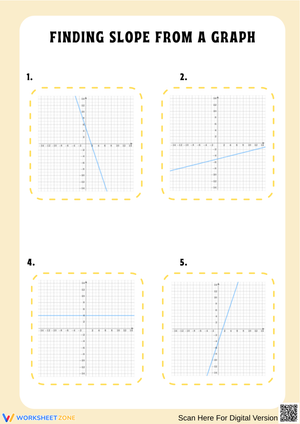
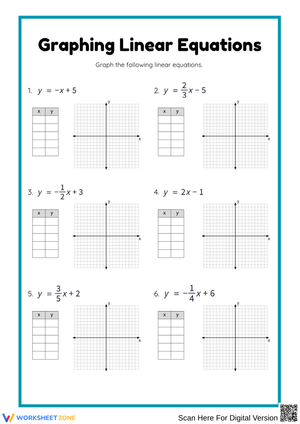
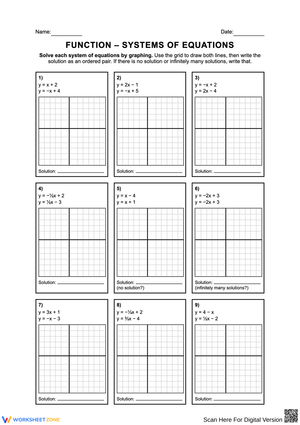
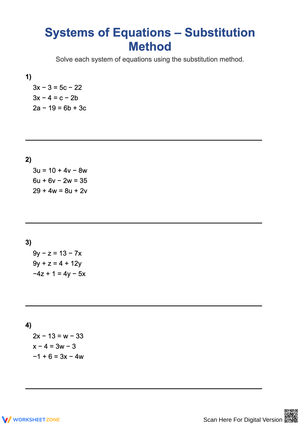
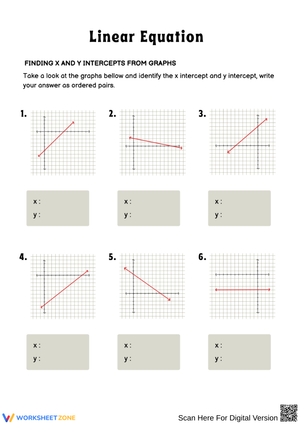
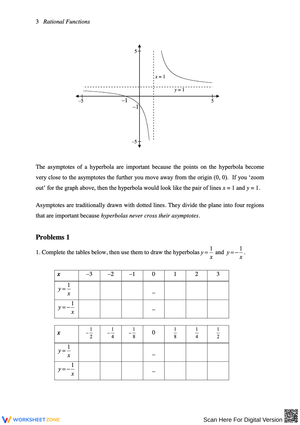
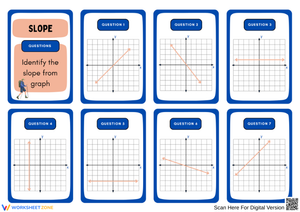
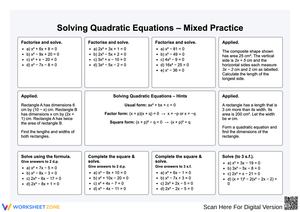
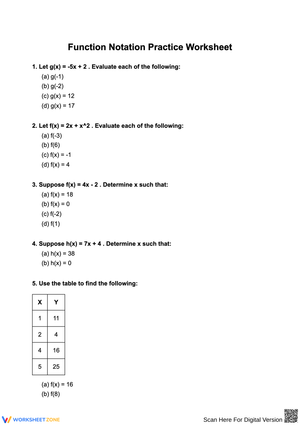
These 9th grade algebra printable worksheets cover the full Algebra 1 arc — from multi-step linear equations through quadratic functions — giving teachers a ready supply of practice that maps to a standard ninth-grade course sequence. The set addresses four domains students spend most of the year working through: linear relationships, systems of equations, polynomial operations, and quadratics. Each worksheet targets a specific skill, which means teachers can assign what a class actually needs on a given day rather than working around a packet that mixes too many concepts at once.
Skills These Worksheets Build
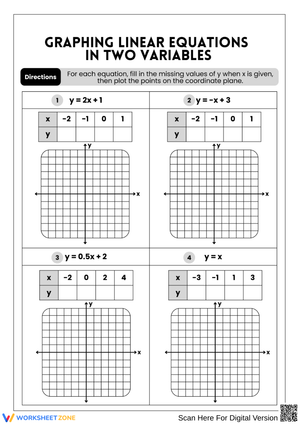
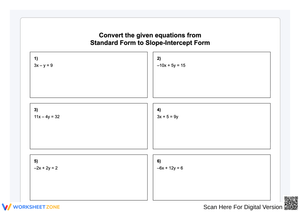
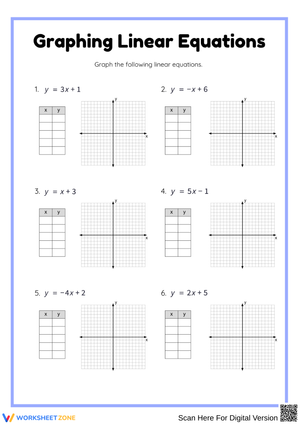
The linear equations worksheets begin with multi-step problems involving distribution and combining like terms, then progress to equations with variables on both sides and expressions with fractional coefficients. Inequalities run as a parallel track — students graph solution sets on number lines and work through what "greater than or equal to" means in context, not just as a symbol to flip when multiplying by a negative.
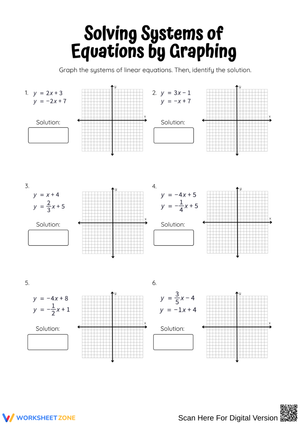
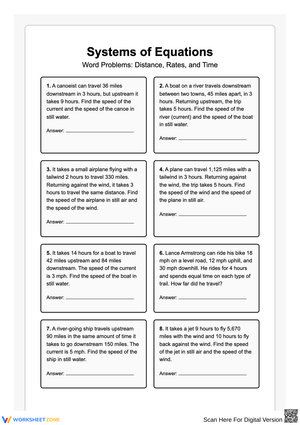
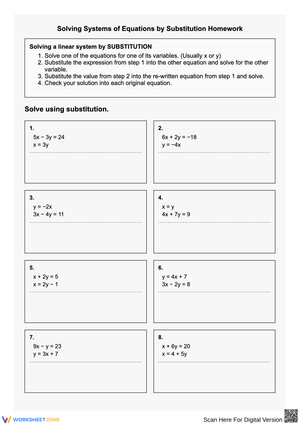
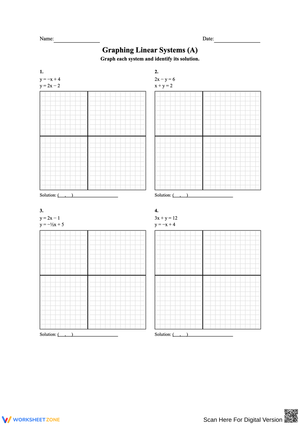
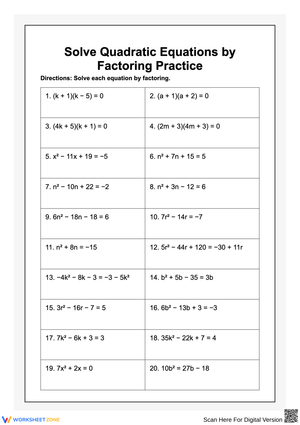
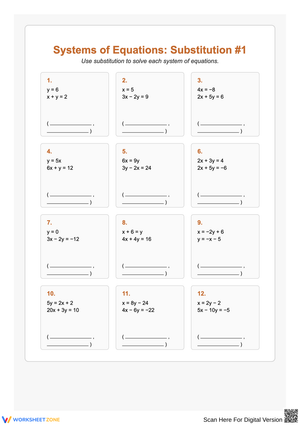
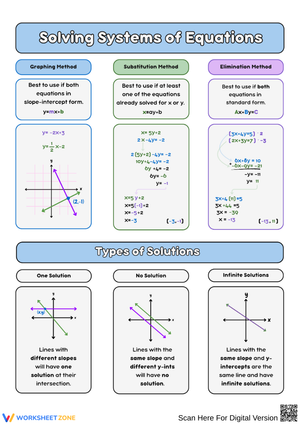
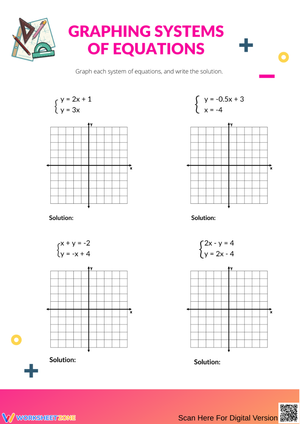
Systems of equations worksheets cover all three solution methods: graphing, substitution, and elimination. Each method gets its own focused set of problems so students build genuine facility with each approach rather than defaulting to whichever one feels fastest. Polynomial worksheets move from addition and subtraction through binomial multiplication, with explicit attention to the distributive property before the FOIL shorthand appears. Factoring — GCF first, then trinomials, then difference of squares — is framed as the inverse of multiplication throughout, which helps students see the structural connection instead of treating each factoring type as a separate procedure to memorize.
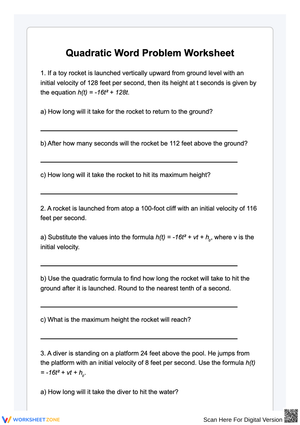
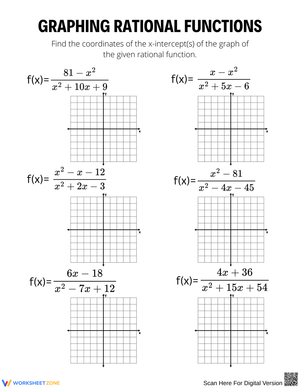
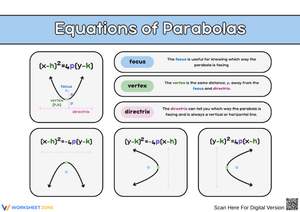
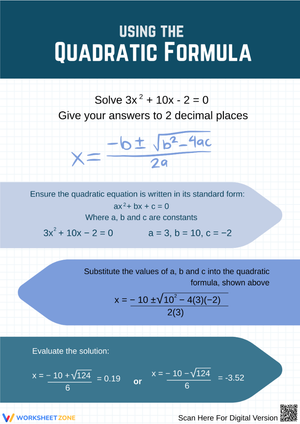
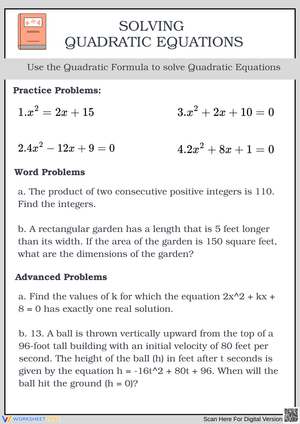
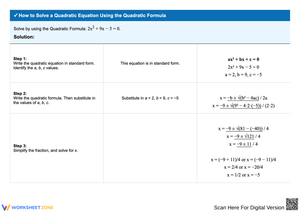
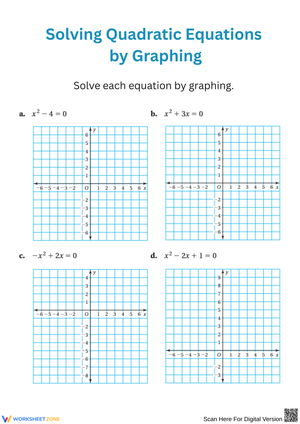
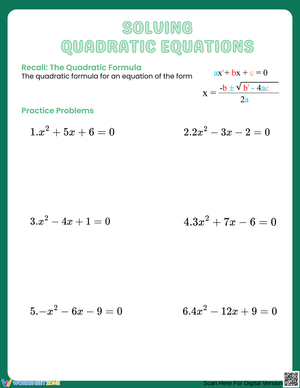
Quadratic function worksheets ask students to identify vertex, axis of symmetry, and intercepts from both equations and graphs, and to solve quadratic equations by factoring, completing the square, and the quadratic formula. Several worksheets include problems where students choose the most efficient solution method rather than being told which one to apply — a push past rote application toward strategic thinking.
Mistakes Students Make That These Worksheets Help Surface
Distribution errors are the most consistent source of lost points in ninth-grade algebra, and they are conceptual, not careless. When students see -(2x - 5), they write -2x - 5 rather than -2x + 5. The negative sign attaches to the first term in their minds and stops there. Telling students to "be careful with negatives" during a lesson does not fix this. The polynomial worksheets provide enough repeated practice with negative leading coefficients — in varied problem structures — that the pattern finally sticks over time.
Factoring trinomials produces a second predictable error: students find a factor pair that gives the correct product but stop checking before verifying the sum. They factor x² + 2x - 15 as (x + 5)(x - 3), confirm that 5 times 3 equals 15, and move on — without noticing that the same shortcut fails on the next problem when the signs shift. The factoring worksheets build in a multiplication check step so students expand their factors before writing a final answer, which catches the error without requiring teacher intervention every time.
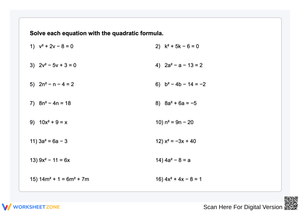
With the quadratic formula, the error almost always occurs at the "negative b" substitution. When solving x² - 6x + 5 = 0, students routinely enter negative 6 rather than positive 6 for -b, losing the sign before the calculation even begins. The quadratic worksheets ask students to explicitly write out a, b, and c before substituting into the formula — a step that slows the work just enough to interrupt that particular error pattern.
How to Build These Worksheets Into Your Week
The most reliable use is a daily warm-up. Five minutes at the start of class with two or three problems from a prior unit — combining like terms while a systems unit is underway, for instance — keeps earlier skills active without taking instructional time away from new content. Spaced retrieval is the mechanism that makes this worth doing: students who revisit factoring problems two weeks after the initial unit retain the skill far better than those who only practiced during the unit itself.
During a lesson, one worksheet works well as the independent practice phase — students work through problems while the teacher circulates, rather than watching another worked example. That structure surfaces confusion immediately. The student who nods along during direct instruction will often stall on problem three of an independent worksheet, and the stall tells the teacher exactly where to intervene. Error-analysis tasks, where students identify and correct a pre-solved problem containing a deliberate mistake, work particularly well in the 10 minutes before a unit test — students need consolidation at that point, not new input.
Teachers on a block schedule often pair two worksheets within one period: one at the start as retrieval practice, one after the lesson as a formative check. That pairing gives a practical before-and-after view of what the day's lesson actually moved.
Standard Alignment
These worksheets align to the Common Core State Standards for Mathematics High School Algebra domain. Linear equation and inequality practice addresses HSA-REI.B.3 (solving linear equations and inequalities in one variable) and HSA-REI.C.6 (solving systems of linear equations). Polynomial and factoring work connects to HSA-APR.A.1 (polynomial arithmetic) and HSA-SSE.A.2 (using structure in expressions to rewrite them in equivalent forms). The quadratic worksheets directly target HSA-REI.B.4, which requires students to solve quadratic equations by inspection, factoring, completing the square, and the quadratic formula — the standard explicitly names all four methods, and the worksheets give deliberate practice with each one.
In most Algebra 1 pacing guides, these standards span the full school year, which means 9th grade algebra printable worksheets from this set serve different instructional moments across the calendar. Linear equation worksheets typically come into play in September and October; systems land around November and December; polynomials and factoring carry most of the winter; quadratics close out the spring semester before end-of-course assessments.
Adjusting These Worksheets for a Range of Learners
For students who need more support with linear equations, starting with integer-coefficient problems and setting aside fractional coefficients cuts cognitive load without changing the core skill. A student who cannot yet manage (3/4)x + 2 = 11 still needs to solve 3x + 2 = 11 correctly — that is the productive starting point, and the fractional version belongs later once the procedure is solid. The single-skill structure of each worksheet makes this kind of selective assignment straightforward without requiring the teacher to edit anything out.
Students who move through the standard problems quickly benefit from error-analysis extensions or open-ended prompts — "Write three different quadratic equations that have x = 4 as a solution, and explain how you constructed each one." That task requires structural thinking rather than procedural repetition, which is exactly what a student who has already mastered the procedure actually needs. For students working well above grade level, the systems worksheets extend naturally by introducing a third equation and asking whether the system has a solution — a concept that previews ideas from linear algebra without requiring any prior exposure.
Students with IEP accommodations that include reduced problem sets or extended time benefit from the focused format of 9th grade algebra printable worksheets in this set. Because each worksheet stays within one concept, teachers can assign half a worksheet and still get a clear, usable picture of whether a student has the target skill — there are no unrelated problem types mixed in to obscure the result.
Frequently Asked Questions
Which Algebra 1 topics do these worksheets cover?
The set covers linear equations and inequalities, systems of equations using graphing, substitution, and elimination, polynomial operations, factoring, and quadratic functions. The quadratic worksheets address all four solution methods named in CCSS HSA-REI.B.4: factoring, inspection, completing the square, and the quadratic formula.
Do the worksheets include answer keys?
Yes. Each worksheet comes with a full answer key that shows the solution process for multi-step problems, not just the final answer. That matters most when students are self-correcting or when teachers need to locate exactly where in a procedure a student's work broke down.
Are these worksheets appropriate for 8th-grade accelerated math courses?
With some selection, yes. Eighth-grade students in accelerated courses typically work through most of the linear equation and systems content already. The polynomial and quadratic worksheets sit at a genuinely ninth-grade level and may extend beyond an 8th-grade scope. Teachers should pull the specific worksheets that match their course standards rather than assigning the full set.
Can these support end-of-course test preparation?
The skill coverage aligns with what most state Algebra 1 end-of-course assessments test. In the two to three weeks before the exam, 9th grade algebra printable worksheets from this set give teachers a practical way to assign targeted review by standard — pulling linear inequality practice for students whose formative data shows weakness there, or quadratic formula practice for students who rushed through it in the spring. That approach yields more diagnostic information than a broad review packet that takes the full period to complete and tells the teacher nothing about where the gaps actually are.














 Interactive Worksheet Maker
 Quiz Maker
 Word Search Maker
 Crossword Puzzle Maker
 Word Scramble Generator
 Sentence Scramble Generator
 Handwriting Worksheet Generator
 Name Tracing Generator
 Fill In The Blank Generator




 BACK TOSCHOOL