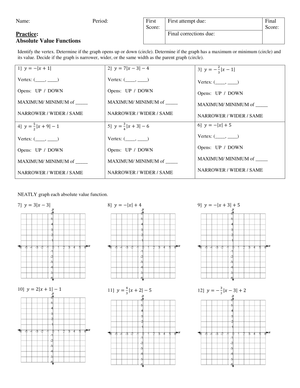
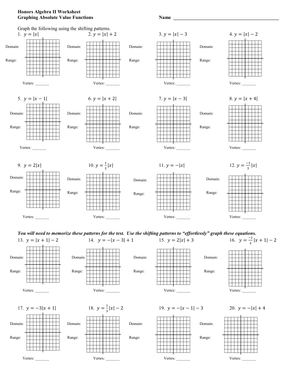
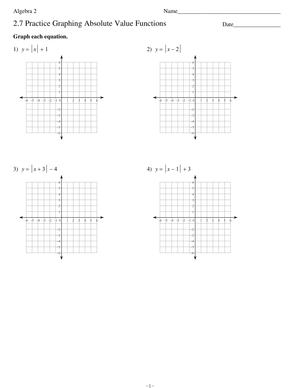
Graphing Absolute Value Functions printable worksheets for 9th Grade
These graphing absolute value functions printable worksheets for 9th grade give Algebra 1 teachers a set of standalone practice resources that move students from plotting the parent function to working fluently with full vertex-form transformations. Each worksheet targets a specific layer of the skill — vertex identification, direction of opening, axis of symmetry, stretch and compression, domain and range — so teachers can pull exactly the right practice for where a class is on a given day.
The Specific Skills Each Worksheet Builds
The set covers the core components of absolute value graphing in an order that mirrors how most Algebra 1 units sequence the content. Students begin with the parent function f(x) = |x|, build a table of values, and label the vertex at the origin alongside the axis of symmetry at x = 0. From there, individual worksheets address each parameter in vertex form — f(x) = a|x - h| + k — one at a time, before students encounter equations that combine all three simultaneously.
- Pulling the vertex (h, k) from vertex form, including equations where the sign inside the absolute value bars requires careful rewriting before the coordinates can be read
- Drawing the axis of symmetry as a first step, before any point-plotting begins
- Applying vertical and horizontal shifts independently, then in combination
- Reading the sign of a to determine whether the graph opens upward or downward
- Identifying vertical stretch when |a| is greater than 1 and compression when |a| falls between 0 and 1
- Writing domain and range in inequality notation once the graph is complete
Mistakes Students Make That These Worksheets Surface
The horizontal shift direction is the most persistent error in this unit, and it appears in student work at every ability level. When students see f(x) = |x + 4| - 1, they place the vertex at (4, -1) almost without exception — because the plus sign reads as a rightward movement. The formula runs directly against that reading: since vertex form is written as |x - h|, a positive number inside the bars means h is negative. Having students rewrite |x + 4| as |x - (-4)| before they extract the vertex coordinates interrupts this pattern more reliably than any mid-lesson reminder. One focused exercise built around this rewriting step, repeated across several worksheets early in the unit, shows measurable improvement in accuracy by the time students encounter more complex equations.
The second consistent error involves the sign of a. Students will locate the vertex correctly, mark the axis of symmetry, and then draft a V opening upward — because that is the only V-shape in their experience. A negative value of a reflects the graph across the x-axis, producing a downward-opening shape, but this does not register until students see their own graph fail. Error analysis tasks are effective here: provide a completed graph where the opening direction is wrong and ask students to identify, explain, and correct the mistake. That task makes the sign of a matter in a way that routine point-plotting never quite achieves.
Fitting These Worksheets Into the Week Without Disrupting Pacing
The graphing absolute value functions printable worksheets for 9th grade fit into the lesson cycle at several natural points without requiring a full period. As a warm-up, one equation takes three to four minutes: students write the vertex, note the direction of opening, sketch the axis of symmetry, and plot four points — two on each side. That narrow scope keeps daily contact with the skill alive across a multi-week unit, which matters because students who go untouched on this concept for even a week show measurable regression on the sign-of-h error.
For a full class period, a matching activity shifts the cognitive demand without changing the content. Students receive a set of equations and a set of pre-drawn graphs, then match them by reading key features — vertex position, direction of opening, relative width of the V — rather than re-plotting every function from scratch. This is consistently the task that separates students who have internalized vertex form from those still executing a memorized sequence of steps. Teachers who run it on a Friday, two days after initial direct instruction, find it a more honest formative read than a typical exit ticket.
Color-coding during early graphing practice reduces errors in student work in a way that verbal instruction does not. When students use one color for the parent function, a second for the horizontal shift, and a third for the vertical shift, the movement of the vertex from the origin to its final position becomes traceable on paper. Students who have mis-shifted can spot the error in their own color layers before the teacher reaches their desk.
Standard Alignment
These worksheets address Common Core standard HSF.IF.C.7b, which requires students to graph absolute value functions and identify key features — vertex, axis of symmetry, direction of opening, domain, and range. In the Algebra 1 sequence, this standard sits between linear functions and quadratics, and it does real structural work: vertex form for absolute value, f(x) = a|x - h| + k, uses the exact same h, k, and a framework as vertex form for quadratics. Students who leave this unit understanding what each parameter does carry that understanding directly into the parabola unit, and the transition is noticeably faster for students who had solid, repeated practice here first.
Modifying These Worksheets for Students at Different Readiness Levels
For students still building fluency with integer operations, the graphing absolute value functions printable worksheets for 9th grade work best when the first several problems use integer-only values for h and k and hold a equal to 1. This removes the arithmetic complexity so students can concentrate on reading the transformation itself. Once those problems run smoothly, introducing a values like 2, 3, or one-half raises the demand without altering the underlying concept being practiced.
Students who move through basic graphing problems quickly benefit from tasks that reverse the direction: given a pre-drawn graph, write the equation. This requires reading the vertex from the coordinate grid, determining whether the graph opens upward or downward, and calculating the value of a from two plotted points — a meaningful extension that stays within the same standard. Several worksheets in the set include this reverse task alongside standard graphing exercises, so both groups can work from the same resource during the same class period.
Frequently Asked Questions
How do students correctly find the vertex when the equation has a plus sign inside the absolute value bars?
The most reliable approach is rewriting before reading. If the equation is f(x) = |x + 5| - 3, students rewrite the inside expression as |x - (-5)|, making the vertex form explicit: h = -5 and k = -3, placing the vertex at (-5, -3). Teaching this habit early — before students have practiced the wrong approach enough to automate it — is the most efficient use of instructional time on this particular error.
In what order should the three parameters be introduced?
Vertical shifts first. Moving from f(x) = |x| to f(x) = |x| + 3 simply raises the vertex by three units, and students accept this without difficulty. Horizontal shifts come second because they carry the sign reversal problem and need focused attention before more complex equations appear. The parameter a comes last — it requires students to hold the vertex fixed while changing the shape of the branches, which is a higher demand than either shift alone and benefits from the other two being already secure.
How do absolute value transformations connect to the quadratics unit later in the year?
The connection is structural and direct. Vertex form for absolute value and vertex form for quadratics share the same parameters — a, h, and k — with the same meaning in both. Students who worked carefully through absolute value transformations recognize the format immediately when f(x) = a(x - h)² + k appears, and the parabola unit moves faster because the transformation logic is already in place. Teachers who cover absolute value graphing well report that their students need significantly less re-teaching on vertex form when they reach quadratics.
Are these worksheets useful for review before an end-of-course assessment?
The graphing absolute value functions printable worksheets for 9th grade align directly with the problem types that appear on Algebra 1 end-of-course tests and common district benchmarks. Students are typically asked to identify the vertex, determine the range, or match an equation to a graph — all tasks this set covers. Assigning them in the two weeks before a benchmark gives students targeted review without requiring new instruction or a separate prep resource.
Clear All