


























Views
Downloads



Printable Substitution Method Worksheet | Grade 8 Algebra
Paste this activity's link or code into your existing LMS (Google Classroom, Canvas, Teams, Schoology, Moodle, etc.).
Students can open and work on the activity right away, with no student login required.
You'll still be able to track student progress and results from your teacher account.
Solving systems of linear equations using the substitution method is a fundamental algebraic skill. This three-page worksheet provides a structured pathway to master substitution, from basic variable replacement to multi-step equation manipulation. Learners will confidently find intersection points of linear systems.
At a Glance
- Grade: 8 · Subject: Algebra
- Standard:
8.EE.C.8.b— Solve systems of two linear equations in two variables algebraically using substitution- Skill Focus: Solving systems via substitution method
- Format: 3 pages · 14 problems · Answer key included · PDF
- Best For: Algebra I direct instruction and practice
- Time: 40–50 minutes
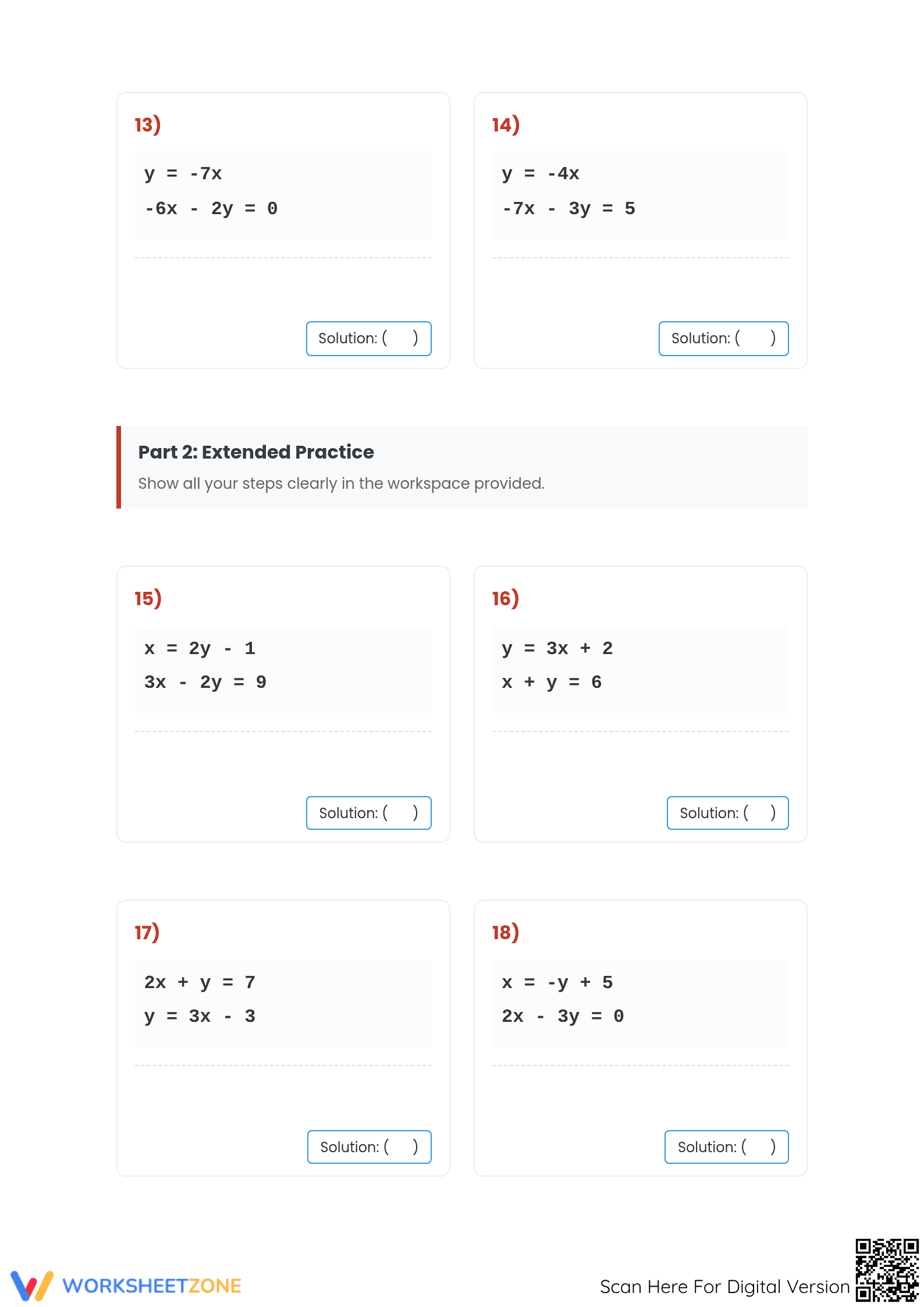
This resource contains 14 carefully curated problems divided into three distinct difficulty tiers. The first page focuses on simple substitution where one variable is already isolated. The second page introduces extended practice requiring students to isolate a variable before substituting. The final page presents challenge problems involving fractions and larger integers to test numerical fluency. Each problem includes a dedicated workspace and a clear coordinate box for the final solution. A full answer key is provided for immediate feedback and grading efficiency.
Skill Progression
- Guided Practice (Part 1): 6 problems where y or x is explicitly defined, allowing students to focus on the mechanics of substitution and solving for the remaining variable with minimal frustration.
- Supported Practice (Part 2): 4 problems requiring multi-step algebraic manipulation, where students must identify the easiest variable to isolate before proceeding with the standard substitution algorithm.
- Independent Mastery (Part 3): 4 challenge problems that incorporate complex coefficients and fractional results, ensuring students can apply the method to more rigorous mathematical scenarios without scaffolding.
This progression follows the gradual-release model, shifting cognitive load from the teacher's initial demonstration to the student's independent execution of the strategy.
Standards Alignment
The primary focus of this worksheet is 8.EE.C.8.b, which requires students to "solve systems of two linear equations in two variables algebraically, and estimate solutions by graphing the equations." While this resource focuses on the algebraic component, it builds procedural fluency necessary for higher-level work. It also supports HSA-REI.C.6, covering exactly and algebraically solved systems.
How to Use It
Use this worksheet as a primary practice tool during a 50-minute Algebra I block. For best results, assign Part 1 immediately following your direct instruction on substitution to ensure students have grasped the basic replacement concept. Part 2 and Part 3 can then be used as a differentiation strategy during the second half of the period. A valuable formative assessment tip is to observe students during Part 2 to see if they are selecting the most efficient variable to isolate, which is a key indicator of procedural flexibility.
Who It's For
This resource is designed for Grade 8 and Grade 9 students enrolled in Pre-Algebra or Algebra I courses. It is particularly effective for learners who struggle with abstract concepts, as the tiered structure provides a safe entry entry point. It pairs naturally with a coordinate plane anchor chart or a short video tutorial on the "Find, Replace, Solve" sequence of substitution.
The substitution method is a cornerstone of algebraic reasoning, fostering understanding of the transitive property and equality. This Grade 8 worksheet targets 8.EE.C.8.b through 14 distinct tasks, helping students master algebraic solutions for linear equations systems. Focusing solely on substitution helps learners develop the precision needed for higher-level mathematics. Challenge problems enhance confidence in tackling complex numerical results, including non-integer solutions.


