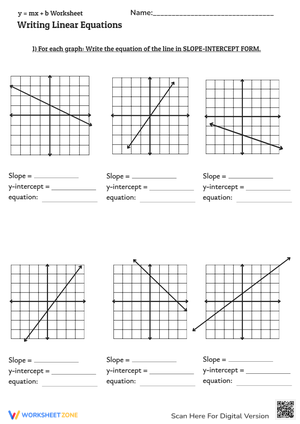
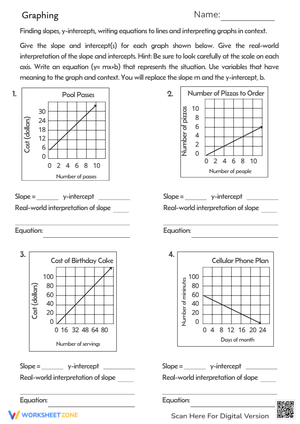
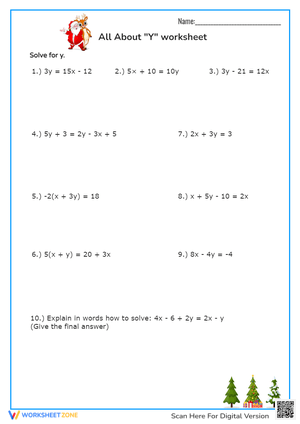
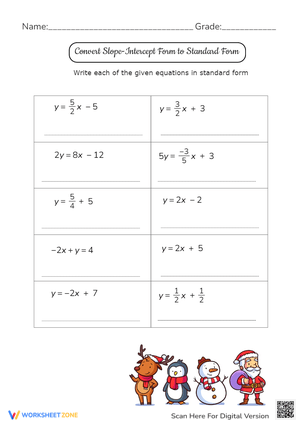
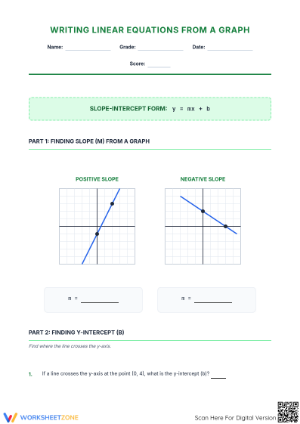
These writing linear equations pdf worksheets for 9th grade give algebra teachers a sequenced set of practice resources that moves students from reading slope directly off a graph to deriving equations from two coordinate pairs to translating word problems into algebraic statements. The resources cover all three forms — slope-intercept, point-slope, and standard — without treating any one as an afterthought.
What Students Practice Across the Set
Each worksheet targets a specific skill layer within the broader unit. The sequence starts with slope-intercept form because its connection to a graphed line is concrete: students read the y-intercept as the point where the line crosses the vertical axis and calculate slope by counting rise over run on the coordinate plane. Once that's solid, the worksheets shift to point-slope form — problems where the y-intercept isn't immediately visible and students must choose a point on the line and substitute correctly into the formula. Standard form closes the sequence, requiring students to rearrange expressions so the equation fits the Ax + By = C structure with integer coefficients, which means clearing fractions before any rearranging happens.
Word problems appear throughout the set, not only at the end of the unit. Students identify which quantity changes at a constant rate (slope) and which represents the starting condition (y-intercept), then produce a complete equation and use it to answer a follow-up question. A typical problem describes a cell phone plan with a flat monthly fee and a per-minute charge — simple enough that 9th graders can focus on the algebraic translation rather than decoding an unfamiliar context.
Mistakes Students Make That These Worksheets Help You Catch
The subtraction order in the slope formula creates errors more consistently than almost anything else in this unit. Students who have memorized "y2 minus y1 over x2 minus x1" will flip the x-coordinates when the values look reversed — writing (x1 minus x2) in the denominator because that order felt natural to them. The result is a slope with the wrong sign, which then produces a wrong y-intercept in every step that follows. A single worked example on the board using two points with a negative slope gives students a built-in self-check before they hit it on the worksheet.
Point-slope form produces a different, equally predictable error. Students routinely write y minus y1 equals m times (x plus x1) instead of (x minus x1), reversing the sign inside the parentheses. This happens because the formula feels backward — a point with a positive x1 value generates a subtraction, and students instinctively correct what looks like a sign error without realizing the formula already accounts for it. Teaching the formula as a strict substitution — plug in the coordinate value with its sign attached — reduces this pattern significantly.
In word problems, the most common mix-up is assigning slope and y-intercept to the wrong quantities. Students who see a starting fee of $25 and a $3-per-hour rate often write b = 3 and m = 25 without questioning it. A brief pre-writing step — label the rate of change and the starting value before writing anything else — catches this before it calculates all the way through to a wrong equation.
How to Build These Worksheets Into Your Lesson Plans
Writing linear equations pdf worksheets for 9th grade fit naturally into several points in the instructional week. The slope-from-two-points worksheets make effective Monday warm-ups — five problems in the first few minutes re-activate the formula before the lesson continues forward. Exit-ticket use works especially well with the word problem worksheets: two problems in the last eight minutes of class show immediately which students are still swapping slope and y-intercept values, letting the teacher sort the next day's opening accordingly.
Partner work adds a practical self-correction layer. Two students solve different problems that share the same slope value, then compare results. When their slopes don't match, they have to argue through whose setup went wrong — that conversation surfaces errors that quiet individual work never surfaces. The answer-key PDFs support small-group station rotations by letting students self-check intermediate steps, not just final answers, so they can identify exactly where their reasoning diverged.
Standard Alignment
These resources address HSA.CED.A.2 — Creating Equations: create equations in two or more variables to represent relationships between quantities. In practice, this standard shows up in two distinct instructional moments during the linear equations unit: first when students write equations from visual graphs, and again when they extract equations from contextual descriptions. Writing linear equations pdf worksheets for 9th grade address both moments directly. The word problem sets are the strongest connection to HSA.CED.A.2 because they ask students to identify the relationship between quantities before any notation appears — which is precisely the move the standard requires.
Adjusting the Resources for a Range of Learners
Students who need more support benefit from a two-column format: the left column presents a step-by-step worked example, and the right column offers a parallel problem for them to complete. This keeps the cognitive load on the algebraic structure itself rather than splitting it between reading comprehension and problem setup simultaneously. Starting with problems where slope is already calculated — so students only write the equation — before advancing to open-ended versions gives those students a foothold without lowering the ceiling of the overall unit.
Students who move through the core problems quickly can work with extension problems involving non-integer slopes and requiring conversion between all three forms in a single item. Asking them to write a word problem that matches a given equation — reversing the usual direction — pushes into higher-order thinking without requiring a separate set of materials. Writing linear equations pdf worksheets for 9th grade that include challenge problems alongside core exercises keep this differentiation manageable within a single class period.
Frequently Asked Questions
Which form should teachers introduce first?
Slope-intercept form, consistently. Its visual connection to a graphed line gives students a concrete reference: b is where the line crosses the y-axis, and m describes whether the line tilts up or down and how steeply. Point-slope and standard form make more sense after students have that grounding — otherwise, the formulas feel arbitrary rather than connected to something they've already seen on a coordinate plane.
How does the set handle the jump from graph-based problems to two-point problems?
The sequence makes that transition explicit rather than assuming students will bridge it on their own. Graph-based worksheets come first. Once students are reliably reading slope and y-intercept off a line, the worksheets shift to problems where no graph is provided and students must calculate slope from two coordinate pairs before writing the equation. The move is deliberate, not buried inside a mixed problem set.
Are the word problems drawn from recognizable real-world situations?
Yes. The contexts include service costs with a flat fee and per-unit rate, distance-time relationships, and straightforward financial scenarios. The goal is that students spend their attention on the algebraic translation rather than on interpreting an unfamiliar situation — the context is a vehicle, not the obstacle.
Do the worksheets include answer keys with shown work?
Each worksheet comes with a corresponding answer key that shows intermediate steps, not just final equations. This matters most during small-group instruction: when a student's answer doesn't match, the teacher can scan the key quickly to identify exactly where the solution went off track — whether it was the slope calculation, the substitution step, or the rearrangement into standard form — without working through the problem from scratch.














 Interactive Worksheet Maker
 Quiz Maker
 Word Search Maker
 Crossword Puzzle Maker
 Word Scramble Generator
 Sentence Scramble Generator
 Handwriting Worksheet Generator
 Name Tracing Generator
 Fill In The Blank Generator




 BACK TOSCHOOL