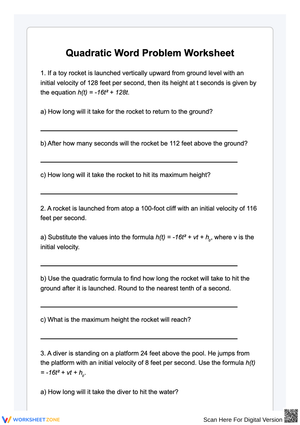
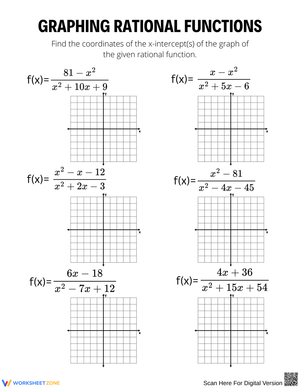
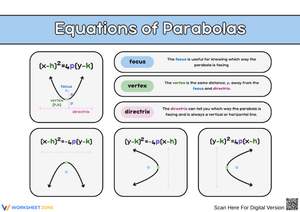
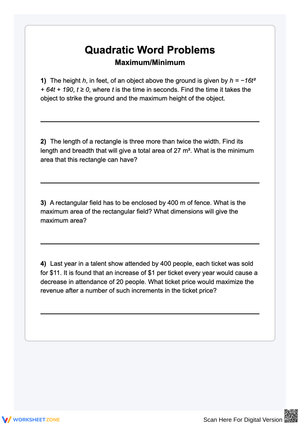
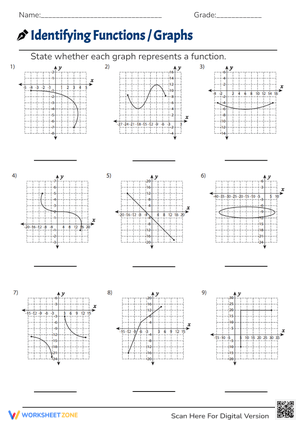
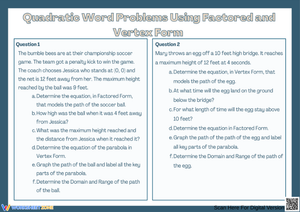
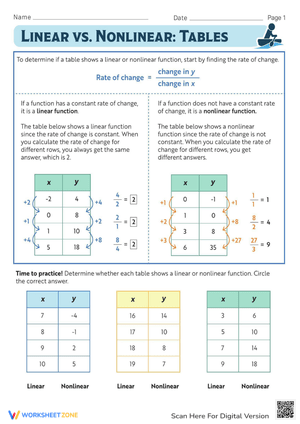
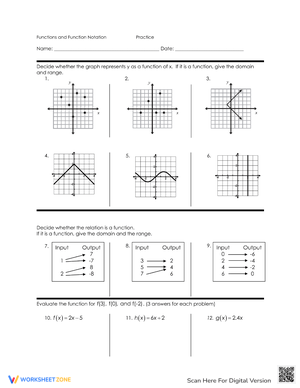
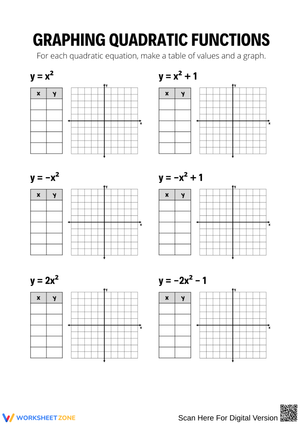
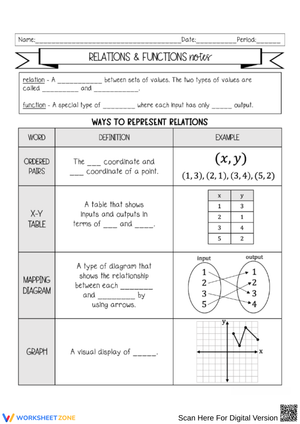
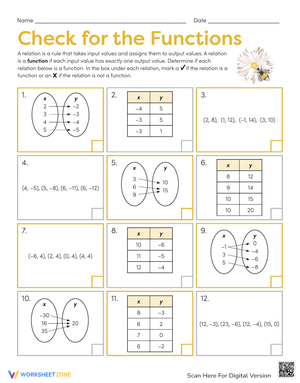
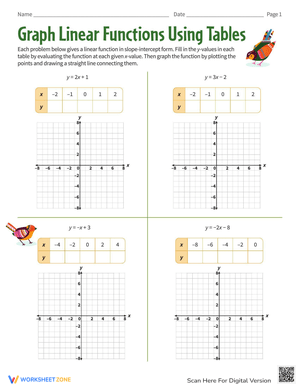
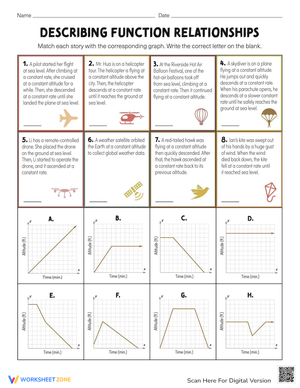
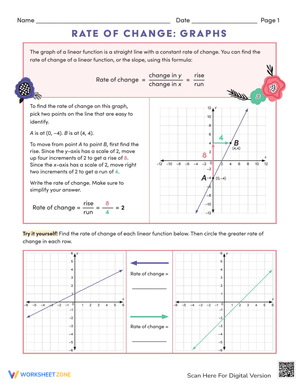
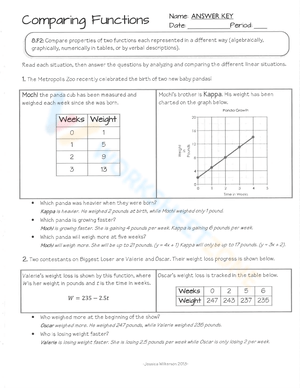
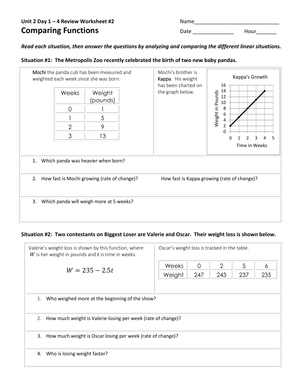
These 9th grade functions printable worksheets address the conceptual jump that hits most freshmen around the third week of Algebra 1 — when y = mx + b gives way to f(x) notation and the question of what counts as a function shifts from intuitive to precisely defined. The set covers function identification, notation, evaluation, and domain and range across multiple representations. Teachers get standalone resources built for bell-ringers, small-group stations, and independent practice blocks.
Misconceptions Students Bring Into This Unit
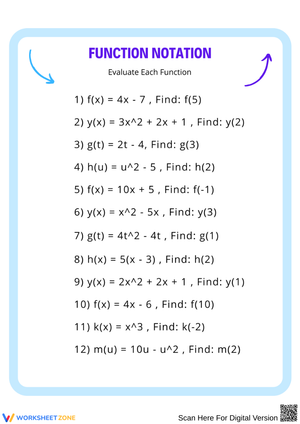
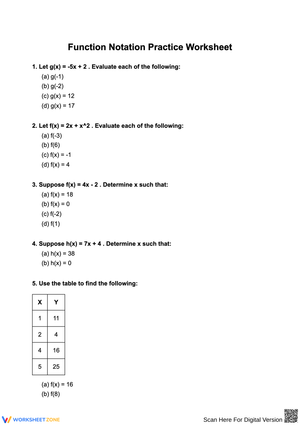
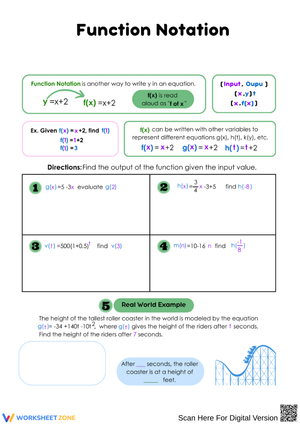
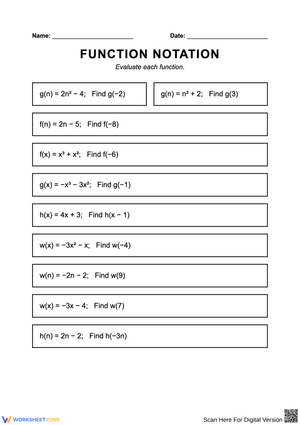
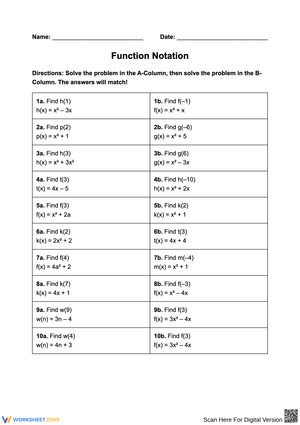
The f(x) confusion comes first. Students who have spent two years writing equations as y = mx + b read f(x) as multiplication — "f times x" — and that habit does not die with one explanation. The notation worksheets address this by isolating substitution entirely: given f(x) = 3x − 1, find f(0), find f(−2), find f(a + 1). No graph, no table, no extra context — just the mechanism, repeated until students stop reaching for the multiplication sign. Stripping away competing information during this phase reduces cognitive load at a point in the year when students are absorbing an unusually dense set of new symbols.
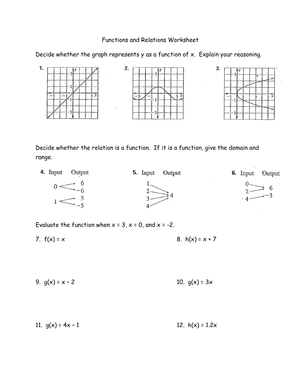
A subtler error appears with the vertical line test. Students learn the visual rule quickly and apply it correctly to parabolas and circles on a graph. Then they encounter a table where x = 2 appears twice with different y-values and freeze — there is no picture in front of them, so the test they memorized does not seem to apply. They have learned the procedure without understanding what it is actually testing. The mapping-diagram worksheets in the set require students to draw the arrows themselves before touching a coordinate plane, which makes the one-input-one-output rule concrete rather than purely visual.
What the Set Covers
Each worksheet focuses on one skill area, sequenced to reflect how teachers actually build this unit:
- Function identification — Students classify relations from mapping diagrams, ordered-pair tables, and coordinate graphs. Every problem asks for a written justification, not just a yes/no answer.
- Function notation and evaluation — Integer, fraction, and variable inputs into linear and quadratic expressions. Later worksheets introduce problems like finding f(g(2)) before formal composition study, giving students early exposure without the full formal treatment.
- Domain and range from discrete sets — Reading scatter plots and listed ordered pairs, then writing the domain and range in both set notation and inequality notation side by side.
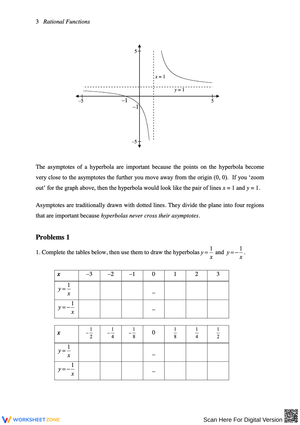
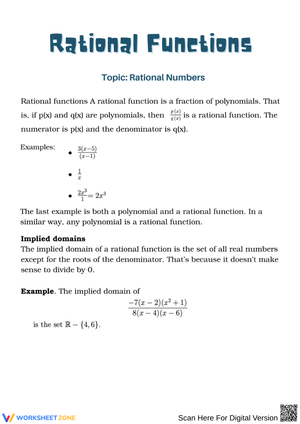
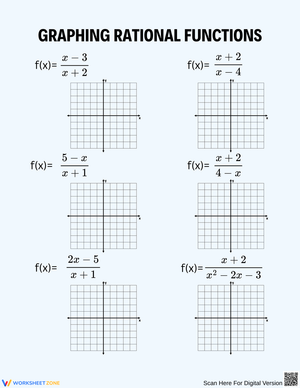
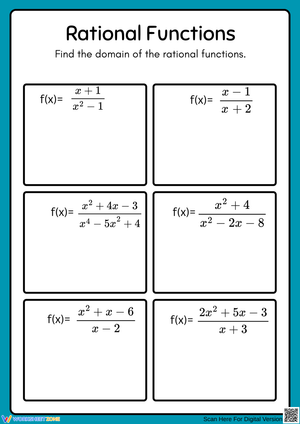
- Domain and range from continuous graphs — Interpreting open and closed endpoints, arrows, and behavior near asymptotes to write interval notation. Students who skip the discrete worksheets consistently struggle here, which is why the set is ordered the way it is.
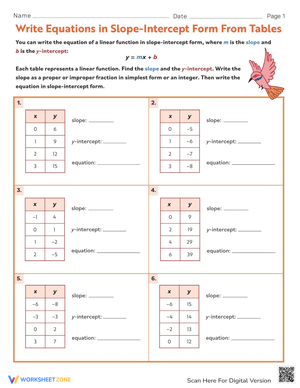
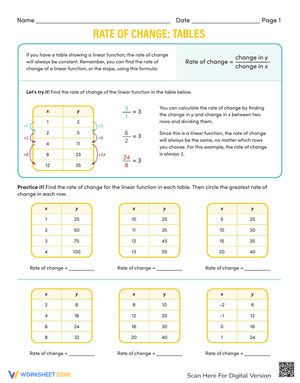
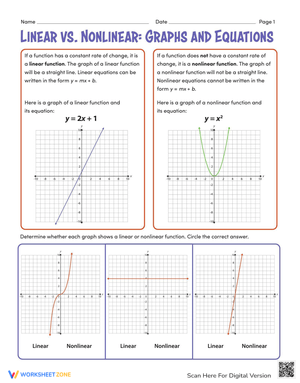
- Function family comparison — Short classification worksheets where students match a table or equation to its parent function type and describe how the graph shifts from the parent.
Fitting These Worksheets Into Your Weekly Planning
The notation worksheets earn their keep as daily five-minute openers during the first two weeks of the unit. Running evaluation problems every morning — before new instruction begins — builds fluency through spaced retrieval rather than a single heavy practice session. By the end of week two, most students stop treating the parentheses as a multiplication sign and start reading the expression correctly without prompting.
These 9th grade functions printable worksheets also fit naturally into a station rotation during a block period. A four-station setup works well: mapping diagrams at one table, graph-based identification at another, domain-and-range notation at a third, and a context-building station where students construct a function from a real-world scenario — a cell phone data plan, a delivery fee structure, or a temperature conversion. The teacher circulates and pulls a small group toward whichever station generates the most confusion, which is almost always domain and range.
Common Student Mistakes Worth Catching Before the Unit Test
Beyond the f(x) notation error, three patterns show up consistently in student work. First, students write domain and range as a single combined set rather than two separate ones — they list all the numbers that appear in the relation without distinguishing between x-values and y-values. Second, when writing interval notation for a continuous graph, students reverse the direction of an inequality when the graph opens left or runs below the x-axis. Third, students identify a graph correctly using the vertical line test, then contradict themselves on a table version of the same relation because they approach the two representations as unrelated tasks.
The third error is the most instructive one to watch for. When a student passes the graph problem and misses the table problem on the same assessment, the gap is almost never about arithmetic — it is about representation flexibility. Running one worksheet that presents the same relation as a mapping diagram, a table, and a graph side by side, and asking students to apply the function test to all three, typically surfaces this gap faster than three separate worksheets can.
Adjusting the Work for Different Student Levels
For students still shaky on substitution from pre-algebra, the notation worksheets pair well with a function-machine reference card that stays on the desk during the first several sessions — input goes in, rule applied, output comes out — and comes away gradually as fluency develops. That card takes about three minutes to draw on an index card and eliminates most of the procedural confusion before it becomes a confidence issue.
For students who move through the material quickly, the domain-and-range worksheets extend into a brief writing task: describe a real-world context in two sentences, then write the domain restriction as an inequality. A parking garage that charges only for the first five hours or a delivery service operating within a ten-mile radius both work cleanly. The task is short but demands thinking about what makes a valid input value in context — exactly the applied reasoning that HSF.IF.B.5 targets and that most Algebra 1 students do not encounter in a meaningful way until domain-restriction problems appear on an end-of-course exam.
Standard Alignment
These 9th grade functions printable worksheets align to the CCSS High School Functions domain, specifically:
- HSF.IF.A.1 — A function assigns exactly one output to each input. The mapping-diagram and graph-based identification worksheets build toward this definition through repeated classification work before the formal statement arrives in instruction.
- HSF.IF.A.2 — Using function notation and evaluating functions. The notation worksheets address this standard across three levels of input complexity: integers, fractions, and variable expressions such as f(x + h).
- HSF.IF.B.5 — Relating the domain of a function to its graph and to the context of a problem. The real-world domain restriction problems address this standard directly. It is the one most likely to get skipped when teachers run short on time near the end of the marking period, so having a standalone worksheet for it matters.
HSF.IF.A.1 and HSF.IF.A.2 appear consistently on state end-of-course Algebra 1 assessments. In Common Core-aligned states, the language and problem formats in these worksheets transfer closely enough to released test items that teachers use them as low-stakes formative checks throughout the unit rather than reserving them for test-prep week.
Frequently Asked Questions
How should these worksheets be sequenced within a functions unit?
Start with mapping-diagram and identification worksheets before introducing f(x) notation. Students need the one-input-one-output rule to be concrete before the symbolic layer arrives. Notation and evaluation worksheets follow and should run as daily practice for at least a week. Domain and range from discrete sets comes before continuous graphs. The function-family comparison worksheets work best near the end of the unit, once students have seen enough graphs and tables to recognize patterns across types.
What do I do with students who pass the vertical line test but still miss function problems on assessments?
That pattern almost always means a student has the visual rule without the underlying definition. Put them on the mapping-diagram worksheets and have them draw the arrows themselves, tracing each input to its output by hand. The one-input-one-output logic becomes concrete in a way that the graph never forced it to be. One or two worksheet sessions with the diagrams closes the gap most of the time without re-teaching the whole concept from scratch.
Are there word problems in the set, and how reading-heavy are they?
The word-problem worksheets keep each scenario to two or three sentences, with the mathematical task stated explicitly at the end rather than buried in the paragraph. Students who freeze on reading-heavy textbook problems typically handle these more successfully. For students whose reading level is significantly below grade level, a brief verbal walkthrough of the scenario before independent work — thirty seconds, nothing elaborate — makes the difference between a student engaging with the math and a student spending the period re-reading the setup.
Do these work as standalone homework, or are they better used in class?
The notation and identification worksheets replace textbook homework cleanly for those sections — most Algebra 1 textbooks revisit function notation in a later chapter and students essentially relearn it, whereas running these worksheets as daily openers in week one builds fluency that holds. For domain and range, the worksheets go deeper into notation formats than most textbooks do at the introductory stage, so they work best alongside the textbook. Teachers who integrate these 9th grade functions printable worksheets into their planning typically assign the worksheet first for concept-building and use the textbook problems afterward as a self-check, which keeps the gradebook honest without doubling the student workload.














 Interactive Worksheet Maker
 Quiz Maker
 Word Search Maker
 Crossword Puzzle Maker
 Word Scramble Generator
 Sentence Scramble Generator
 Handwriting Worksheet Generator
 Name Tracing Generator
 Fill In The Blank Generator




 BACK TOSCHOOL