These inequalities worksheets for 9th grade give Algebra I teachers a set organized by skill type — from one-step problems through compound inequalities — with graphing tasks and application questions included, so the set covers the full Algebra I inequalities unit without pulling material from multiple sources or reformatting problems mid-week. Each worksheet stays on a defined skill, which means teachers can assign targeted practice immediately after a mini-lesson rather than sorting through mixed-topic pages.
What's Inside the Set
Each worksheet targets a defined portion of the inequalities progression rather than mixing everything together. The sequence moves from procedural fluency to graphical interpretation to contextual application, which tracks with how most Algebra I units are structured.
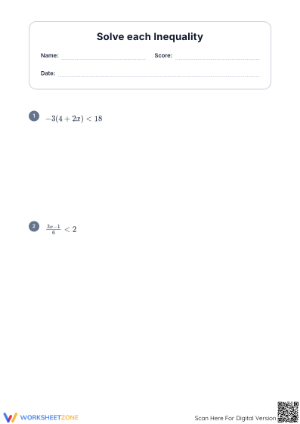
- One-step and two-step inequalities: Students isolate the variable using inverse operations, then check whether a test value satisfies the solution set.
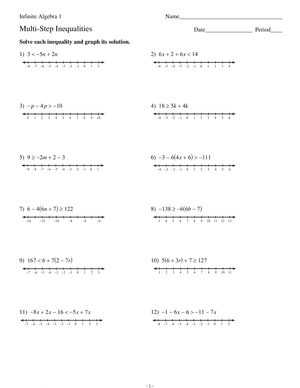
- Multi-step inequalities: Problems require combining like terms or applying the distributive property before isolating the variable — the stage where sign-tracking errors become most common.
- Sign reversal: A dedicated cluster of problems addresses cases where students multiply or divide by a negative number, with space to write whether and why the inequality symbol changes direction.
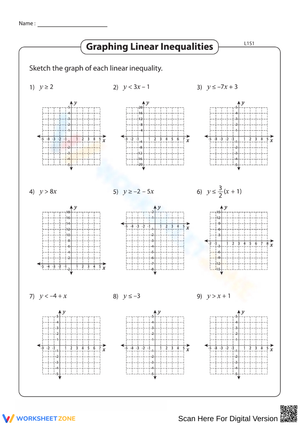
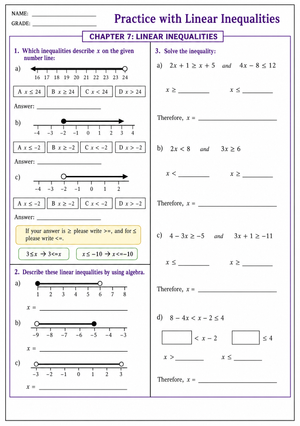
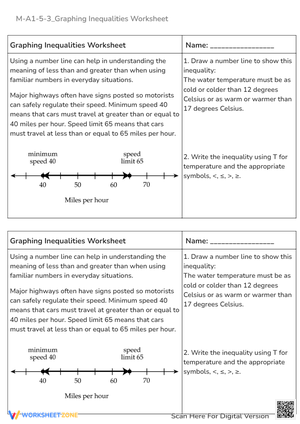
- Graphing solution sets: Number lines are pre-printed so students focus on placing open or closed circles and shading in the correct direction, not on drawing the model from scratch.
- Compound inequalities: Students work with "and" and "or" statements, including notation such as 3 less than x less than or equal to 8.
- Word problems: Short application items ask students to write an inequality from a stated constraint and interpret what the solution means in context — not just solve a given expression.
Common Misconceptions to Watch For and Correct
The sign-reversal rule generates more errors in this unit than any other step. Students who correctly solve 2x less than 6 to reach x less than 3 will still write x less than negative 3 when dividing both sides of negative 2x less than 6 — they execute the division correctly but leave the symbol unchanged because the operation feels identical. That error is automatic, not careless. The sign-reversal worksheets isolate this step from the rest of the multi-step routine, which lets teachers see the misconception clearly before it gets buried in longer problems.
Two other patterns appear regularly in student work. Students who solve x greater than negative 2 correctly in symbolic form will often plot the dot at positive 2 on the number line — they read the numeral but drop the negative when moving from the equation to the visual model. Separately, students regularly use a closed circle for "greater than" because they associate "more" with "solid." A targeted graphing worksheet that mixes open-circle and closed-circle problems across several items forces that distinction into the open rather than leaving it as a detail students assume they already know.
Building These Worksheets Into Your Unit Pacing
The cleanest way to use these inequalities worksheets for 9th grade is to assign each worksheet immediately after modeling its target skill, then return to it two days later as a short retrieval warm-up. Students who do the initial practice and get it right on Monday often blank on the sign-reversal rule by Thursday if they only encountered it once. A three-problem review at the start of class — not graded, used strictly for visibility — surfaces that forgetting before the quiz does.
For sub days, the solving and graphing worksheets run without introduction because each one has a worked example and clear directions at the top. Teachers who rotate math stations during the inequalities unit often place the error-analysis version of the graphing worksheet in the small-group spot: students mark the incorrect step in a pre-worked problem, fix it, and write a one-sentence explanation. That task runs about twelve minutes and separates students who understand the concept from those who can only follow a procedure when no one has made a mistake yet. The word problem worksheets, by contrast, work better during whole-class instruction or partner work — open-ended interpretation tasks tend to stall in unsupervised rotations.
Standard Alignment
These resources align to CCSS HSA-REI.B.3, which calls for solving linear equations and inequalities in one variable, including cases where coefficients are represented by letters. In most Algebra I courses, this standard appears mid-year — after students have built equation-solving fluency — because the sign-reversal rule only holds up conceptually once students understand how applying an operation to both sides maintains or reverses the truth of a statement. Number line graphing is the expected representational output at this stage, connecting the symbolic solution to a visual form that students first encountered in 6th and 7th grade and must now apply within a more abstract procedural context.
Differentiating These Worksheets Across Ability Levels
The most effective differentiation in this unit targets the specific breakdown point rather than adjusting difficulty across the board. A student stuck on sign reversal needs focused repetition on that rule — not easier problems in general. The set's organization by skill type makes that kind of targeting straightforward.
- Students who need additional support: Assign the one-step and two-step worksheets with the sign-change rule printed at the top as a reference. Include a partially completed example on each problem type so students have a model to check their steps against before they work independently.
- On-level practice: Mixed solving-and-graphing worksheets where students work through multi-step problems and graph each solution immediately, then check a test value. That three-step routine builds the connection between symbolic and visual answers without treating them as separate topics.
- Students ready for extension: Compound inequality worksheets with word problems that require writing the inequality from a verbal constraint, not just solving one that's already written. These also hold up well as ten-minute partner tasks during the last stretch of class.
Color-coding worksheets by type — one color for solving, another for graphing, a third for applications — takes a few minutes to organize once and makes targeted pre-quiz review significantly faster when you need to pull specific practice for specific students without re-sorting the whole set.
Frequently Asked Questions
Do the worksheets include answer keys?
Yes. Each worksheet in the set comes with a full answer key, making it practical for homework assignments, sub plans, and station rotations where immediate teacher feedback is not always available.
When in the unit should compound inequalities be introduced?
After students can solve and graph single inequalities independently. If students are still misplacing open and closed circles or forgetting the sign reversal, compound inequalities introduce enough new notation that both errors compound each other. Most Algebra I pacing guides place compound inequalities in the final third of the inequalities sequence for exactly this reason.
How does the set handle the graphing component?
Number lines are pre-printed on each graphing worksheet rather than leaving students to draw them. That decision reduces the chance that a poorly constructed number line obscures whether the student placed the dot and the shading correctly — which matters more for reading student work accurately than for the underlying math.
Are these resources better suited for classwork, homework, or test review?
Teachers who use inequalities worksheets for 9th grade most effectively tend to keep the uses separate: focused single-skill worksheets during instruction and homework, mixed-skill review sets before quizzes and unit tests. Treating them as interchangeable produces less useful data — a student who performs well on a mixed-review worksheet the day before a test may still have gaps in one specific skill that a targeted worksheet would have caught earlier.
What course level is this set intended for?
These inequalities worksheets for 9th grade target students in Algebra I, whether that course runs in 9th grade or in an accelerated 8th-grade setting covering high school algebra content. The skill progression fits standard Algebra I pacing and aligns with HSA-REI.B.3, so the set works anywhere that standard is the instructional target.














 Interactive Worksheet Maker
 Quiz Maker
 Word Search Maker
 Crossword Puzzle Maker
 Word Scramble Generator
 Sentence Scramble Generator
 Handwriting Worksheet Generator
 Name Tracing Generator
 Fill In The Blank Generator




 BACK TOSCHOOL