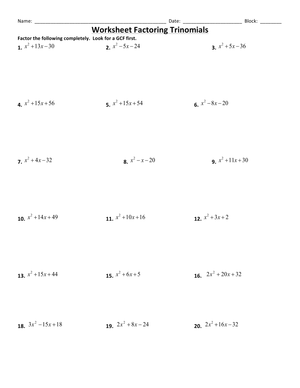
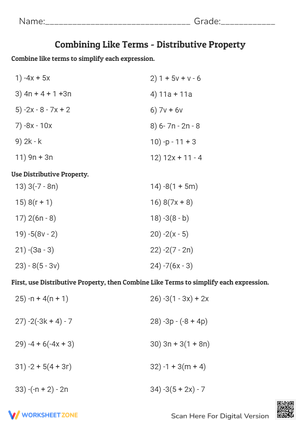
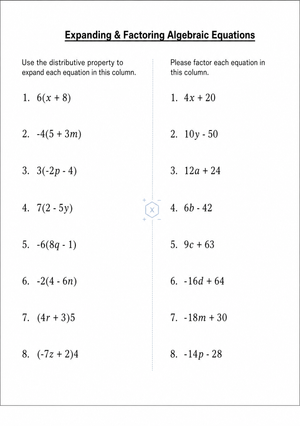
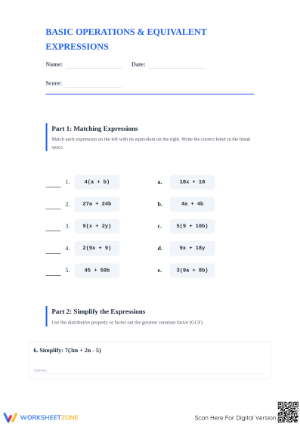
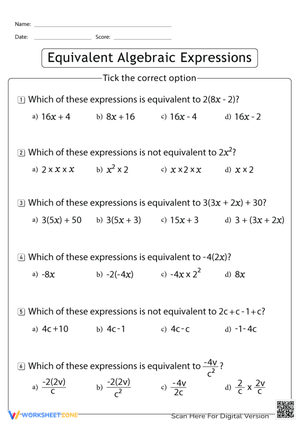
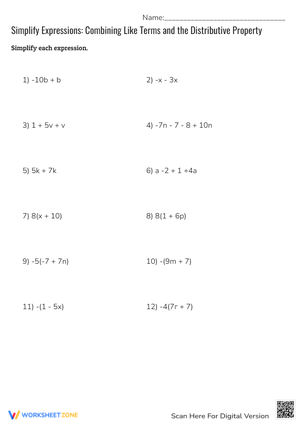
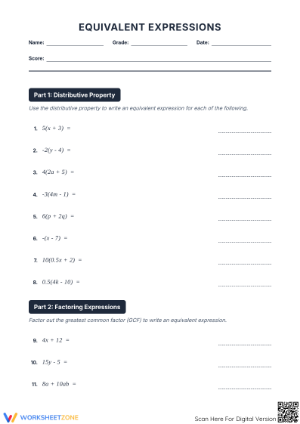
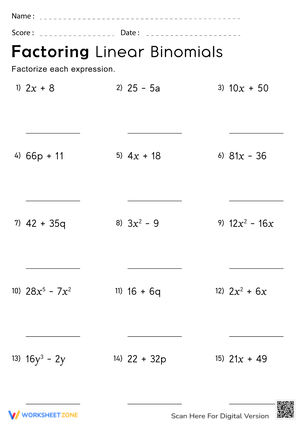
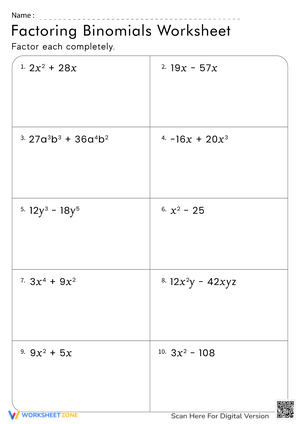
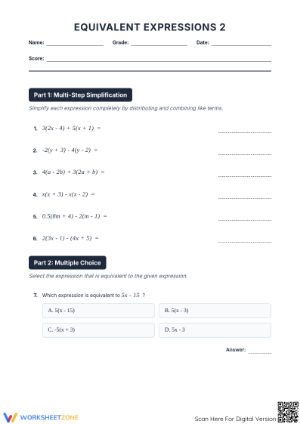
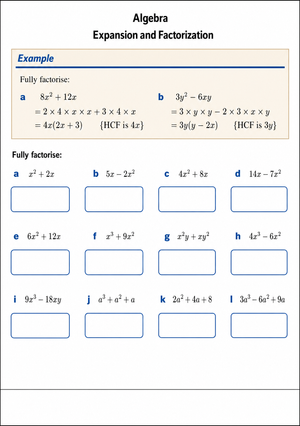
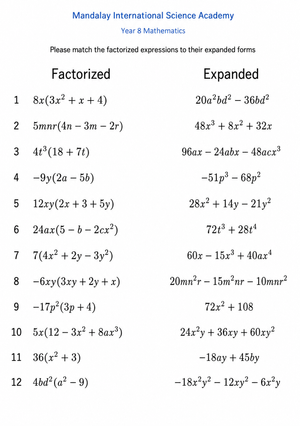
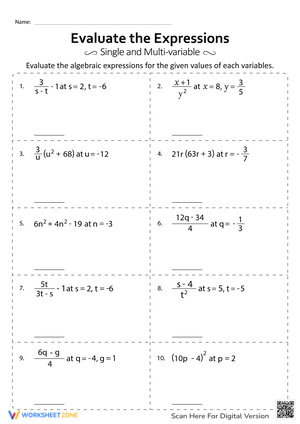
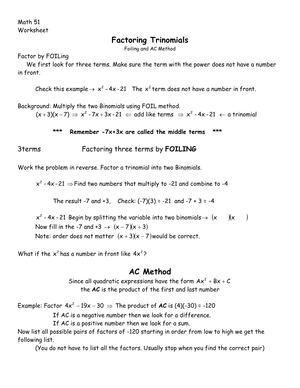
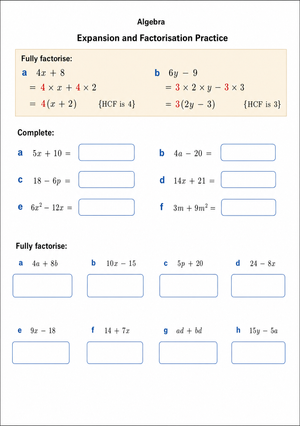
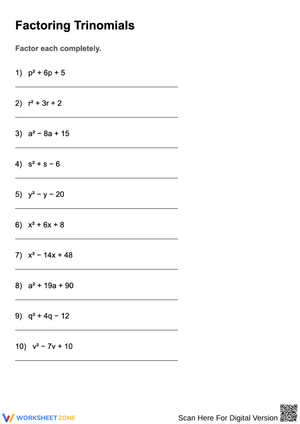
These 9th grade expressions printable worksheets give Algebra 1 teachers targeted, independent practice for the three skills that define the first semester: simplifying expressions, evaluating them by substituting values, and converting verbal phrases into algebraic notation. Each worksheet isolates one of those skills so students aren't simultaneously juggling translation and simplification—a cognitive load problem that surfaces constantly in mixed-task assignments. The set spans single-variable linear expressions through introductory polynomials, matching the pacing most districts follow.
The Three Skills These Worksheets Target
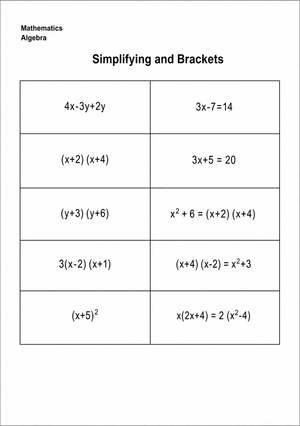
Simplifying is the largest cluster. Students combine like terms, apply the distributive property, and manage subtracted groupings—which means rewriting something like 3x - (2x + 5) as x - 5 rather than the common error of x + 5. Worksheets in this group range from single-variable expressions to multi-variable work with integer exponents, covering the full arc from early September through late November.
Among the 9th grade expressions printable worksheets, the evaluating cluster is the one that catches arithmetic gaps. Students substitute specific numerical values for variables and work through the order of operations to a result. Several worksheets use negative and fractional substitution values—not to make things harder arbitrarily, but because students who practice only with whole numbers often collapse when a problem introduces -3 or one-half as the input value.
Translating verbal phrases into algebraic form is the hardest skill for most 9th graders. The worksheets in this group move from one-operation phrases ("the product of a number and seven") to multi-step descriptions where students must determine which operation governs the structure before writing anything. Reverse translation—reading an expression and writing the phrase it represents—appears later in the sequence as a check on whether students understand expression structure or are just memorizing keyword-to-symbol pairings.
Student Error Patterns Worth Anticipating
The most persistent simplification error is failing to distribute a negative sign across every term inside parentheses. When students encounter 3x - (2x + 5), a predictable portion will write x + 5 instead of x - 5—they subtract from the leading term and leave the constant alone. These worksheets surface that pattern early because subtracted binomials appear in the first third of each simplifying worksheet, not buried at the end where students might not reach them.
Translation errors are subtler and harder to correct. "Five less than a number" reliably produces 5 - n in student work rather than n - 5. The phrase "less than" signals subtraction, but students default to writing numbers in the order they hear them. A related error: students who handle "less than" correctly will still write 4 ÷ n when a problem says "the quotient of a number and four," reversing the dividend and divisor. Both patterns appear explicitly in the translation worksheets—not just once, but in varied phrasing so students encounter the reversal in multiple contexts rather than memorizing one example.
Fitting These Worksheets Into Your Weekly Plan
The simplifying worksheets work well as Monday warm-ups—eight to ten minutes at the start of class before the new lesson begins. The spacing effect is real here: students who revisit expression structure at the start of the week retain it more durably through Thursday assessments than students who practice only once during a lesson block. The evaluating worksheets suit days when students finish a lesson activity early and need something substantive. Once the substitution procedure is established, students can work through those independently without additional instruction.
Translation worksheets belong in the middle of a lesson rather than at the end. Students who are uncertain about mathematical phrasing need the teacher present, and using a translation worksheet as a shared whole-class activity—pausing to discuss specific phrases before students commit anything to paper—turns the exercise into a group analysis of language rather than individual guessing. Worth noting: none of these worksheets ask students to solve equations. They stop at writing the expression. That constraint is deliberate. When translation and equation-solving appear in the same task, it becomes difficult to determine whether a wrong answer reflects a language problem or an algebra problem.
For homework, the evaluating worksheets are the most appropriate choice from this set. They require no new reasoning—just careful arithmetic applied to a familiar algebraic form. Sending home translation worksheets, especially early in the year, tends to produce guessing. Students need classroom conversation around mathematical phrasing before that skill develops enough to transfer to independent practice.
Standard Alignment
These worksheets address HSA-SSE.A.1, which asks students to interpret the parts of an expression—terms, factors, and coefficients—in context, and HSA-SSE.A.2, which focuses on using expression structure to identify equivalent forms. In practical classroom terms, HSA-SSE.A.1 governs the evaluating and translation work: students must understand what each part of an expression represents before they can substitute values or write a verbal description. HSA-SSE.A.2 governs the simplifying cluster, where the goal is recognizing that 3x - (2x + 5) and x - 5 describe the same quantity.
Adjusting the Worksheets for a Range of Learners
For students still shaky on integer operations, the evaluating worksheets are the right entry point. The algebraic form is present, but the only computation required is arithmetic—no new concept is introduced. Starting those students with whole-number substitution values removes one layer of difficulty without changing the algebraic task. Once they can substitute and simplify reliably, moving to negative and fractional input values extends the practice without a conceptual leap.
Students ready for more challenge can move into the equivalent expressions work, where they rewrite an expression in a different form and then verify equivalence by evaluating both at the same input value. Teaching students to use x = 3 as a self-check when two simplified forms disagree is a habit with long-term value—it reappears in precalculus when students simplify rational expressions and need to confirm they haven't introduced a new zero into the denominator.
The 9th grade expressions printable worksheets in the translation cluster can be tiered by adjusting the complexity of the phrasing rather than changing the underlying math. Students who need additional support get single-operation phrases with one variable. Students working at or above grade level get two-step relationships—"three more than twice a number"—or phrases that embed a fractional coefficient into the description.
Frequently Asked Questions
Do these worksheets cover polynomial expressions, or only linear ones?
Both. Earlier worksheets focus on linear expressions with one or two variables. Later ones introduce polynomial terms—adding, subtracting, and multiplying binomials—so students apply the same distribution and combining rules to more complex structures. The set does not extend to factoring; that material is covered in a separate resource.
Is an answer key included with each worksheet?
Yes. Each worksheet comes with a corresponding key that shows intermediate steps, not just final answers. For the simplifying worksheets in particular, that step-by-step breakdown is what makes the key useful—when a student's final answer is wrong, you can identify exactly where the arithmetic or distribution broke down rather than simply marking the result incorrect.
Can these be used with students who are repeating Algebra 1?
The 9th grade expressions printable worksheets in the evaluating and translation clusters work well for students retaking the course, particularly as early-semester review. Students who didn't pass Algebra 1 the first time have usually seen the vocabulary and procedures but lack the automaticity to apply them under pressure. The simplifying worksheets—especially those involving subtracted binomials—are where returning students most often identify the specific point where their understanding broke down the previous year.














 Interactive Worksheet Maker
 Quiz Maker
 Word Search Maker
 Crossword Puzzle Maker
 Word Scramble Generator
 Sentence Scramble Generator
 Handwriting Worksheet Generator
 Name Tracing Generator
 Fill In The Blank Generator




 BACK TOSCHOOL