




























Views
Downloads

Printable Integumentary System Worksheet | Grade 6 Science

Paste this activity's link or code into your existing LMS (Google Classroom, Canvas, Teams, Schoology, Moodle, etc.).
Students can open and work on the activity right away, with no student login required.
You'll still be able to track student progress and results from your teacher account.
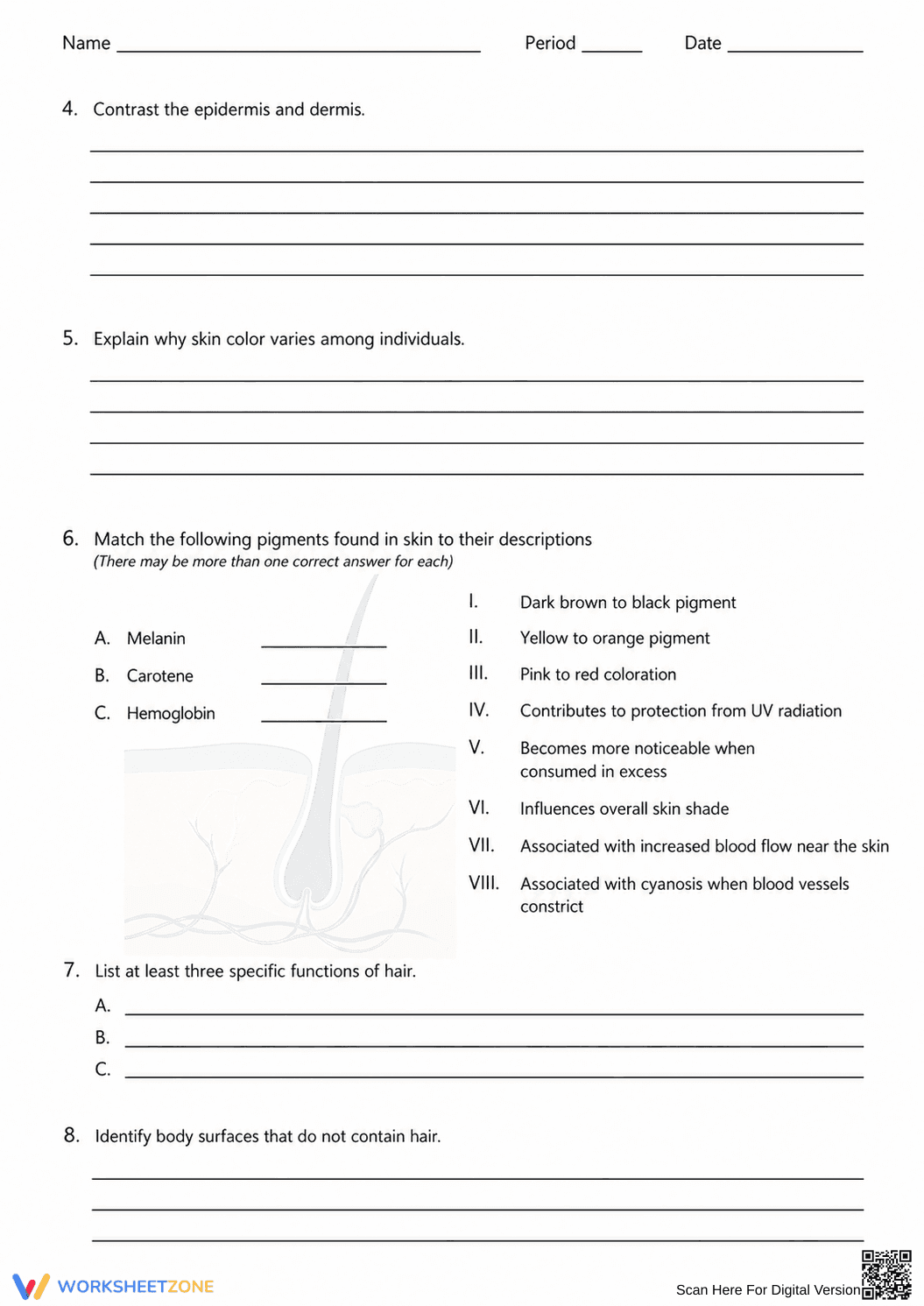
This comprehensive worksheet helps students master the integumentary system by exploring skin pigmentation, hair functions, and anatomical structures. By contrasting skin layers and identifying key pigments, learners will develop a clear understanding of how these biological components protect and regulate the human body.
At a Glance
- Grade: 6 · Subject: Science
- Standard:
MS-LS1-3— Understand how the body is a system of interacting subsystems- Skill Focus: Integumentary system anatomy
- Format: 3 pages · 12 problems · Answer key included · PDF
- Best For: Independent practice and review
- Time: 25–35 minutes
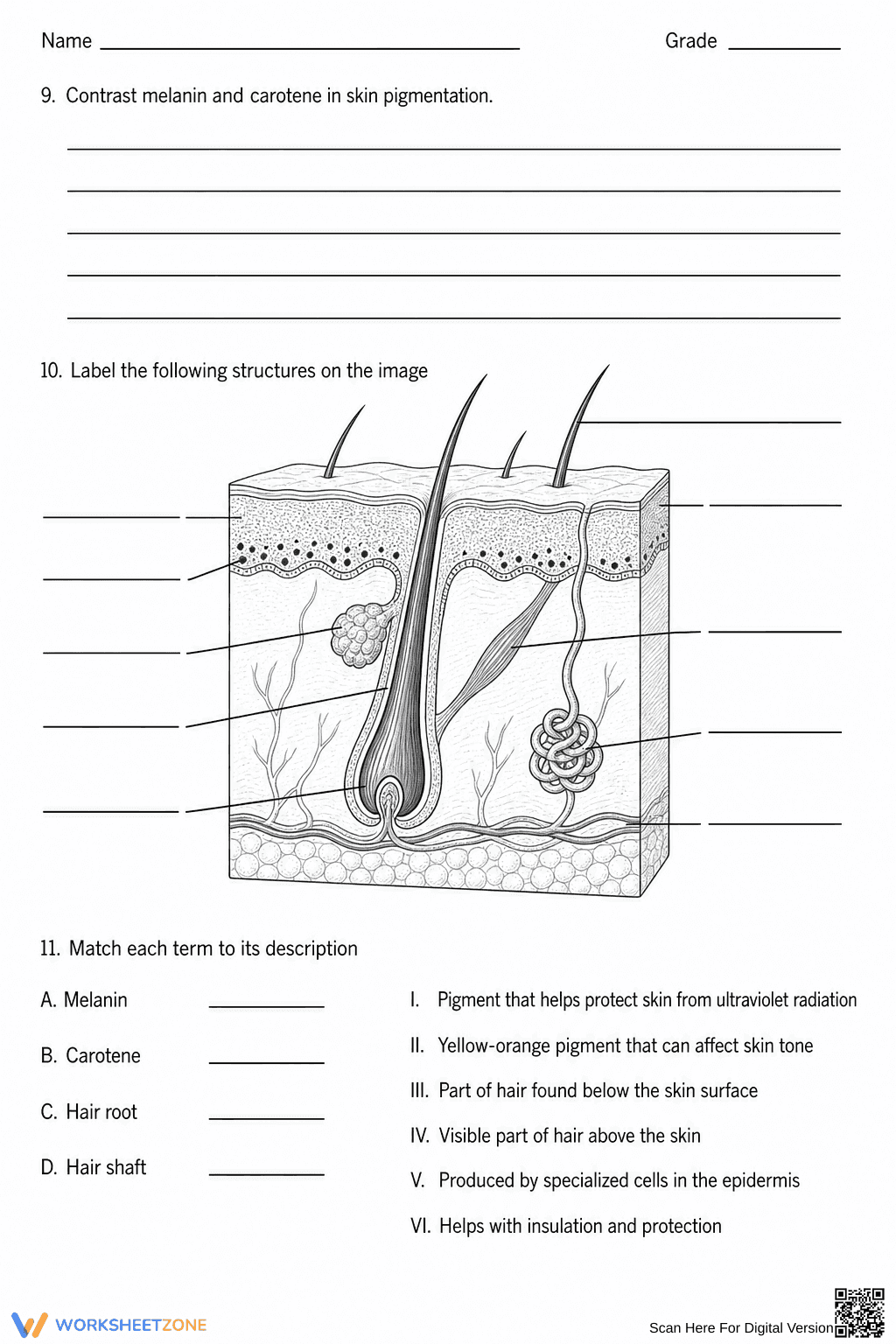
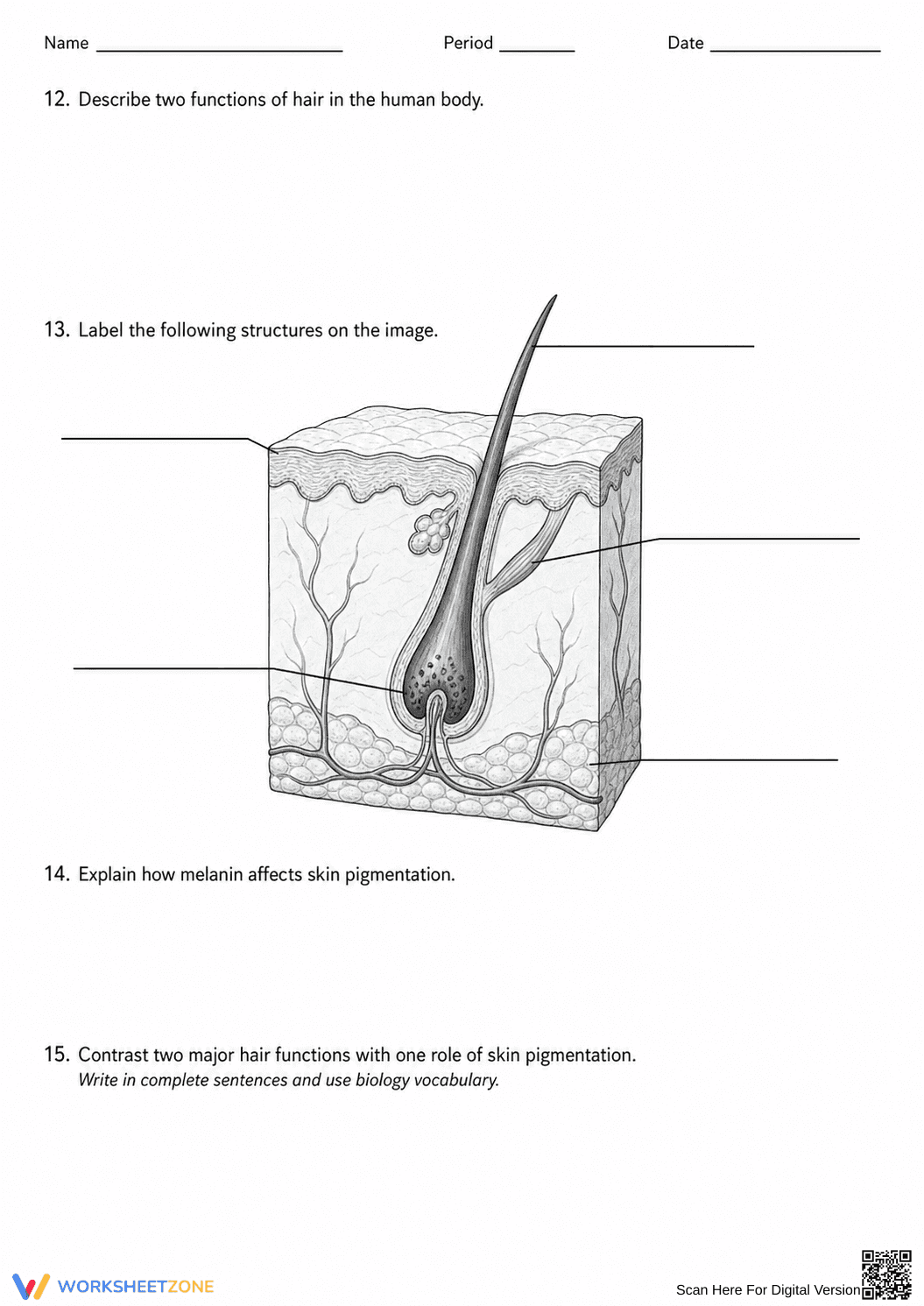
Inside this resource, educators will find three pages of targeted biology practice. The worksheet features a mix of 12 distinct tasks, including short-answer contrast questions, matching exercises for skin pigments like melanin and carotene, and detailed anatomical labeling diagrams of the skin and hair follicles. A complete answer key is provided to ensure accurate grading and quick feedback.
This resource is designed for a smooth, zero-prep classroom experience:
- Print (1 minute): Simply print the three-page PDF and the accompanying answer key.
- Distribute (1 minute): Hand out the worksheets to students after your introductory biology lesson.
- Review (3 minutes): Use the included key to quickly check student diagrams and matching responses.
With under two minutes of total teacher prep time, this assignment is highly suitable for emergency sub plans or independent study stations.
This material is aligned to the Next Generation Science Standards, specifically MS-LS1-3: "Use argument supported by evidence for how the body is a system of interacting subsystems composed of groups of cells." It reinforces the concept that the integumentary system works alongside other body systems to maintain homeostasis. Both standard codes can be copied directly into lesson plans, IEP goals, or district curriculum mapping tools.
Teachers can deploy this worksheet during direct instruction as a guided activity, or assign it as independent homework after a lecture on human body systems. As a formative assessment tip, monitor how accurately students label the dermis and epidermis on the cross-section diagrams to gauge their spatial understanding of tissue layers. Expected completion time ranges from 25 to 35 minutes depending on the student's familiarity with biology vocabulary.
This activity is primarily designed for middle school science students in grades 6 through 8 studying human anatomy. To support differentiation, teachers can provide a word bank for the labeling sections to assist English language learners or students needing extra scaffolding. It pairs perfectly with a 3D anatomical model demonstration or an introductory slide deck on human physiology.
Effective science instruction requires students to actively engage with anatomical models and biological vocabulary to build lasting comprehension. According to EdReports 2024, high-quality science materials must provide students with multiple, varied opportunities to connect structure and function within complex biological systems. This worksheet directly supports that pedagogical goal by requiring learners to label detailed diagrams and explain physiological processes in their own words. By aligning with the MS-LS1-3 standard, the activity ensures students understand how the body is a system of interacting subsystems. Explicitly teaching the functions of melanin, carotene, and hair follicles helps demystify complex human biology concepts for younger learners. Providing structured practice with clear visual aids reduces cognitive load, allowing students to focus entirely on mastering the specific mechanisms of the integumentary system rather than struggling with the assignment format.


