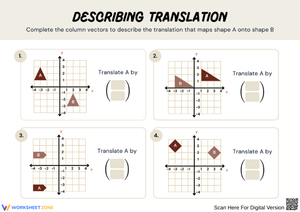
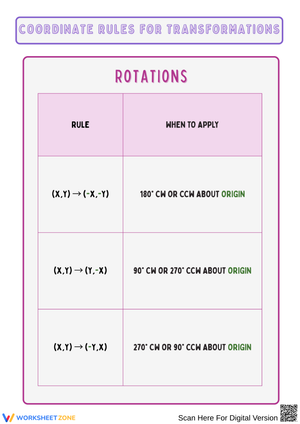
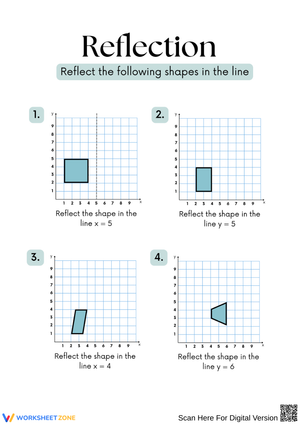
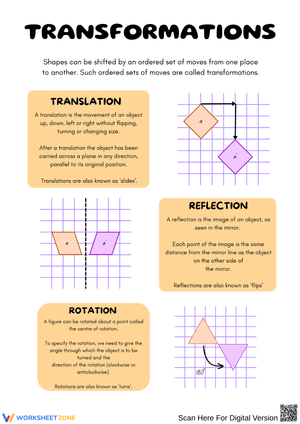
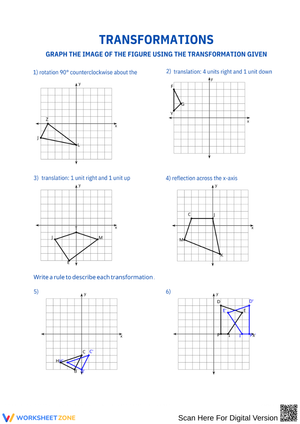
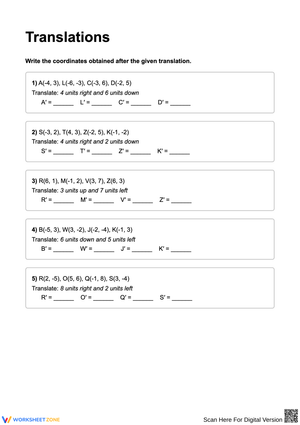
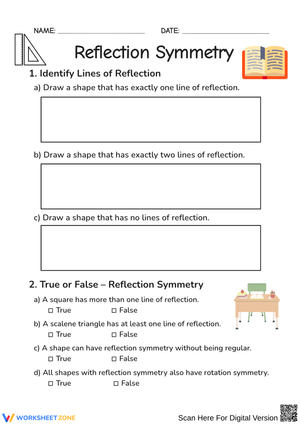
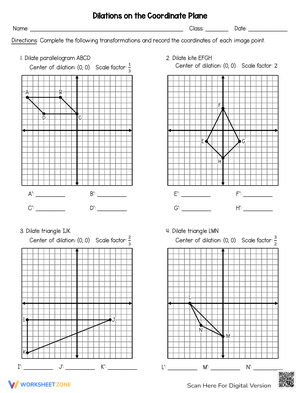
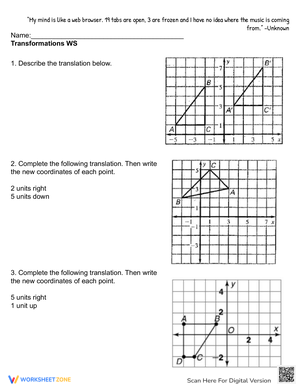
These 8th grade transformations printable worksheets give geometry teachers a concrete, low-prep way to build student fluency with translations, reflections, rotations, and dilations on the coordinate plane. What separates useful transformation practice from filler problems is whether students are asked to do something mathematical — graph a figure, write the coordinate rule, justify an image — rather than simply name a movement they've already memorized. Each worksheet in this set asks students to do both: work visually on a coordinate grid and articulate the underlying math in writing.
Specific Skills Each Worksheet Targets
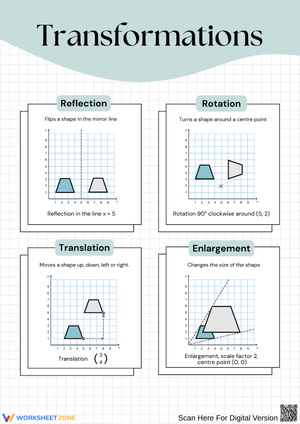
Eighth grade is the first time most students are expected to connect a visual transformation to a precise coordinate rule, and the jump from "slide right" to (x, y) → (x + 4, y) trips up more students than teachers expect. Each worksheet addresses one or more of the following:
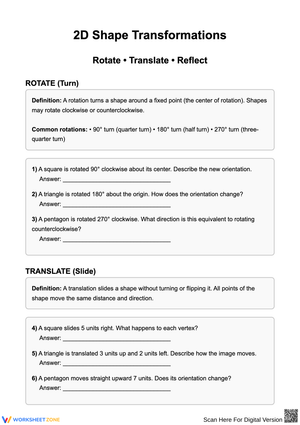
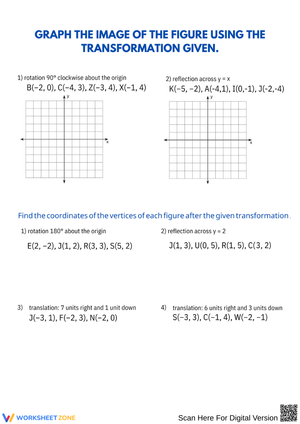
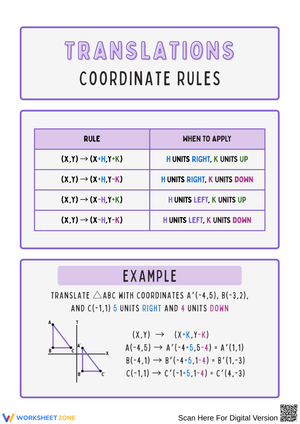
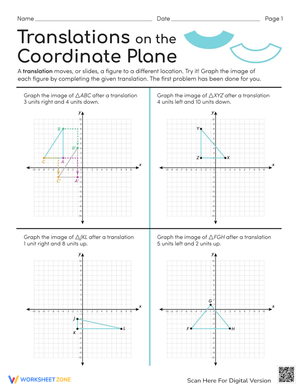
- Translations: Students plot translated images and write coordinate rules using horizontal and vertical shift values, moving between verbal descriptions and algebraic form in the same problem.
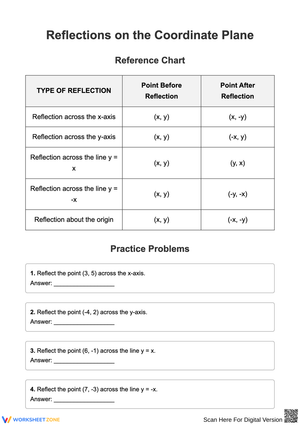
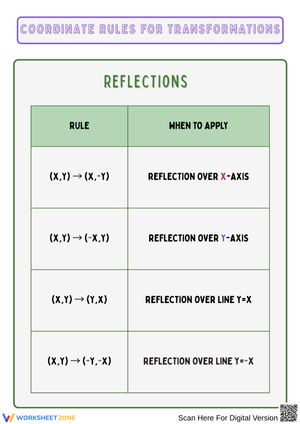
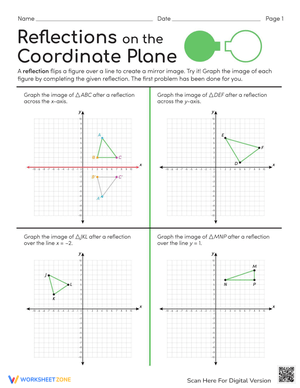
- Reflections: Worksheets cover reflection across both axes and across y = x and y = −x — the two lines that generate the most persistent confusion during late-unit review.
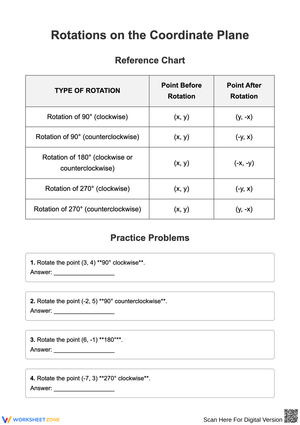
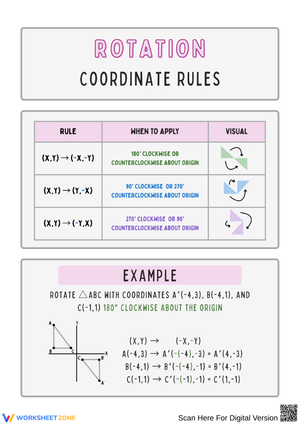
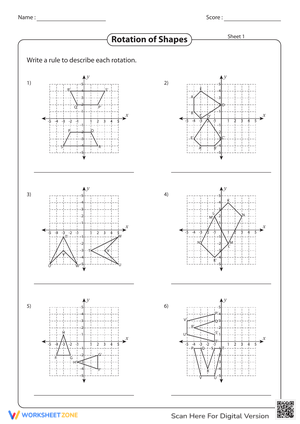
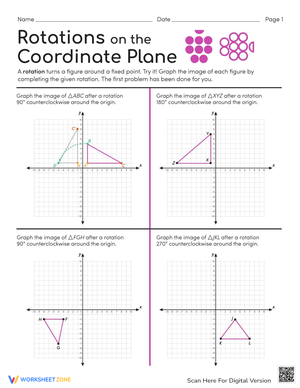
- Rotations: Students rotate figures 90°, 180°, and 270° about the origin, recording the coordinate change for each degree measure. Some worksheets include rotation about a non-origin point for students ready for that extension.
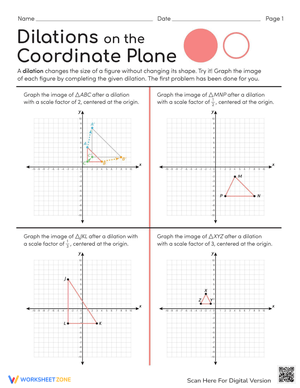
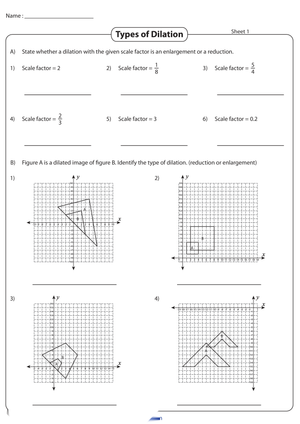
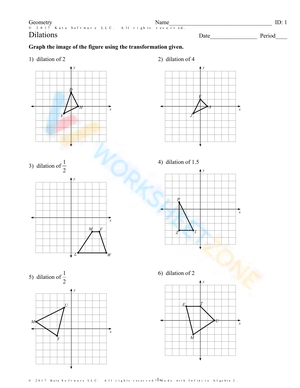
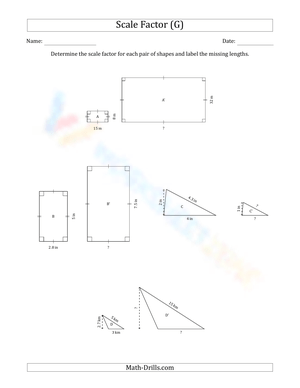
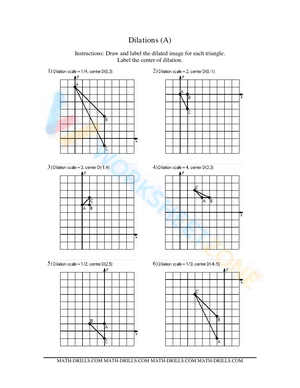
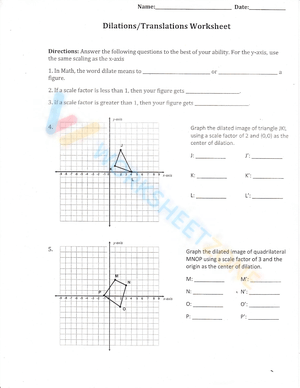
- Dilations: Students apply scale factors greater than 1 and between 0 and 1 to enlarge and reduce figures, then confirm whether the resulting image and preimage qualify as similar figures.
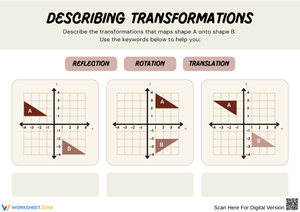
- Sequences of transformations: Later worksheets ask students to apply two transformations in order and then consider whether reversing that sequence produces the same image — a task that surfaces genuine conceptual understanding rather than procedural recall alone.
Mixed-review worksheets appear throughout the set. On those, students identify the transformation type first, then graph the image or write the rule — forcing them to move between recognition and application rather than drilling one skill in isolation.
Mistakes Students Make That These Worksheets Help You Catch
Transformation errors in eighth grade fall into predictable patterns, and catching them on paper before a unit test changes what reteaching looks like. The most persistent involves reflections across y = x: students who can reflect correctly across the axes will often write image coordinates in the form (y, x) but then plot the point using the original order, arriving at the wrong location with no visible sense that anything went wrong. A related error appears with y = −x, where students negate one coordinate instead of both before swapping — they complete two of the three required steps and end up with a wrong image they believe is correct.
Rotation errors have their own character. Students frequently conflate 90° clockwise with 90° counterclockwise because they are rarely asked to state their chosen direction explicitly before computing. On printed work, the error is immediately visible: the image lands in the wrong quadrant. That is far more informative than a circled wrong answer on a multiple-choice test. The 180° rotation tends to be more accurate because negating both coordinates aligns with student intuition about "going through the origin," but that accuracy can mask whether students understand the transformation or are just following a memorized sign change.
Dilation creates a different problem. When the center of dilation is the origin, most students can multiply coordinates by the scale factor and get a correct result. Move the center to a point like (2, 3) and the error rate climbs sharply — students omit the step of measuring distance from the center and instead multiply the coordinates directly. Seeing this on a worksheet in week two of the unit is far more useful than seeing it on the unit test.
Building These Worksheets Into Your Lesson Sequence
The most efficient use of these resources is to sort them by the type of thinking they require, not just by transformation topic. Keep three categories ready: graphing tasks, coordinate rule writing, and identification with justification. When a quick formative check on Tuesday shows the class can graph rotations but cannot produce the corresponding rule, you can assign the right worksheet that afternoon without reorganizing your whole plan. 8th grade transformations printable worksheets work best when they match the specific gap in front of you, not just the position in a pacing guide.
A few routines fit these worksheets naturally. Using one as a bell ringer in the 8 to 10 minutes after morning announcements gives students quiet graphing time before the lesson begins and gives teachers a fast read on who still needs support from the day before. During guided practice, working through the first two problems alongside the class before releasing students to finish independently reduces mid-class confusion because those opening problems establish what notation should look like. At the end of a unit, a mixed-review worksheet assigned as a partner task lets students surface and discuss coordinate discrepancies before those discrepancies show up on a test.
Standard Alignment
These worksheets align to CCSS 8.G.A, specifically standards 8.G.A.1 through 8.G.A.4. Standard 8.G.A.3 is the procedural core: it requires students to describe the effects of translations, rotations, and reflections using coordinate notation — the skill most directly practiced across the majority of these worksheets. Standards 8.G.A.1 and 8.G.A.2 address the properties that rigid transformations preserve (angle measure, segment length, parallelism) and the definition of congruence in terms of those transformations. The dilation worksheets connect directly to 8.G.A.4, which asks students to explain similarity relationships using scale factor.
In practical terms, 8.G.A.3 is where the hardest teaching lives. Students are expected to produce coordinate rules, not just visualize movement. Worksheets that ask students to graph the image and write the coordinate rule in the same problem align most directly to that standard's intent — and provide the most diagnostic information when collected and reviewed.
Adjusting the Set for a Range of Learners
The range of readiness in a typical eighth grade math class is wide enough that a single worksheet often serves very different purposes depending on who is holding it. For teachers navigating that variation, 8th grade transformations printable worksheets in this set offer a clear path from procedural entry points to conceptual extension without requiring two completely separate assignment stacks.
Students who need additional support do better starting with single-quadrant graphs and one transformation per problem. A reference card listing the coordinate rule for each transformation type reduces the demand of recalling notation from memory and lets those students focus on plotting points accurately. Once they can reliably graph a reflection or rotation from the rule, remove the card and ask them to produce the rule on their own.
On-level students use worksheets that combine transformation types and include short written-explanation prompts — something like "Explain how you know this is a rotation and not a reflection" — which push students to use precise vocabulary in context rather than just getting correct coordinates. For students ready for more, the sequences-of-transformations worksheets and tasks asking whether two different transformation paths produce the same final image provide genuine challenge without just adding more graphing volume.
Frequently Asked Questions
Which transformation types do these worksheets cover?
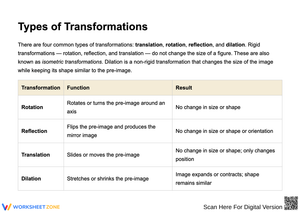
Each worksheet covers one or more of the four transformations addressed in the Grade 8 geometry standard: translation, reflection, rotation, and dilation. The set includes skill-focused practice for each type as well as mixed-review worksheets that combine identification, graphing, and coordinate rule writing in the same assignment.
Do the worksheets include coordinate grids, or do students need graph paper?
Every worksheet includes pre-printed coordinate grids sized for the graphing tasks in that assignment. Students do not need separate graph paper. Grid squares are large enough for accurate point plotting — a detail that matters more than it sounds, because cramped grids produce graphing errors that have nothing to do with students' understanding of the transformation itself.
Are answer keys included?
Answer keys are included for every worksheet in the set. Teachers use them for fast feedback during circulation, for student self-correction during partner activities, and in small-group reteach sessions where checking work immediately reinforces the teaching point rather than leaving errors to sit overnight.
Can these worksheets support spiral review and test prep alongside regular instruction?
The mixed-review worksheets reflect the way transformation questions appear on standardized assessments — students identify, apply, and justify across multiple transformation types in the same assignment rather than working through a single skill at a time. Teachers use those 8th grade transformations printable worksheets during spiral review weeks or as targeted assignments in the final stretch before end-of-year assessments, assigning specific worksheets to students based on which transformation types still show errors in their independent work.













 Interactive Worksheet Maker
 Quiz Maker
 Word Search Maker
 Crossword Puzzle Maker
 Word Scramble Generator
 Sentence Scramble Generator
 Handwriting Worksheet Generator
 Name Tracing Generator
 Fill In The Blank Generator