8th Grade Translations printable worksheets for Geometry Practice
These 8th grade translations printable worksheets resources give math teachers a focused, ready-to-use set of coordinate plane practice that spans the full range of translation skills — from sliding polygons across a grid to writing and interpreting algebraic rules. The set includes grids with enough room to label points clearly, which matters more than it sounds: tight grid space is one of the first things that turns a conceptual gap into a careless-looking error.
What Students Practice Across the Set
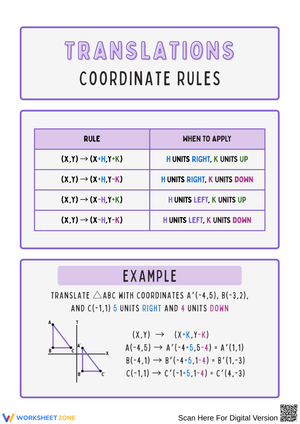
Translation lands at an interesting place in the Grade 8 geometry progression. Students have worked with coordinate planes since sixth grade, so plotting ordered pairs is not new. What is new is treating the coordinate system as a precise language for describing movement — a shift from "the shape moved over there" to a formal statement like (x, y) → (x - 3, y + 4). Each worksheet in the set targets one or more of the skills that build toward that precision.
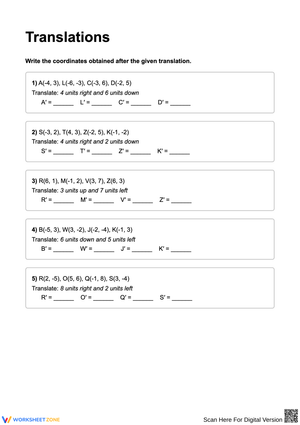
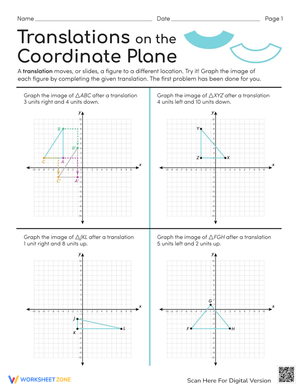
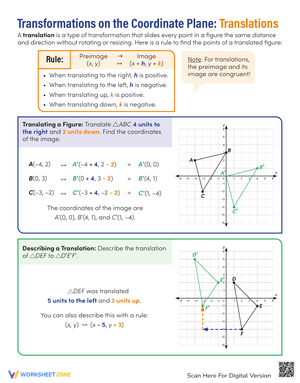
- Grid translation: Students translate a polygon left, right, up, or down by a stated number of units and label the resulting image using prime notation.
- Rule interpretation: Students read a translation rule and sketch where the image lands, moving from the algebraic form back to the graph.
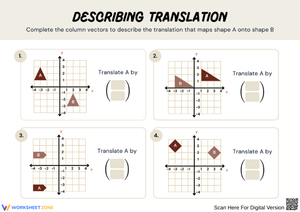
- Rule derivation: Students compare a pre-image and image on a labeled grid, then write the rule that describes the movement.
- Congruence verification: Students confirm that the image preserves side lengths and angle measures from the pre-image — not just that it looks the same.
- Error analysis: Students examine a worked problem with a deliberate mistake — typically a sign error or an axis mix-up — and explain the correction in writing.
That last task type does work the graphing items cannot do alone. A student who plots translations accurately can still be following a surface procedure without understanding what the rule is actually saying. Error-analysis items reveal that distinction quickly.
Mistakes Students Make That Teachers Need to See Coming
The most persistent error is axis confusion when both values in a rule carry signs. A student reading (x, y) → (x - 5, y + 2) will frequently apply the negative five to the y-coordinate instead of the x, or interpret "minus five" as rightward movement because subtraction feels like "less than" rather than "direction." The result is a pentagon in the wrong location — still a polygon, still the right size — so students rarely self-correct. The shape looks plausible. Only a coordinate check catches it.
A second cluster of errors shows up in the counting itself. Students place a finger on a vertex, count carefully, and still record the endpoint one unit off because they treat the starting square as "one" rather than beginning their count from the next square. On grids with small cells, this compounds across a multi-point figure. The finished graph looks only slightly off, which is hard to explain without pulling up the coordinates directly. Worksheets that include a "before and after" table — where students record every vertex in both positions — surface this error in a way a finished graph alone does not.
A third problem emerges when students confuse transformations. A student who rotates the figure ninety degrees will produce a congruent shape with the same side lengths, so a visual check misses the error entirely. Having students verify that the horizontal and vertical difference between each pair of corresponding vertices is identical across the whole figure — not just one vertex — catches this reliably.
How to Build These Worksheets Into Your Lesson Plans
The two- or three-item versions work well in the first five minutes of class, especially early in a transformation unit when students need daily contact with coordinate notation before it becomes automatic. A fuller worksheet with rule-writing tasks fits naturally after direct instruction — students have enough direction to work independently, and the teacher can circulate and listen before anyone reaches for an answer key.
A routine worth building into every problem: before translating, students draw one horizontal arrow and one vertical arrow on the figure and label each with the corresponding change from the rule. This two-arrow habit separates the movements in working memory and cuts the axis-swap errors described above by a noticeable margin. It takes roughly thirty seconds per problem and shows up in cleaner, more consistent work within a few days of use.
These 8th grade translations printable worksheets resources also work well during small-group sessions paired with tracing paper. Students trace the pre-image and physically slide it to the image position, experiencing the definition of a translation — same direction, same distance, every point — before formalizing it with notation. That physical step reaches students who are technically accurate with coordinates but have not yet connected the rule to what is happening to the shape.
For homework, a mixed worksheet with one grid problem, one rule-writing problem, and one error-analysis item gives a reliable window into what held from the lesson. The error-analysis question is particularly useful as a next-day planning signal: a student who catches the sign error quickly has internalized the rule structure; a student who agrees with the wrong work needs a different entry point the following day.
Adjusting the Set for a Range of Learners
For students still building coordinate plane fluency, start with worksheets that use only positive coordinates and single-direction moves — right 4, up 3 — before introducing negative values in the rule. Printing those worksheets at 115 percent gives students more grid space and reduces the fine-motor frustration that can pull attention away from the math during independent practice.
Students ready for deeper work benefit most from inverse translation tasks: write the rule, graph the image, then write the rule that moves the image back to the original position. This requires genuine reasoning about what the rule means — particularly the relationship between adding and subtracting the same integer — rather than executing a stated movement. That level of thinking does not surface in standard plotting tasks.
Sorting 8th grade translations printable worksheets resources into three readiness bands — guided practice with vocabulary support, on-level rule-writing tasks, and extension problems requiring inverse or multi-step moves — keeps the whole class working on the same concept while adjusting the entry point. Students are all practicing translations; what differs is the complexity of the movement and how much of the notation work is already set up for them.
Standard Alignment
These worksheets address CCSS 8.G.A.1 and 8.G.A.3. Standard 8.G.A.1 asks students to verify experimentally the properties of rigid transformations — specifically that translations preserve lengths, angle measures, and parallelism. Standard 8.G.A.3 asks students to describe the effect of translations on coordinates. In classroom terms, these two standards work together naturally: students graph the translation (8.G.A.3) and then confirm that the image retains the pre-image's measurements (8.G.A.1). A worksheet that asks students to both graph and verify covers both standards without doubling the lesson time.
Frequently Asked Questions
What do students need to know before these worksheets are useful?
Students need to plot ordered pairs accurately in all four quadrants, understand positive and negative integers as directions on a number line, and distinguish horizontal from vertical movement. Without those foundations, the algebraic rule form is noise. A five-minute pre-check — three or four coordinate plotting prompts on a blank grid — tells a teacher whether students are ready to work through the set or need a brief prerequisite review first.
How do students learn to write a translation rule from a graph?
The most reliable approach is to isolate a single vertex. Take one point on the pre-image — say (2, -1) — and its corresponding image point — say (-1, 3). Ask how far the x-coordinate changed and how far the y-coordinate changed. Once students confirm those two values for one point and verify them against a second vertex, they have enough information to write (x, y) → (x - 3, y + 4) with confidence. Worksheets that include a structured coordinate table make this comparison process visible and keep students from skipping the verification step.
How do these worksheets help students tell translations apart from other transformations?
Translations preserve orientation — the figure does not turn or flip, and every corresponding vertex shifts the same amount in the same direction. Students confirm this by checking that the horizontal and vertical changes between corresponding points are identical across all vertices. If those differences vary from vertex to vertex, a different transformation occurred. Several worksheets include figures where students must determine whether a movement qualifies as a translation, which makes that reasoning explicit rather than assumed.
Can these worksheets support intervention for students who missed the unit?
The 8th grade translations printable worksheets set includes enough variation in difficulty that intervention teachers can pull the simpler grid tasks — single quadrant, whole-number moves, figures with fewer vertices — and use them without modification. Those worksheets pair well with a brief direct re-explanation of horizontal versus vertical change before students attempt the rule-writing tasks independently.
Clear All