


























1 / 4
0
Views
0
Downloads



0.0
0
Save
0 Likes
Share
Reflection on the Coordinate Plane: Shapes and Transformations Worksheet
0 Views
0 Downloads
Paste this activity's link or code into your existing LMS (Google Classroom, Canvas, Teams, Schoology, Moodle, etc.).
Students can open and work on the activity right away, with no student login required.
You'll still be able to track student progress and results from your teacher account.
Information
Description
What It Is:
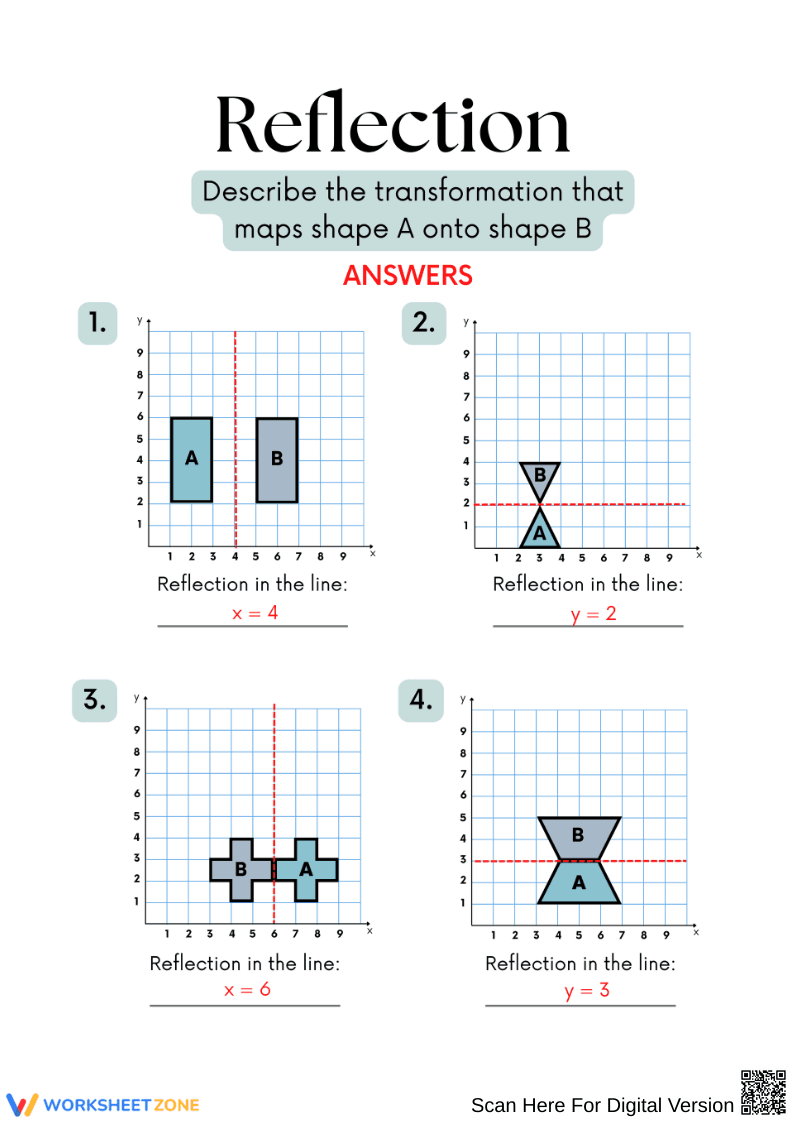
A practice worksheet that helps students understand how to reflect shapes across given lines on the coordinate plane. Students work with visual grids and geometric figures as they reflect shapes across vertical and horizontal lines, including x = 5, y = 5, x = 4, and y = 6. A second task challenges students to describe the specific reflection that maps one shape onto another, reinforcing conceptual understanding through real examples.
Why Use It:
This worksheet strengthens students’ understanding of reflections as rigid transformations. By observing how figures move across lines of reflection, students develop spatial reasoning, symmetry awareness, and confidence in working with coordinate geometry. The visuals make abstract concepts concrete, while the transformation descriptions promote deeper reasoning and vocabulary use.
How to Use It:
• Have students reflect each shape across the indicated line using the coordinate grid.
• Encourage checking by counting units from the line of reflection.
• Use the second section for discussion about how shapes move under reflections.
• Extend by asking students to write coordinate rules or create their own reflection problems.
Grade Suitability:
Best suited for Grades 5–8.
• Ideal for introducing reflections in middle school geometry.
• Useful reinforcement for students preparing for more advanced transformation work.
Target Users:
Teachers, tutors, homeschooling families, and students learning how to reflect shapes and describe reflections on the coordinate plane.
A practice worksheet that helps students understand how to reflect shapes across given lines on the coordinate plane. Students work with visual grids and geometric figures as they reflect shapes across vertical and horizontal lines, including x = 5, y = 5, x = 4, and y = 6. A second task challenges students to describe the specific reflection that maps one shape onto another, reinforcing conceptual understanding through real examples.
Why Use It:
This worksheet strengthens students’ understanding of reflections as rigid transformations. By observing how figures move across lines of reflection, students develop spatial reasoning, symmetry awareness, and confidence in working with coordinate geometry. The visuals make abstract concepts concrete, while the transformation descriptions promote deeper reasoning and vocabulary use.
How to Use It:
• Have students reflect each shape across the indicated line using the coordinate grid.
• Encourage checking by counting units from the line of reflection.
• Use the second section for discussion about how shapes move under reflections.
• Extend by asking students to write coordinate rules or create their own reflection problems.
Grade Suitability:
Best suited for Grades 5–8.
• Ideal for introducing reflections in middle school geometry.
• Useful reinforcement for students preparing for more advanced transformation work.
Target Users:
Teachers, tutors, homeschooling families, and students learning how to reflect shapes and describe reflections on the coordinate plane.


