


























1 / 4
0
Views
0
Downloads


0.0
0
Save
0 Likes
Share
Transformations on the Coordinate Plane: Graphing Practice Worksheet
0 Views
0 Downloads
Paste this activity's link or code into your existing LMS (Google Classroom, Canvas, Teams, Schoology, Moodle, etc.).
Students can open and work on the activity right away, with no student login required.
You'll still be able to track student progress and results from your teacher account.
Information
Description
What It Is:
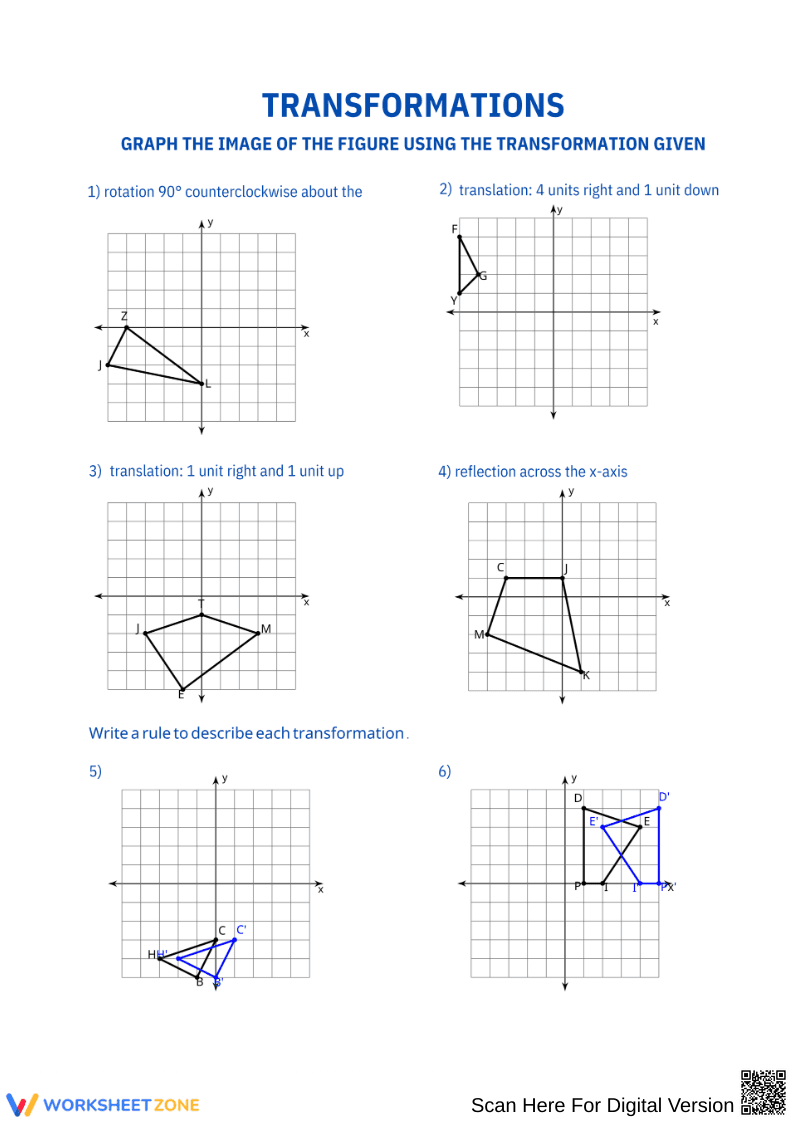
A structured worksheet that guides students through performing geometric transformations directly on the coordinate plane. Students graph the images of figures after applying rotations, translations, and reflections. Each problem includes a clear transformation rule and coordinate grid, allowing learners to visualize how shapes move, turn, and flip across axes. Open-ended items at the end ask students to write transformation rules, reinforcing conceptual understanding.
Why Use It:
This worksheet builds confidence in recognizing and applying rigid transformations—rotation, reflection, and translation. Students deepen their spatial reasoning skills by working with real coordinate grids rather than abstract rules alone. The mixed problem set prepares students for geometry standards involving congruence, mapping figures, and describing transformations using precise mathematical language.
How to Use It:
• Review rotation, reflection, and translation rules before students begin.
• Have students graph the original figure, then carefully plot each transformed vertex.
• Encourage accuracy by checking distances and orientation before connecting points.
• Use the open-ended rule-writing questions to strengthen vocabulary and symbolic notation.
• Extend learning by asking students to create their own transformations for a partner to solve.
Grade Suitability:
Best suited for Grades 6–9.
• Ideal for middle school geometry units on congruence and transformations.
• Supports Algebra I students learning transformations of geometric figures and functions.
Target Users:
Teachers, tutors, and students practicing how to graph and describe transformations on the coordinate plane.
A structured worksheet that guides students through performing geometric transformations directly on the coordinate plane. Students graph the images of figures after applying rotations, translations, and reflections. Each problem includes a clear transformation rule and coordinate grid, allowing learners to visualize how shapes move, turn, and flip across axes. Open-ended items at the end ask students to write transformation rules, reinforcing conceptual understanding.
Why Use It:
This worksheet builds confidence in recognizing and applying rigid transformations—rotation, reflection, and translation. Students deepen their spatial reasoning skills by working with real coordinate grids rather than abstract rules alone. The mixed problem set prepares students for geometry standards involving congruence, mapping figures, and describing transformations using precise mathematical language.
How to Use It:
• Review rotation, reflection, and translation rules before students begin.
• Have students graph the original figure, then carefully plot each transformed vertex.
• Encourage accuracy by checking distances and orientation before connecting points.
• Use the open-ended rule-writing questions to strengthen vocabulary and symbolic notation.
• Extend learning by asking students to create their own transformations for a partner to solve.
Grade Suitability:
Best suited for Grades 6–9.
• Ideal for middle school geometry units on congruence and transformations.
• Supports Algebra I students learning transformations of geometric figures and functions.
Target Users:
Teachers, tutors, and students practicing how to graph and describe transformations on the coordinate plane.


