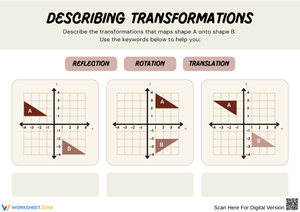
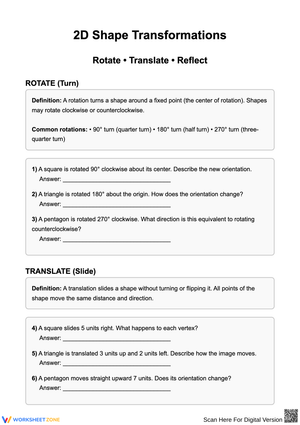
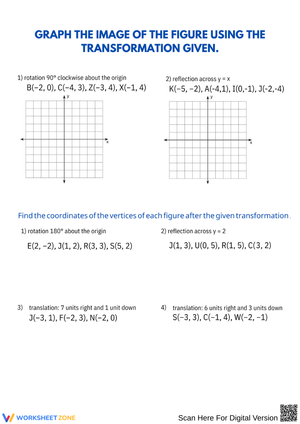
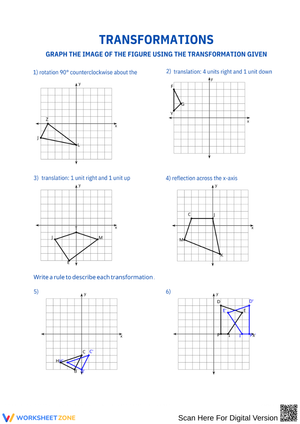
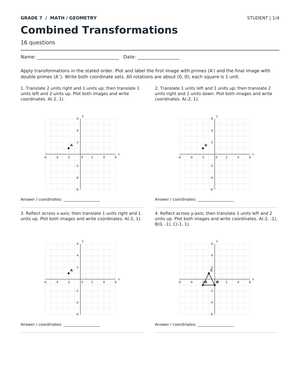
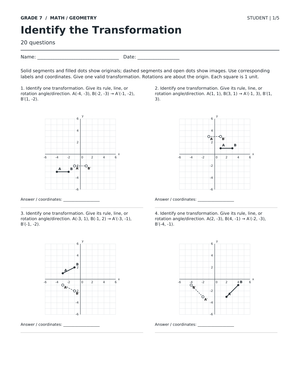
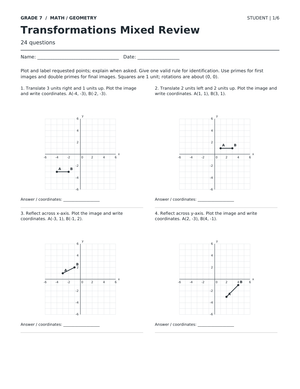
Translation rotation reflection worksheets for 8th grade push students past visual pattern-matching into genuine coordinate work — graphing preimages and images on a labeled axis, writing rules in coordinate notation, and explaining in precise mathematical language why a figure's size and shape stay the same through each motion.
At this grade level, the skill gap that separates students who understand rigid transformations from those who are stuck is almost always language. A student who can slide a triangle three units right on a grid but cannot write the rule (x, y) → (x + 3, y) is missing the piece of the standard that matters most for what comes next. These worksheets pair visual tasks with written tasks because one without the other leaves that gap in place.
The Specific Skills Targeted
Each worksheet in the set builds one or more of four core practices Grade 8 students need to develop:
- Identifying the transformation — students examine a preimage and image, then name the motion and justify their answer using coordinates or a description of orientation.
- Graphing the image — given a preimage and a stated rule, students plot the resulting figure accurately on a coordinate grid, vertex by vertex.
- Writing the rule or description — students produce coordinate notation for translations, name the angle and direction for rotations, and identify the line of reflection.
- Error analysis — students examine a worked example containing a mistake and explain the error, which typically reveals whether their own understanding is solid or borrowed from a procedure they half-remember.
The mix of problem types across the set matters. Students who only graph without ever writing a rule can match the right diagram without building the algebraic thinking they will need when transformation notation appears on standardized assessments or connects to later similarity work.
Mistakes Students Make That These Worksheets Help You Catch
The most persistent confusion in Grade 8 transformation units is treating a reflection across the x-axis and a 180° rotation around the origin as interchangeable. They are not — a 180° rotation maps (x, y) to (−x, −y), negating both coordinates, while a reflection across the x-axis maps (x, y) to (x, −y), negating only the y-coordinate. Students who guess based on how the figure "looks" rather than checking individual vertex coordinates will get this wrong repeatedly. Error-analysis prompts are the fastest way to surface that confusion before a unit quiz makes it permanent.
Rotation direction produces a second reliable mistake. When a problem specifies a 90° counterclockwise rotation, students who memorized a clockwise shortcut frequently apply it backwards and produce a 270° result. The correction — anchor the rule to the origin, verify one vertex, then complete the figure — is straightforward once the error is named, but worksheets with explicit direction prompts are what make it visible in the first place.
Reflection tasks carry their own specific trap: students correctly identify the line of reflection but measure distance along the axis rather than perpendicular to it. When reflecting a point across the line y = 2, some students count two units left or right instead of up or down. Grids with clear tick marks and problems that ask students to mark the perpendicular distance before plotting the image cut this error significantly.
Building These Worksheets Into Your Weekly Lesson Plan
A four-day progression works well for most Grade 8 classes. Day one: translation practice with graphing and rule-writing, where the only decision is horizontal shift, vertical shift, or both. Day two: rotation worksheets with explicit attention to angle and direction — problems require students to write "90° counterclockwise" rather than simply drawing an arrow. Day three: reflection tasks focused on identifying the line of reflection and verifying equal perpendicular distance on both sides. Day four: a mixed-review worksheet where students must decide which transformation applies before graphing anything. That decision step is where the real thinking lives.
Translation rotation reflection worksheets for 8th grade also adapt well to station work. A three-station setup works: one station for graphing given a rule, one for identifying and naming the transformation from a diagram, and one for correcting a worked error. The written record from each station is easy to compare across groups when you are diagnosing which type of motion needs a follow-up mini-lesson — and it generates the same evidence as independent practice while keeping students active.
One concrete teacher move worth adding to any of these routines: ask students to highlight one matching vertex pair before they begin graphing the full image. It forces a commitment to direction and distance before the rest of the figure goes down, which slows the visual guessing that leads to avoidable rotation and reflection errors.
Standard Alignment
These worksheets address CCSS 8.G.A.1, 8.G.A.2, and 8.G.A.3. Standard 8.G.A.1 establishes the property that translations, rotations, and reflections preserve line lengths and angle measures — the definition of a rigid motion that students will return to when they justify congruence. Standard 8.G.A.2 asks students to describe sequences of these transformations between congruent figures, which requires both graphing accuracy and precise descriptive language. Standard 8.G.A.3 specifies using coordinates to describe the effect of each transformation, and that is exactly where the rule-writing tasks in this set are directed.
In classroom terms, 8.G.A.3 tends to drive pacing decisions more than the other two because it requires students to produce a coordinate rule, not simply recognize one. That production demand is where repeated written practice on a worksheet matters more than a single class demonstration or a one-time digital tool.
Adjusting the Set for Mixed-Ability Classrooms
Translation rotation reflection worksheets for 8th grade are practical to differentiate because the core task — graphing on a coordinate plane — adjusts in several concrete ways without changing the underlying mathematics. For students who struggle with coordinate plotting, assign worksheets with larger grids, figures with three or four vertices rather than five or six, and problems that state the rule explicitly rather than requiring students to derive it. Accurate graphing with correct vocabulary is the target at this level; algebraic reasoning about the rule comes with more experience.
For students ready to move beyond single-step problems, extend the work with tasks that chain two transformations: reflect a triangle across the y-axis, then translate the image four units down, then identify the coordinate notation for the combined effect. Ask these students to write a brief argument for why a given transformation produces a congruent figure, pointing to specific side lengths or angle measures as evidence. That kind of written justification previews the reasoning they will need in high school geometry without pulling them outside Grade 8 content.
Students who land in the middle — graphing accurately but writing incomplete descriptions — benefit from sentence frames attached to rule-writing prompts: "This is a ___ because the figure moved ___ in direction and the orientation ___." That structure keeps the written task from stalling without giving the answer away.
Frequently Asked Questions
How are these worksheets different from a typical geometry review sheet?
Most transformation review sheets ask students to graph one type of motion in isolation. The worksheets in this set include both isolated-type practice and mixed-review items where students must identify which transformation applies before graphing anything. That identification step is where the real thinking happens, and it is the step most standard review sheets skip entirely.
Do students need prior experience with coordinate notation before starting?
Students should be comfortable plotting ordered pairs and reading coordinates from a labeled grid. Formal coordinate notation for transformation rules — such as (x, y) → (x + a, y + b) — is introduced through the worksheet tasks themselves, so extensive prior instruction is not required, but basic coordinate plane fluency is.
What is the most efficient way to use these worksheets as a formative check?
Collect the mixed-review worksheet at the end of a transformation sequence and sort student work into three groups: those who graphed correctly and wrote a clear rule, those who graphed correctly but left the description vague or blank, and those who made graphing errors. Those three groups need different follow-up, and the written record from translation rotation reflection worksheets for 8th grade makes that sorting take roughly ten minutes rather than requiring a separate quiz period.
Are answer keys included with each worksheet?
Yes. Each worksheet includes a complete answer key with plotted images and written rule examples. The answer keys for error-analysis problems include an explanation of what the original mistake was and why the correction works, so teachers can use them to lead a brief class discussion rather than simply marking answers right or wrong.













 Interactive Worksheet Maker
 Quiz Maker
 Word Search Maker
 Crossword Puzzle Maker
 Word Scramble Generator
 Sentence Scramble Generator
 Handwriting Worksheet Generator
 Name Tracing Generator
 Fill In The Blank Generator