




























0
Views
0
Downloads

0.0
0
Save
0 Likes
Share
Describing Transformations on the Coordinate Plane Worksheet
0 Views
0 Downloads

Paste this activity's link or code into your existing LMS (Google Classroom, Canvas, Teams, Schoology, Moodle, etc.).
Students can open and work on the activity right away, with no student login required.
You'll still be able to track student progress and results from your teacher account.
Information
Description
What It Is:
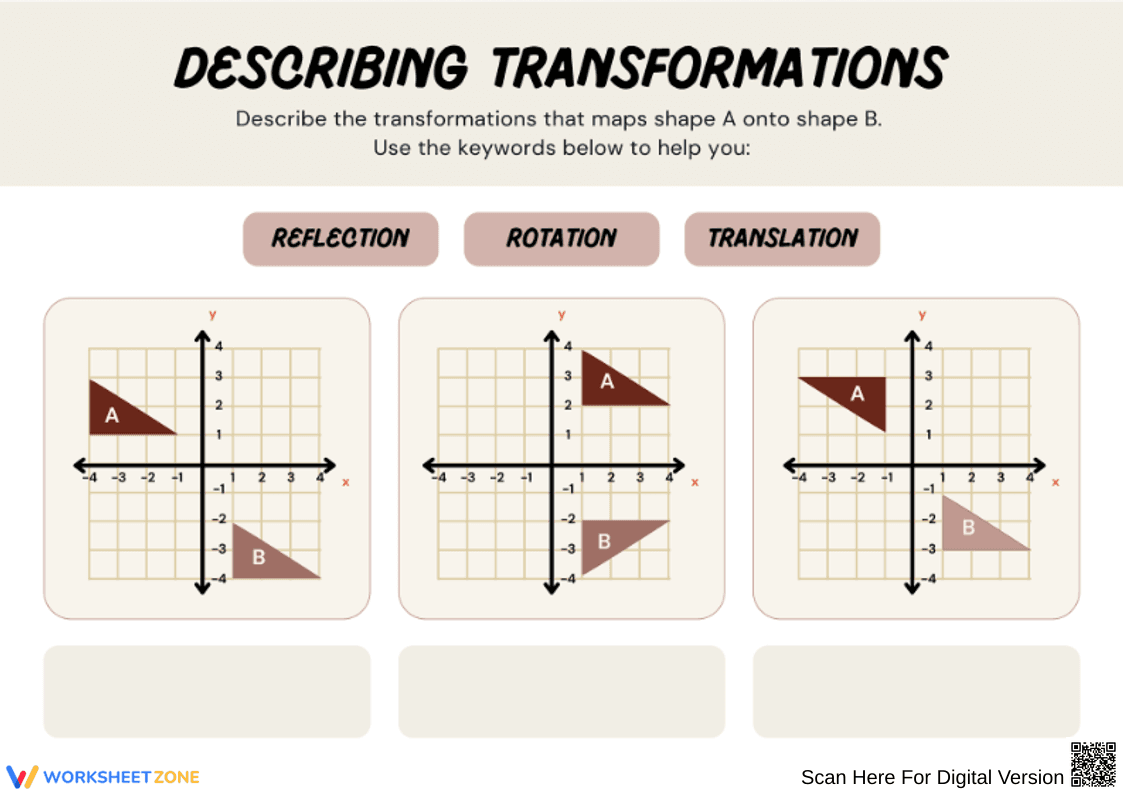
A visual, student-friendly worksheet that teaches learners how to describe transformations on the coordinate plane. Students analyze how Shape A maps onto Shape B in three different scenarios and identify whether the transformation is a reflection, rotation, or translation. Each example includes a clearly labeled coordinate grid, making it easy to observe movement, orientation, and symmetry.
Why Use It:
This worksheet builds essential geometry skills by helping students recognize and describe rigid transformations. Students deepen their understanding of how figures change position while maintaining size and shape. It strengthens vocabulary—such as reflection, rotation, and translation—and prepares learners for more advanced concepts like congruence, sequences of transformations, and geometric proofs.
How to Use It:
• Review transformation keywords with students before beginning the activity.
• Have students compare Shape A and Shape B in each grid and identify the type of transformation shown.
• Encourage students to describe the transformation using precise mathematical language (e.g., "reflected over the x-axis," "rotated 90° clockwise about the origin," "translated 4 units right and 3 units down").
• Allow students to sketch optional guidelines or arrows to visualize movement.
• Use the worksheet as guided practice, stations work, homework, or an assessment warm-up.
Grade Suitability:
Best suited for Grades 6–9.
• Excellent for middle school units on transformations and congruence.
• Supports Algebra I students learning function transformations and coordinate rules.
Target Users:
Teachers, tutors, and students studying geometric transformations on the coordinate plane.
A visual, student-friendly worksheet that teaches learners how to describe transformations on the coordinate plane. Students analyze how Shape A maps onto Shape B in three different scenarios and identify whether the transformation is a reflection, rotation, or translation. Each example includes a clearly labeled coordinate grid, making it easy to observe movement, orientation, and symmetry.
Why Use It:
This worksheet builds essential geometry skills by helping students recognize and describe rigid transformations. Students deepen their understanding of how figures change position while maintaining size and shape. It strengthens vocabulary—such as reflection, rotation, and translation—and prepares learners for more advanced concepts like congruence, sequences of transformations, and geometric proofs.
How to Use It:
• Review transformation keywords with students before beginning the activity.
• Have students compare Shape A and Shape B in each grid and identify the type of transformation shown.
• Encourage students to describe the transformation using precise mathematical language (e.g., "reflected over the x-axis," "rotated 90° clockwise about the origin," "translated 4 units right and 3 units down").
• Allow students to sketch optional guidelines or arrows to visualize movement.
• Use the worksheet as guided practice, stations work, homework, or an assessment warm-up.
Grade Suitability:
Best suited for Grades 6–9.
• Excellent for middle school units on transformations and congruence.
• Supports Algebra I students learning function transformations and coordinate rules.
Target Users:
Teachers, tutors, and students studying geometric transformations on the coordinate plane.


