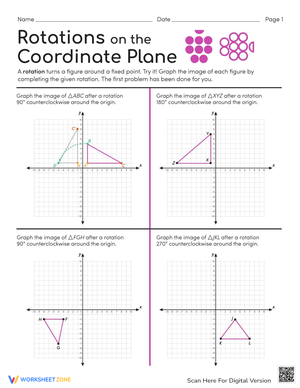
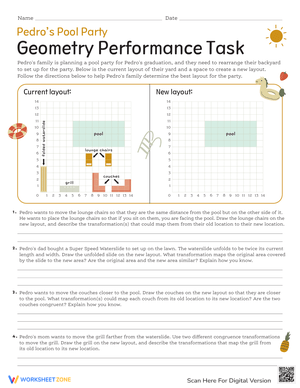
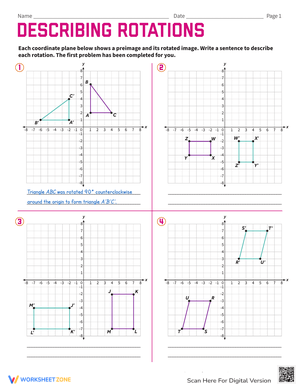
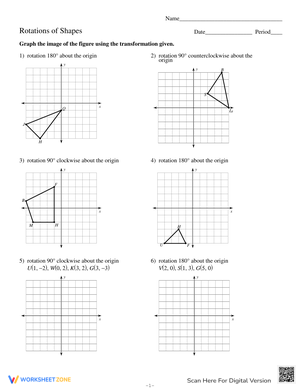
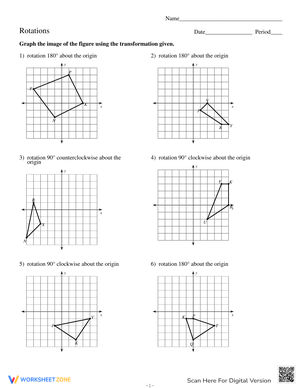
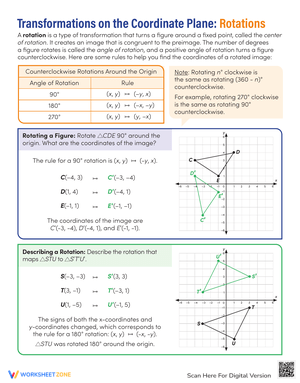
These 8th grade rotations printable worksheets pair coordinate-rule practice with graphing tasks so students have to do both — not just apply (x, y) → (−y, x) but also plot the image and confirm it looks like a turn, not a flip. Rotation ranks among the harder transformation concepts in Grade 8 partly because the rules for 90° clockwise and 90° counterclockwise look nearly identical until a student slows down and traces the actual movement. Each worksheet in the set is built to make that slowing-down happen.
Skills Each Worksheet Builds
The core competencies here follow a natural progression: students first identify rotations from a diagram — naming angle, direction, and center — before moving into coordinate problems that require applying rules and graphing results. That order matters because students who skip the visual identification phase tend to apply rules blindly, and a wrong rule applied with confidence produces an image that looks completely reasonable until someone actually checks the coordinates.
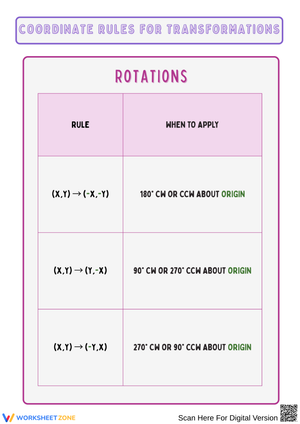
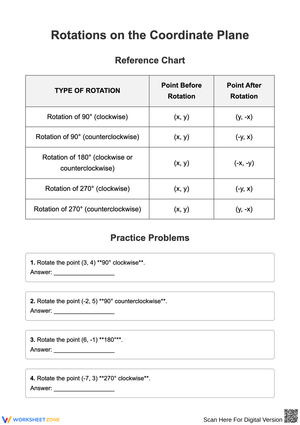
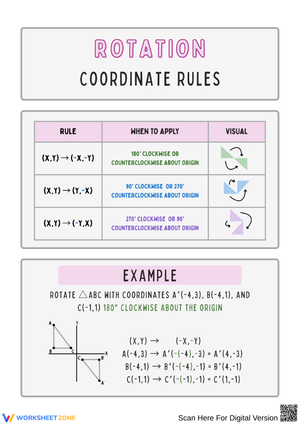
The three rotations Grade 8 students work with most are 90° clockwise, 90° counterclockwise, and 180° about the origin. A 90° clockwise rotation maps (x, y) to (y, −x). A 90° counterclockwise rotation maps (x, y) to (−y, x). A 180° rotation maps (x, y) to (−x, −y). Many teachers also include 270° problems because students who recognize that a 270° counterclockwise turn produces the same image as a 90° clockwise turn are thinking structurally, not just procedurally.
- Direction and angle identification from diagrams, completed before any coordinate work begins
- Ordered-pair rule application for all three standard rotation types, with space to show each step
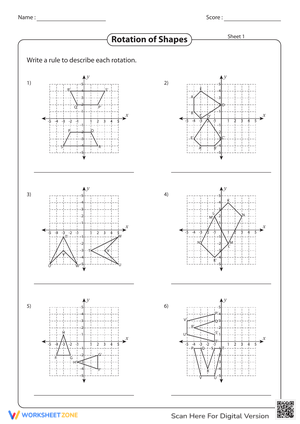
- Pre-image and image graphing on labeled coordinate planes
- Transformation comparison items where students distinguish rotations from reflections and translations
- Short written explanations asking students to state why the image remains congruent to the original figure
The written explanation items are worth protecting even when time is tight. They reveal whether a student can articulate that rotation changes position and orientation but not size or shape — or whether they are pattern-matching on coordinate notation alone.
Errors Worth Watching For and Addressing
The most persistent mistake is the clockwise/counterclockwise reversal. A student who can recite the 90° counterclockwise rule may still plot the image in the wrong quadrant because they memorized a formula without ever physically tracing the turn. The second most common problem is rule contamination from reflection work: both transformations involve changing signs and swapping coordinate positions in certain cases, and students who have recently drilled reflections often carry that logic into rotation problems without noticing the difference.
Two other errors show up consistently in student work:
- Assuming the origin is always the center of rotation: Students who have only practiced origin-centered problems apply origin rules even when the center is labeled at a different point. The image lands in the wrong location entirely, and without a graph to check, the student has no way to catch it.
- Trusting the formula without plotting: Students who record coordinates without graphing miss the moment when the image is visibly on the wrong side of the plane. One look at a plotted result would catch the error; the rule check alone will not.
A simple intervention that works: after students finish a graphing item, ask them to draw a small curved arrow from one pre-image vertex to its image. That physical gesture forces confirmation of turn direction before they move forward, and it gives teachers visible evidence of how the student is thinking — not just what they wrote down.
Standard Alignment
These worksheets address CCSS 8.G.A.3, which asks students to describe the effect of rotations, reflections, translations, and dilations using coordinates. In classroom terms, rotation typically comes after students have worked with translations and reflections, because the coordinate rules are more complex and the visual confirmation is harder to apply without a foundation in transformation properties generally. The problems in this set are sequenced to meet 8.G.A.3 at full depth — students connect the algebraic rule to the graphical result rather than treating notation and graphing as separate, unrelated tasks.
How to Fit These Worksheets Into Your Weekly Plans
Short bell ringers are where 8th grade rotations printable worksheets earn some of their most reliable use. Two or three identification items — angle, direction, center — take under eight minutes and give teachers an immediate read on whether students retained key vocabulary from the previous lesson. That information shapes the opening stretch of class: whether to address a widespread confusion, clarify one sticking point, or move directly into new content.
During guided practice, a useful structure is to have students complete each graphing item and then compare image coordinates with a partner before moving to the next problem. That brief comparison catches sign errors and direction reversals early, without requiring a full class interruption. For independent work, pull a worksheet that mixes rule application with graphing — that combination forces students to connect notation to the visual model rather than treating them as parallel but unrelated activities.
Before a quiz or unit assessment, a mixed review worksheet covering all three rotation types plus a few short written explanation items gives students practice with both procedural fluency and transformation vocabulary. Teachers who run this kind of review during the last 15 minutes of a class period often find it moves faster than expected — students have already processed the rules through earlier practice, so the review functions as confirmation rather than first exposure.
Calibrating the Set for a Range of Learners
For students still building fluency with signed numbers, isolate the 180° rotation first. The rule (x, y) → (−x, −y) is the most symmetrical of the three and tends to produce fewer sign errors than the 90° variants, making it a stable entry point. Using a larger printed grid — where each square represents one unit and students can count spaces cleanly — also reduces the working memory demand before they are ready to handle coordinate notation and visual tracking at the same time.
Students who have internalized all three standard rotation rules benefit from reversal problems: given a pre-image and an image, determine which rotation was applied. That task requires working backwards through coordinate relationships and is considerably harder than applying a rule that was given. A further extension pairs rotation with comparison — after rotating a figure 90° counterclockwise, ask whether a specific reflection would produce the same image. Sometimes it does, sometimes it does not, and reasoning through why builds a more flexible understanding of transformation properties than rule practice alone can develop.
Frequently Asked Questions
What rotation rules do Grade 8 students need to know?
The standard set covers three rotations about the origin: 90° clockwise (x, y) → (y, −x); 90° counterclockwise (x, y) → (−y, x); and 180° (x, y) → (−x, −y). Many teachers also include 270° counterclockwise, which maps (x, y) to (y, −x) — the same result as 90° clockwise. That equivalence is worth making explicit in class because students who notice it are reasoning about rotation rather than just retrieving a memorized pattern. Students should always connect each rule to a graphed result.
How do I help students keep clockwise and counterclockwise straight?
Consistent physical reference before any coordinate work. Have students trace the turn with a finger, say the direction aloud, and draw a curved arrow on the diagram before writing a single coordinate. On each worksheet, protect one or two items where students must label the direction before they apply the rule. That extra step slows down the guessing that causes most direction errors — and when students skip it, the error pattern in their work makes that visible quickly.
Can these worksheets be used for students who haven't kept pace with the unit?
Yes. Pull worksheets that cover one rotation type at a time and use them in small-group sessions alongside a physical aid — tracing paper, a transparency, or a cardstock cutout — so students can rotate the figure by hand and then check that their coordinate work matches the physical result. The 8th grade rotations printable worksheets in this set include enough directional language and worked example space that a student working with a paraprofessional or in a pull-out setting can follow the task without needing a separate instruction sheet alongside it.
How are these different from reflection worksheets, and should I use them together?
Reflection worksheets focus on flipping a figure across a line — the y-axis, x-axis, or y = x — while rotation worksheets focus on turning a figure around a fixed point. Both preserve congruence, but the movement and the coordinate rule structure differ enough that students who mix them produce images in completely wrong positions. That said, mixed review worksheets combining both transformation types are worth using after each concept has been taught separately, because distinguishing between them is part of what 8.G.A.3 requires. The 8th grade rotations printable worksheets that include a transformation identification component — where students must determine what kind of transformation occurred rather than apply a given rule — directly prepare students for that more demanding, discriminating thinking.













 Interactive Worksheet Maker
 Quiz Maker
 Word Search Maker
 Crossword Puzzle Maker
 Word Scramble Generator
 Sentence Scramble Generator
 Handwriting Worksheet Generator
 Name Tracing Generator
 Fill In The Blank Generator