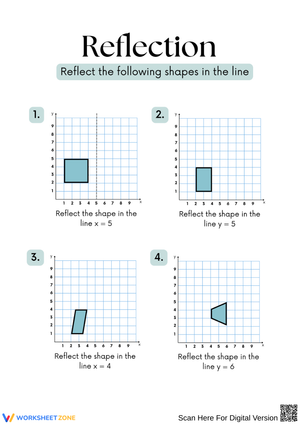
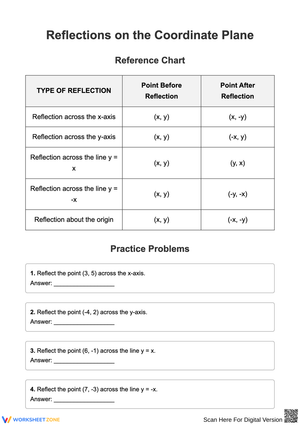
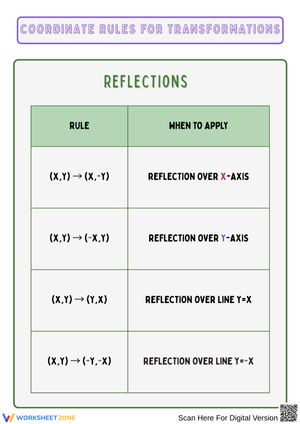
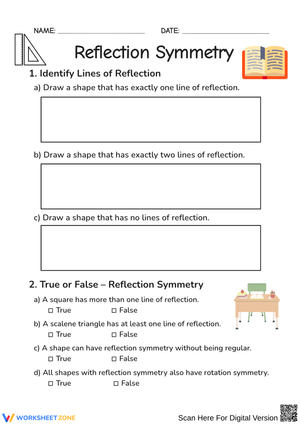
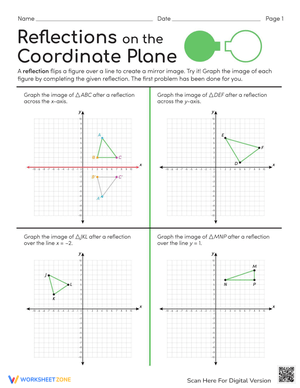
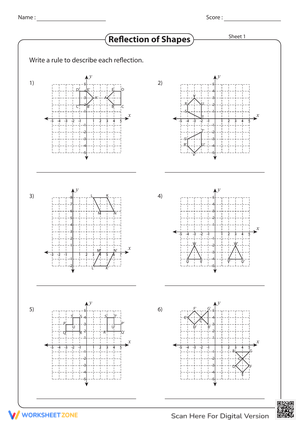
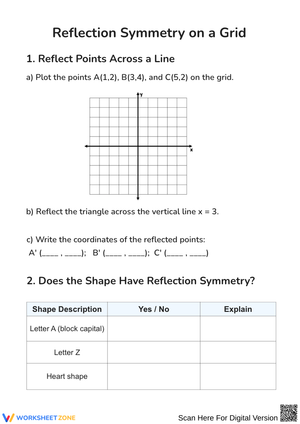
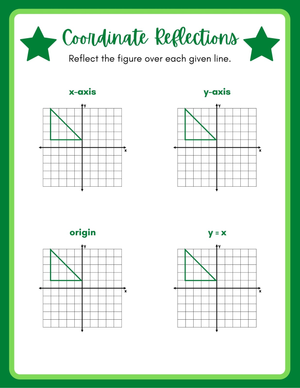
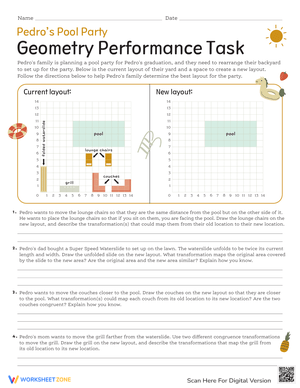
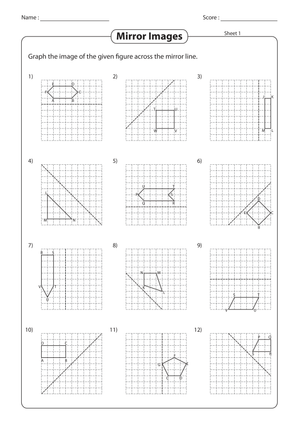
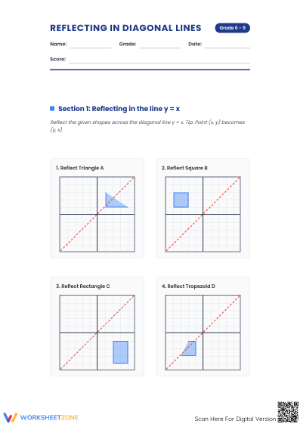
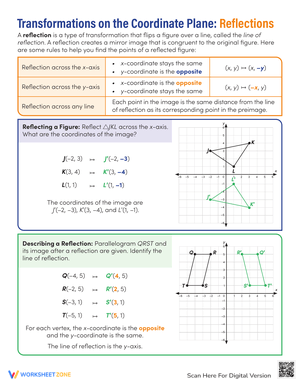
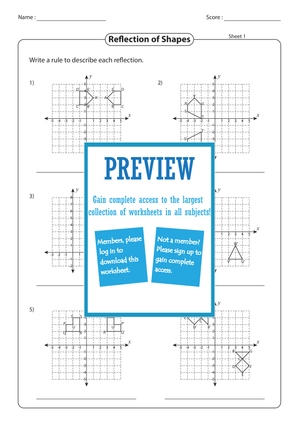
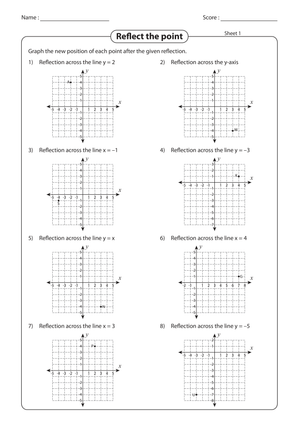
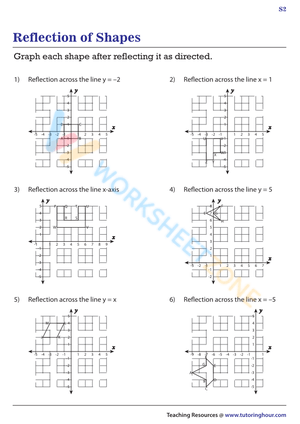
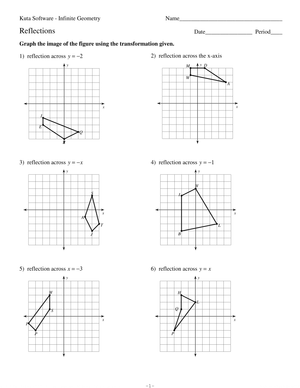
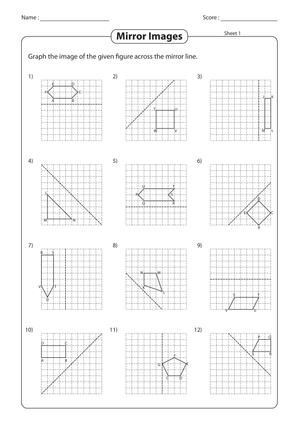
These reflections worksheets for 8th grade give students focused coordinate-plane practice reflecting points and polygons across the x-axis, y-axis, y = x, and y = −x — the four standard lines that cover the bulk of what 8.G.A.3 expects at this level. Each worksheet is print-ready, and the set progresses from single-point tasks to problems where students identify the line of reflection from a completed graph, working backward through the coordinate rule.
What Students Work Through Across the Set
The set opens with single-point problems, and the reasoning behind that choice is deliberate. Applying the rule to one coordinate pair before touching a polygon lowers the cognitive load enough that students can focus on getting the rule right rather than managing the graph simultaneously. Once the rule is automatic for a point, applying it to every vertex of a triangle or quadrilateral becomes a much smaller step.
From there, the worksheets build complexity in a clear order:
- Reflecting polygons over the x-axis and y-axis, with students labeling image vertices using prime notation (A', B', C')
- Reflecting over y = x and y = −x, where the coordinate swap trips students who have been applying axis rules by rote
- Identifying the line of reflection when both pre-image and image are already graphed
- Writing the algebraic coordinate rule that describes a given reflection
- Verifying congruence by computing side lengths before and after the transformation
- Reflecting over non-standard lines like x = 3 or y = −2, which require distance reasoning rather than a memorized formula
Standard Alignment
The reflections worksheets for 8th grade target CCSS 8.G.A.3, which requires students to describe the effects of reflections on two-dimensional figures using coordinates and to recognize that the image is congruent to the pre-image. In classroom terms, this standard sits right after students have worked with the coordinate plane in 6th grade and just before composite transformations appear in 8th grade geometry. The coordinate rules need to be automatic — not just procedurally correct under guidance — before students can handle multi-step transformation problems without losing track of which operation does what.
Where Student Work on Reflections Most Often Breaks Down
The most stubborn error involves confusing the x-axis and y-axis rules. Students who have reduced the concept to "negate a coordinate" frequently negate the x-value when reflecting over the x-axis, producing (−x, y) instead of (x, −y). The visible result is a reflected image in the wrong quadrant — it looks like a y-axis reflection. Catching this on single-point problems, before polygon work begins, prevents the error from hardening into a habit that survives all the way to the unit test.
The y = x reflection generates a separate and persistent problem. The coordinate swap — (x, y) becomes (y, x) — doesn't match the negation pattern students associate with reflections, so they'll negate instead of swap, or do both. A quick sketch showing that the point (2, 5) sits the same distance from the line y = x as (5, 2) usually does more work than re-explaining the algebraic rule from scratch.
Polygon problems reveal a third error that single-point work masks: students apply the rule correctly to two or three vertices and then estimate the remaining ones visually rather than running each coordinate pair through the rule. The resulting image looks approximately right but has distorted side lengths. Worksheets that ask students to verify congruence by computing distances catch this — one incorrectly placed vertex shows up immediately in the measurement step.
Working These Worksheets Into Your Geometry Unit
A brief physical demonstration at the start of the unit — folding a piece of paper along the x-axis to show how a plotted point lands directly on its image — takes about three minutes and substantially reduces confusion on the first independent worksheet. The reflections worksheets for 8th grade then function cleanly across a week: guided single-rule practice early in the week, partner work on the y = x problems mid-week, and independent mixed practice by Thursday or Friday. The exit-ticket worksheets in the set give quick, specific data on which coordinate rule is still breaking down for which students before the class moves on to rotations or composite transformations.
In a block period, the set supports a simple split: students who demonstrate early fluency on axis reflections move to extension work on non-standard lines, while others continue building accuracy with the four standard rules. The visual structure of the coordinate grids and labeled reference boxes on early worksheets give students enough to self-check and keep working without the teacher at every table.
Tiering the Practice for Different Student Readiness Levels
Students who are still uncertain about coordinate plane basics — which quadrant holds a negative x-value paired with a positive y-value, how to plot a fractional coordinate — need the reference box on early worksheets kept visible longer than the pacing guide might suggest. Accuracy with the reflection rule is the priority; pulling the reference too soon for struggling students trades short-term compliance for longer-term confusion. On-level students work through the standard sequence without modification. For students ready to go further, the reflections worksheets for 8th grade covering non-standard lines like x = 3 and y = −2 require genuine distance reasoning rather than formula recall — and adding a written explanation component ("explain in your own words why the coordinates swap over y = x") separates students with geometric understanding from those operating on a memorized procedure.
Frequently Asked Questions
What are the four coordinate rules students need to know?
Over the x-axis, (x, y) becomes (x, −y). Over the y-axis, (x, y) becomes (−x, y). Over y = x, the coordinates swap: (x, y) becomes (y, x). Over y = −x, the result is (−y, −x). Early worksheets include these as a printed reference. Later worksheets remove it so students are recalling from memory rather than locating a formula on the page.
How does a reflection differ from a rotation or translation?
All three are rigid transformations that preserve distance and shape. A translation shifts every point the same distance in the same direction without turning. A rotation turns the figure around a fixed point. A reflection flips the figure over a line, producing a mirror image — and unlike the other two, it reverses the figure's orientation. That orientation reversal is the practical distinction students need to hold onto, and it's why a reflected letter "R" looks like a backward "R."
When in the unit should I introduce the worksheets?
The introductory worksheets belong on days two or three of the unit — after students have seen coordinate rules modeled but before they've done substantial independent practice. The mixed-practice and extension worksheets work better mid-unit, after at least one full class period working through each reflection line with some direct guidance. Using the exit-ticket worksheets at the end of each instructional day keeps formative data current without taking time away from instruction.
Do the worksheets include reflections over non-standard lines?
Yes. Extension worksheets in the set cover reflections over vertical lines such as x = 3 and horizontal lines such as y = −2. These problems require students to count perpendicular distance from the line rather than apply a stored coordinate formula, which makes them a reliable check on whether understanding is genuine or strictly procedural.













 Interactive Worksheet Maker
 Quiz Maker
 Word Search Maker
 Crossword Puzzle Maker
 Word Scramble Generator
 Sentence Scramble Generator
 Handwriting Worksheet Generator
 Name Tracing Generator
 Fill In The Blank Generator