




























Views
Downloads
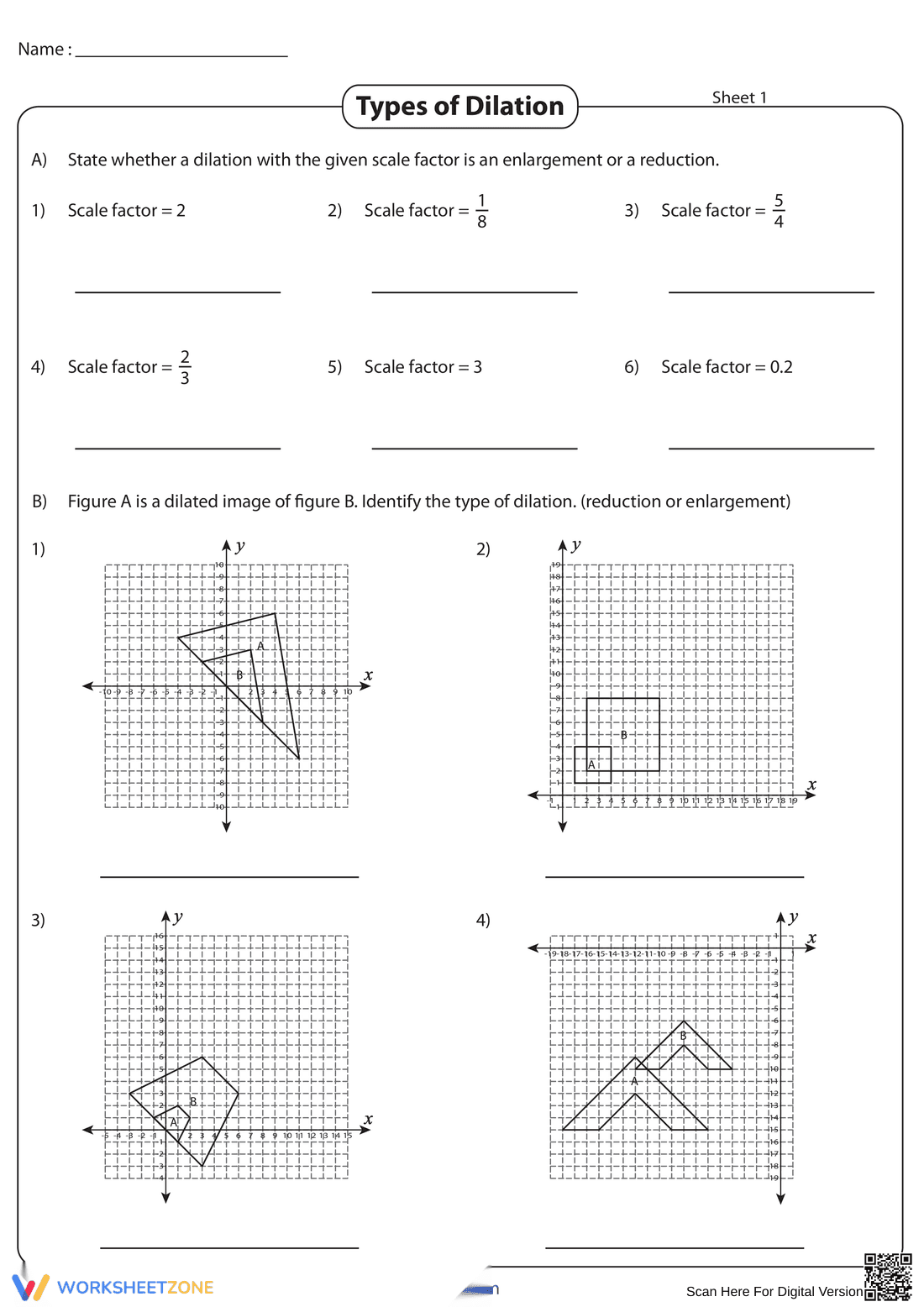

Identifying Dilations Worksheet | Essential Grade 8 Math

Paste this activity's link or code into your existing LMS (Google Classroom, Canvas, Teams, Schoology, Moodle, etc.).
Students can open and work on the activity right away, with no student login required.
You'll still be able to track student progress and results from your teacher account.
This geometry worksheet helps eighth-grade students master identifying types of dilation by analyzing scale factors and coordinate graphs. Students determine whether a geometric transformation results in an enlargement or a reduction. By completing these exercises, learners build the foundational spatial reasoning required for advanced similarity and scale factor calculations in high school geometry.
At a Glance
- Grade: 8 · Subject: Geometry
- Standard:
8.G.A.3— Describe the effect of dilations on two-dimensional figures using coordinates- Skill Focus: Identifying dilation types (enlargement vs. reduction)
- Format: 1 page · 10 problems · Answer key included · PDF
- Best For: Quick homework or independent practice
- Time: 15–20 minutes
This single-page PDF resource contains ten structured problems divided into two distinct sections. Section A features six algebraic questions where students evaluate scale factors, including fractions, decimals, and whole numbers, to classify the dilation. Section B presents four coordinate grid problems showing original and dilated figures, requiring students to visually analyze the transformation and identify the dilation type. A complete answer key is included for rapid grading.
Zero-Prep Classroom Workflow
This resource is designed for immediate deployment with less than two minutes of teacher preparation. First, print the single-page worksheet for your class (1 minute). Second, distribute the sheets to students for independent or partner work during class (1 minute). Third, review the answers as a whole group using the provided key (5 minutes). This structured layout makes it an excellent option for emergency sub plans or quick check-ins.
Standards Alignment
This activity aligns directly with the Common Core State Standard 8.G.A.3, which requires students to describe the effect of dilations, translations, rotations, and reflections on two-dimensional figures using coordinates. It also supports standard 8.G.A.4 by establishing the conceptual foundation of similarity through transformations. Both standard codes can be copied directly into lesson plans, IEP goals, or district curriculum mapping tools.
How to Use It
Use this worksheet as a formative assessment immediately following direct instruction on scale factors. Alternatively, assign it as a warm-up activity at the start of a lesson on similarity to activate prior knowledge. While students work, observe whether they correctly identify fractional scale factors greater than one as enlargements, which is a common misconception. Most students will complete the ten tasks within 15 to 20 minutes.
Who It's For
This worksheet is tailored for eighth-grade math students learning basic transformations. It serves as an excellent remedial tool for high school geometry students struggling with similarity concepts. For differentiation, pair this worksheet with physical coordinate grids or an interactive digital graphing tool to help visual learners trace the pre-image and image points before writing their answers.
According to research by Fisher & Frey (2014) on the gradual release of responsibility, structured independent practice tasks like those in this 10-problem worksheet are essential for consolidating geometric concepts. The worksheet targets standard 8.G.A.3 by prompting students to identify dilations using both numerical scale factors and coordinate graphs. By separating the tasks into algebraic evaluation and visual graph analysis, the resource supports spatial reasoning development. This dual-representation approach ensures students build a robust mental model of geometric transformations, transitioning from concrete visual representations to abstract numerical scale factors. Educators can confidently integrate this tool into their curriculum, knowing it provides targeted practice that reinforces core geometric standards and prepares middle school students for complex high school similarity proofs.


