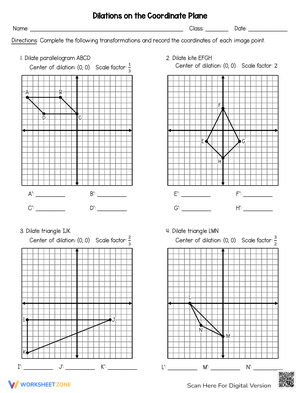
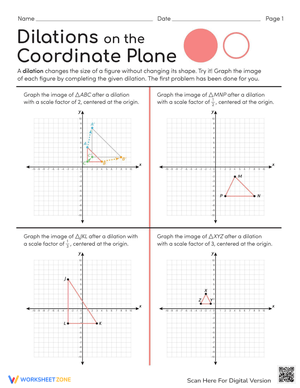
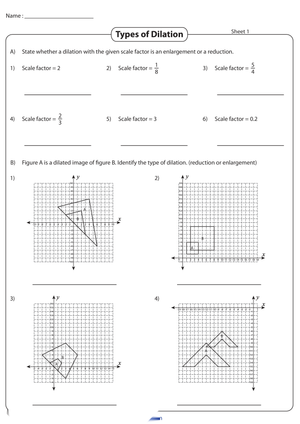
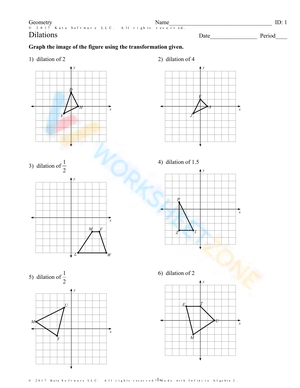
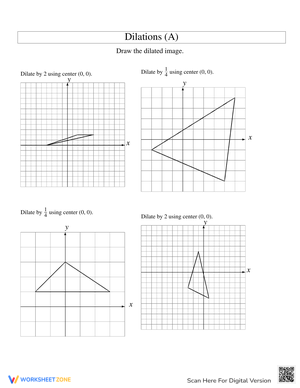
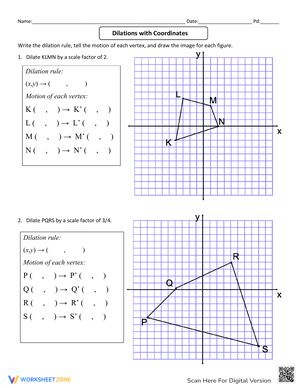
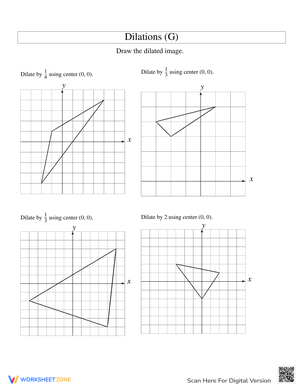
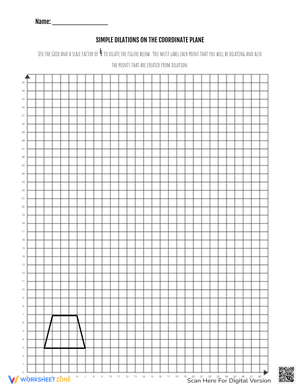
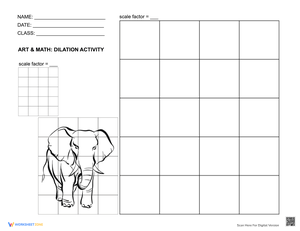
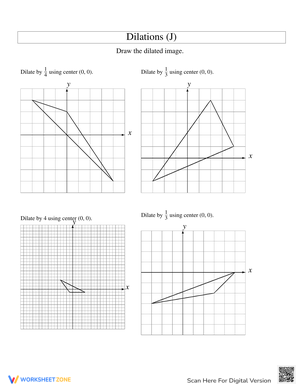
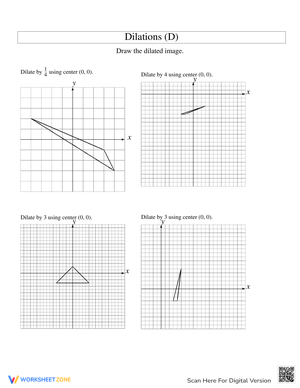
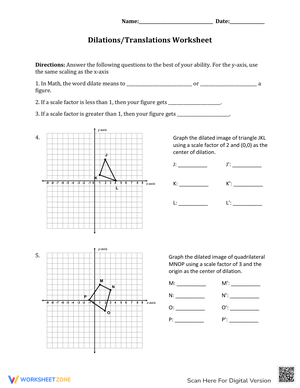
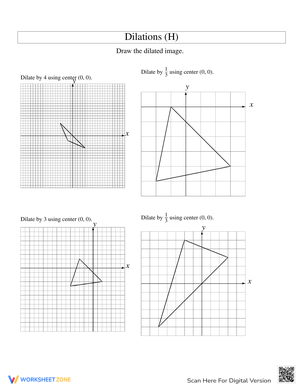
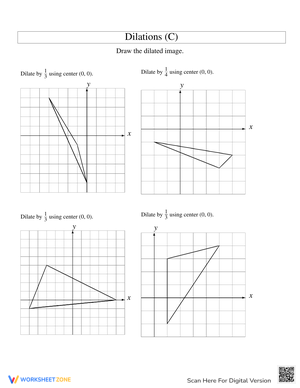
These dilations pdf worksheets for 8th grade give teachers a ready-to-print set built around the specific places Grade 8 students stall — identifying scale factor, plotting image coordinates accurately, and separating dilation from the other three transformations. Each worksheet moves through problem types that build on one another, from vocabulary and visual comparison to coordinate calculation and error analysis. The set covers bell ringers, guided practice, small-group reteaching, and exit checks without requiring additional resources.
What Each Worksheet Covers
Dilation appears in Grade 8 because it lands at the intersection of proportional reasoning from 7th grade and coordinate graphing — two things students already know. The new demand is recognizing that a transformation can change a figure's size while preserving its shape. Angles stay the same; side lengths change proportionally. The worksheets target that specific comparison rather than treating dilation as just another procedure to follow.
- Vocabulary in context: students match pre-image, image, center of dilation, and scale factor to labeled graph examples rather than copying isolated definitions
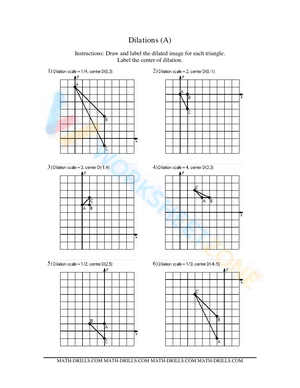
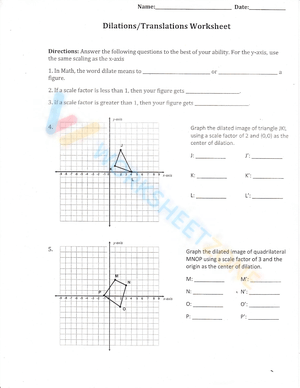
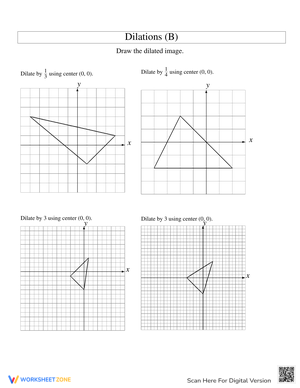
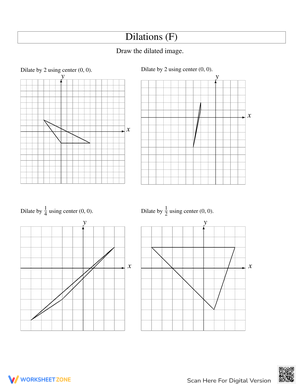
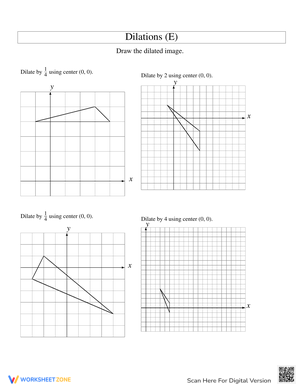
- Coordinate dilations from the origin: students multiply each coordinate pair by a given scale factor and plot the resulting image
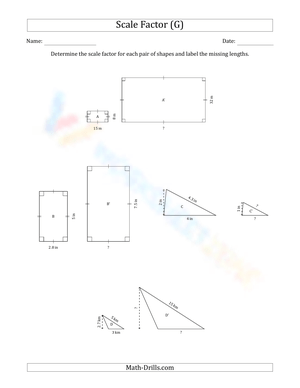
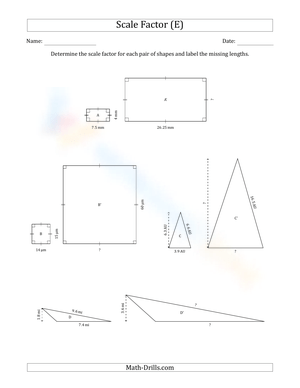
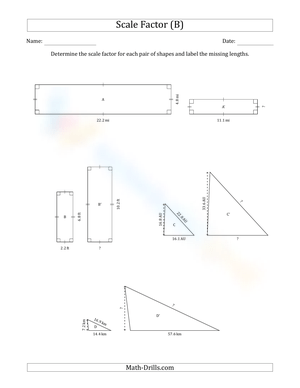
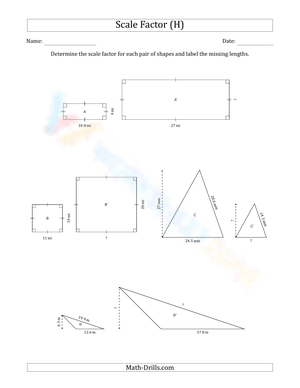
- Scale factor identification: students examine a pre-image and image, measure the ratio of corresponding sides, and name the scale factor
- Enlargement versus reduction: students decide whether a scale factor greater than 1 or less than 1 was applied, then write an explanation
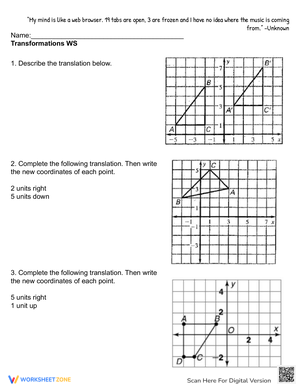
- Transformation sorting: students classify examples as dilation, translation, rotation, or reflection — reinforcing exactly what makes a dilation distinct from the others
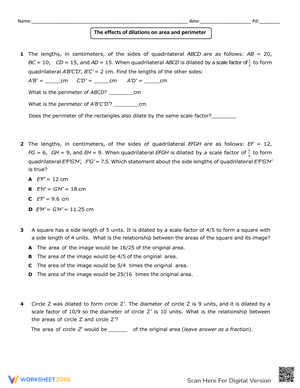
- Error analysis: students examine a completed dilation that contains a mistake and identify precisely what went wrong
Mistakes Students Make That These Worksheets Help You Catch
The most consistent dilation error is what teachers sometimes call the one-coordinate mistake: a student dilating the point (3, 4) with a scale factor of 2 writes (6, 4) instead of (6, 8), doubling only the x-value. On a coordinate grid, the resulting image is visibly distorted — the shape does not match the pre-image — but students focused on getting the multiplication right often do not catch it because they are not reading the graph as a verification step. Printable graph-based work surfaces this error in real time rather than three days later on a quiz.
Two other patterns show up regularly across classes. First, students treat a dilation as a translation because the image appears in a new position — they see "moved" and call it a slide, especially when the center of dilation is not at the origin and the entire figure shifts across the plane. Second, students encounter a scale factor of 1/2 and expect a larger image, partly because dividing carries "bigger" associations from earlier fraction instruction. The sketch-first approach built into these dilations pdf worksheets for 8th grade addresses both patterns directly: committing to a predicted image before calculating forces students to confront the direction of change while the concept is still in front of them.
Lesson-Planning Ideas to Get the Most From These Worksheets
These dilations pdf worksheets for 8th grade fit several different slots in a math block without being forced into a single format. As bell ringers, two or three coordinate dilation items take roughly eight minutes and settle students into proportional thinking before the main lesson. After a mini-lesson on scale factor, assigning one worksheet immediately — before students have time to second-guess what they heard — helps consolidate the steps. For the last five minutes of a period, one graph item plus a one-sentence explanation ("Is this an enlargement or reduction? How do you know?") provides a fast formative read without eating into instruction time.
Math centers work especially well with the graphing worksheets when students use two colors — one for pre-image points, one for image points. The color contrast catches plotting errors before students move on. For small-group reteaching, pull three or four targeted items from one worksheet rather than assigning the whole thing; isolating only the reduction problems, for instance, when that is the specific gap you are closing.
Standard Alignment
CCSS 8.G.A.3 requires students to describe the effect of dilations, translations, rotations, and reflections on two-dimensional figures using coordinates. The coordinate-focused worksheets address this directly — students apply scale factors, plot images, and explain how specific coordinate pairs change. CCSS 8.G.A.4 extends that work into similarity: a figure is similar to another if one can be obtained from the other through a sequence of transformations that includes dilation. Several worksheets ask students to determine whether two figures are similar by reasoning from that definition, making the set useful across both the transformations unit and the similarity unit that follows it in a typical Grade 8 sequence.
Adjusting These Worksheets Across a Range of Readiness Levels
Students who are still uncertain about multiplying fractions will hit a wall on reduction problems — not because they misunderstand dilation, but because the arithmetic creates enough mental load to obscure the concept. Start those students on whole-number scale factors of 2 or 3, where the coordinate multiplication is quick and the enlarged image on the graph is immediately visible. Once they can reliably plot and label corresponding points, introduce fractions: 1/2 or 3/4 as scale factors work well as a next step.
Students who move through the basic coordinate tasks quickly benefit from the error-analysis and transformation-sort items, which require reasoning about dilation without being handed a scale factor to apply. These students can also be asked to explain in writing why a second figure is or is not a dilation of the first — a step that shows whether they understand angle preservation and proportional side lengths or are simply following coordinate multiplication by rote.
One limitation worth naming: this set focuses on dilations centered at the origin. Students who need practice with non-origin centers require supplemental work. The coordinate rule (x, y) → (kx, ky) does not generalize cleanly to off-origin centers without additional instruction, and mixing both center types on the same worksheet without distinguishing them tends to produce confusion rather than productive challenge.
Frequently Asked Questions
Which Common Core standards do these worksheets align to?
The set primarily targets CCSS 8.G.A.3, which asks students to describe the effect of dilations and other transformations using coordinates, and CCSS 8.G.A.4, which connects those skills to the definition of similarity. Teachers working through a full Grade 8 geometry sequence will find the worksheets useful during both the transformations unit and the similarity unit that follows.
My students aren't fluent with fraction multiplication. Will the reduction problems be too difficult?
Start those students on whole-number scale factors and delay fraction-based reductions until arithmetic fluency is no longer a barrier. The error-analysis items do not require fraction multiplication at all, so those remain accessible to all students regardless of where they are with fractions.
Do these worksheets include centers of dilation that are not at the origin?
No — this set focuses on origin-centered dilations, which is where Grade 8 instruction typically begins and where most state assessments concentrate the 8.G.A.3 standard. If non-origin center practice is needed, plan to supplement after students have the origin case solid. Introducing both types at once, before the basic rule is automatic, slows more students down than it challenges.
Can I use these in a similarity unit, or only during the transformations sequence?
Yes. These dilations pdf worksheets for 8th grade include figure-comparison and scale factor identification tasks that connect directly to the definition of similarity in 8.G.A.4. The items that ask students to determine whether two figures are similar — based on whether one is a dilation of the other — belong as naturally in a similarity lesson as in the initial transformations sequence.













 Interactive Worksheet Maker
 Quiz Maker
 Word Search Maker
 Crossword Puzzle Maker
 Word Scramble Generator
 Sentence Scramble Generator
 Handwriting Worksheet Generator
 Name Tracing Generator
 Fill In The Blank Generator