


























Views
Downloads



Grade 8 Dilations — Printable No-Prep Worksheet
Paste this activity's link or code into your existing LMS (Google Classroom, Canvas, Teams, Schoology, Moodle, etc.).
Students can open and work on the activity right away, with no student login required.
You'll still be able to track student progress and results from your teacher account.
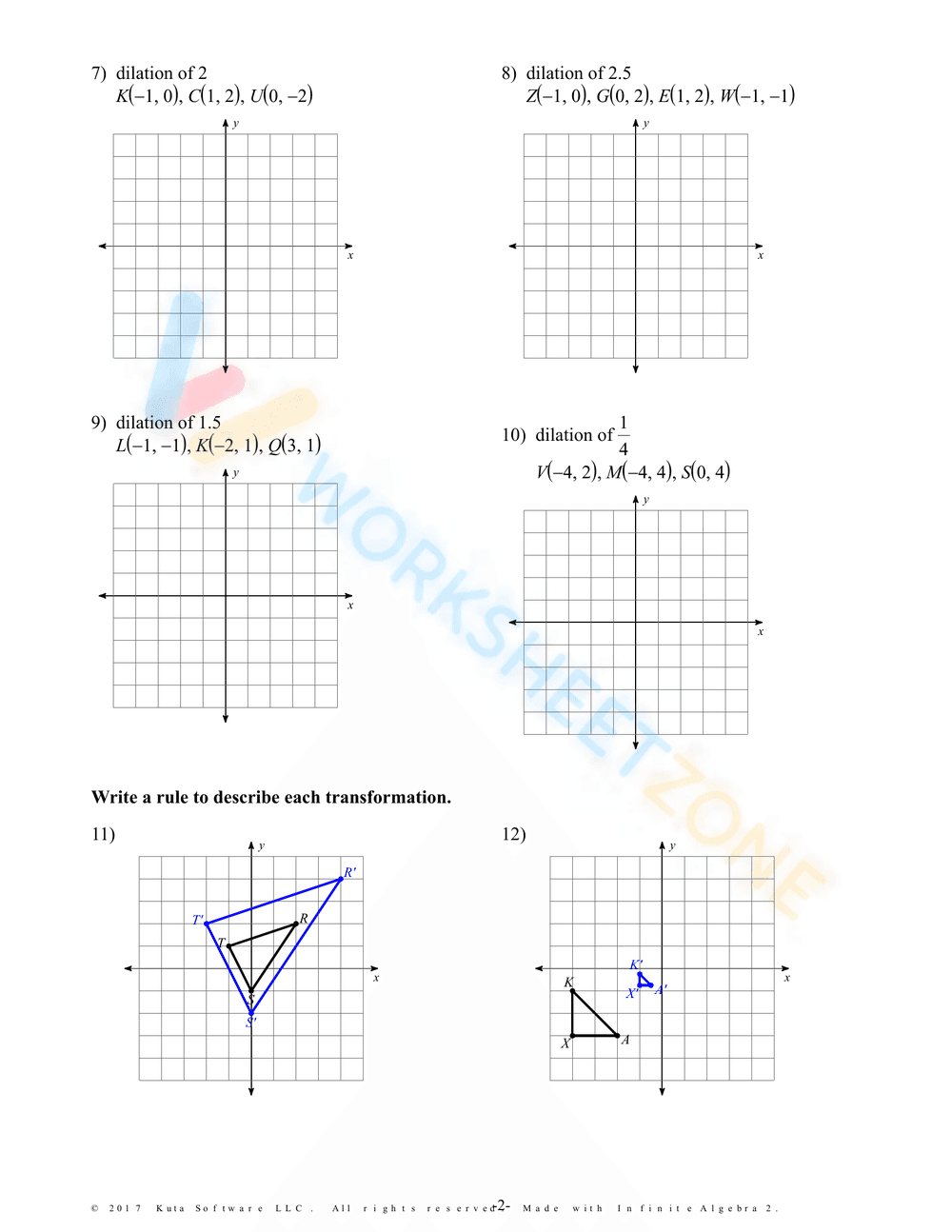
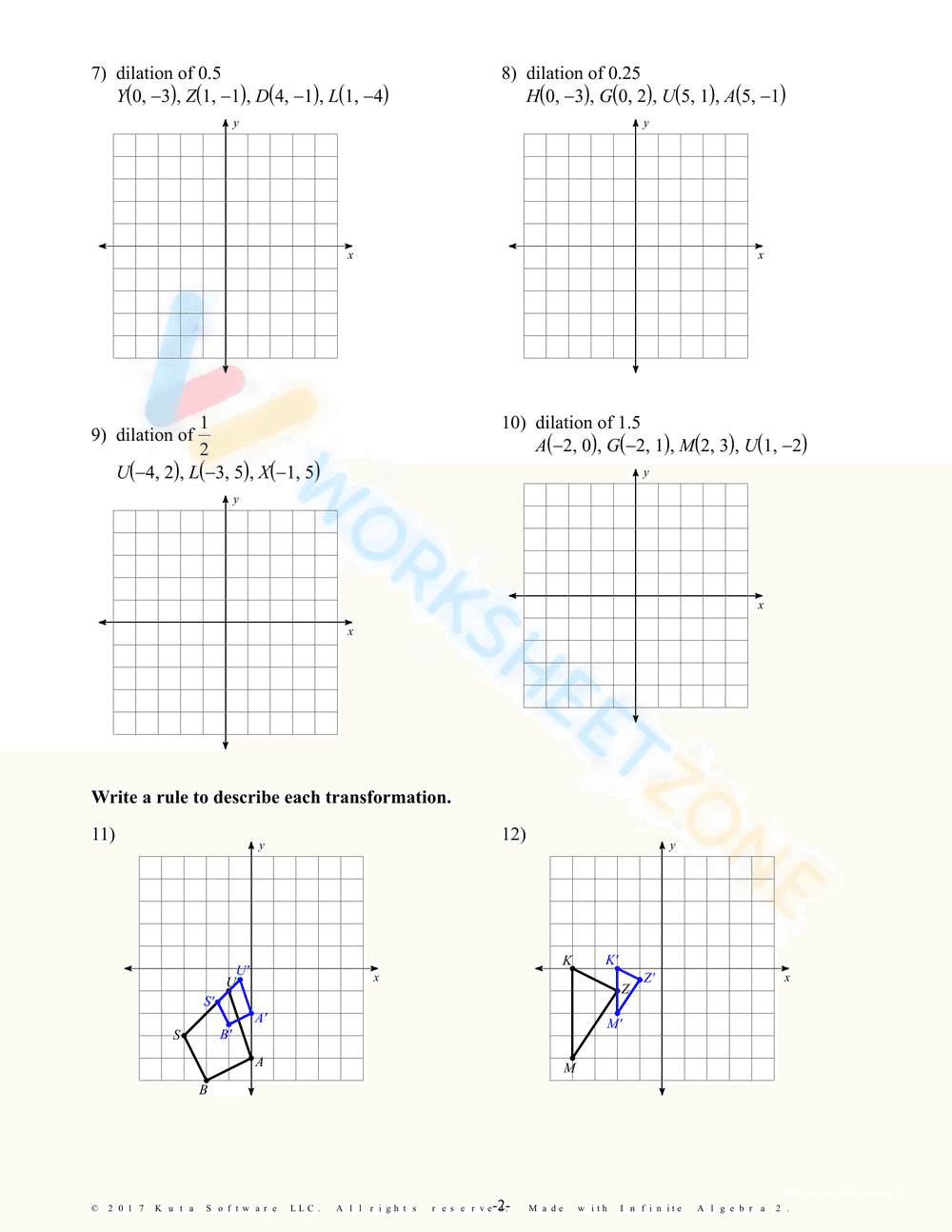
This ready-to-use geometry worksheet provides eighth-grade students with structured practice graphing dilations on the coordinate plane. Students apply scale factors to geometric figures, plot enlarged or reduced images, and determine transformation rules from graphs. The clear layout ensures students develop strong spatial reasoning and coordinate geometry skills without requiring teacher setup.
At a Glance
- Grade: 8 · Subject: Math
- Standard:
CCSS.MATH.CONTENT.8.G.A.3— Describe the effect of dilations on figures using coordinates- Skill Focus: Graphing dilations and writing transformation rules
- Format: 6 pages · 24 problems · Answer key included · PDF
- Best For: Independent practice and sub plans
- Time: 30–45 minutes
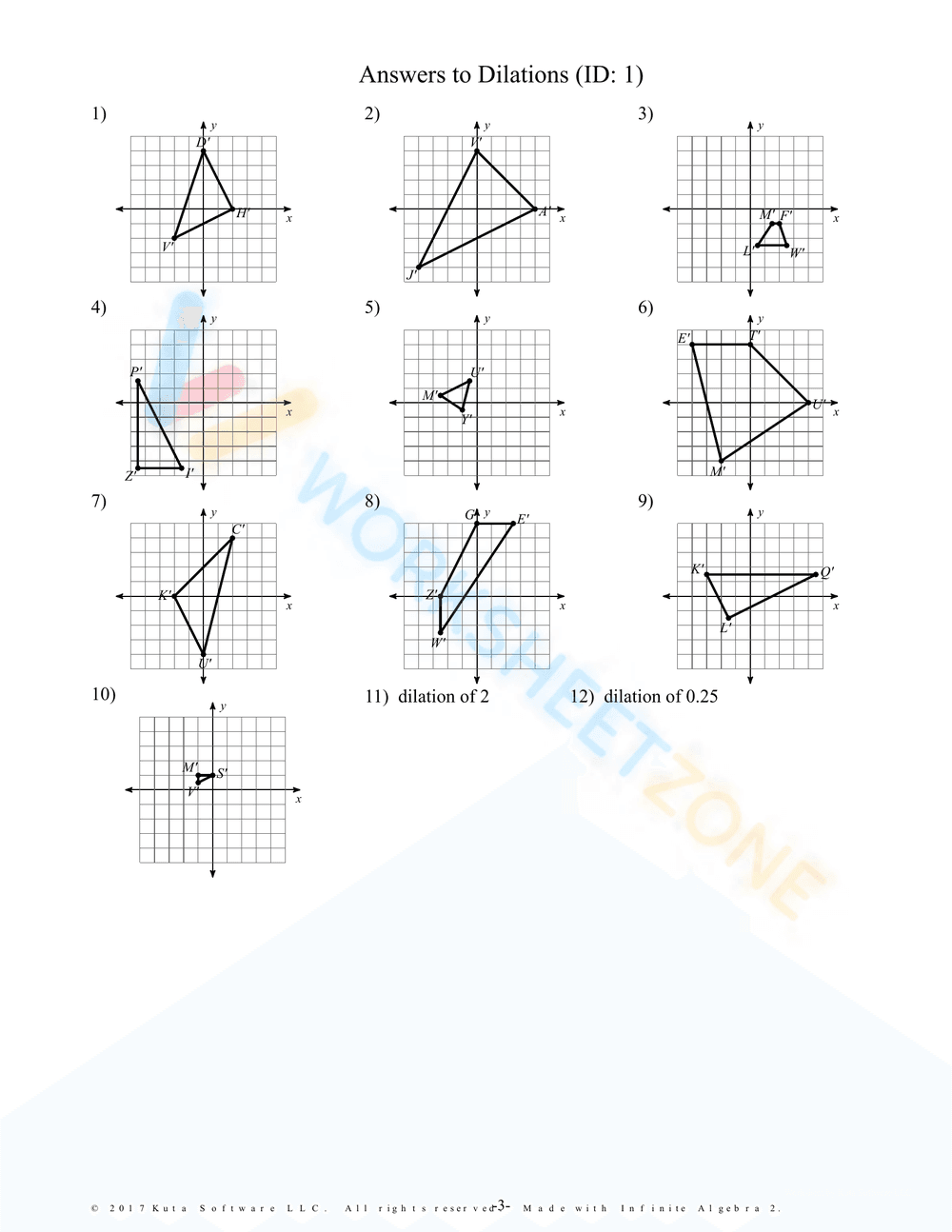
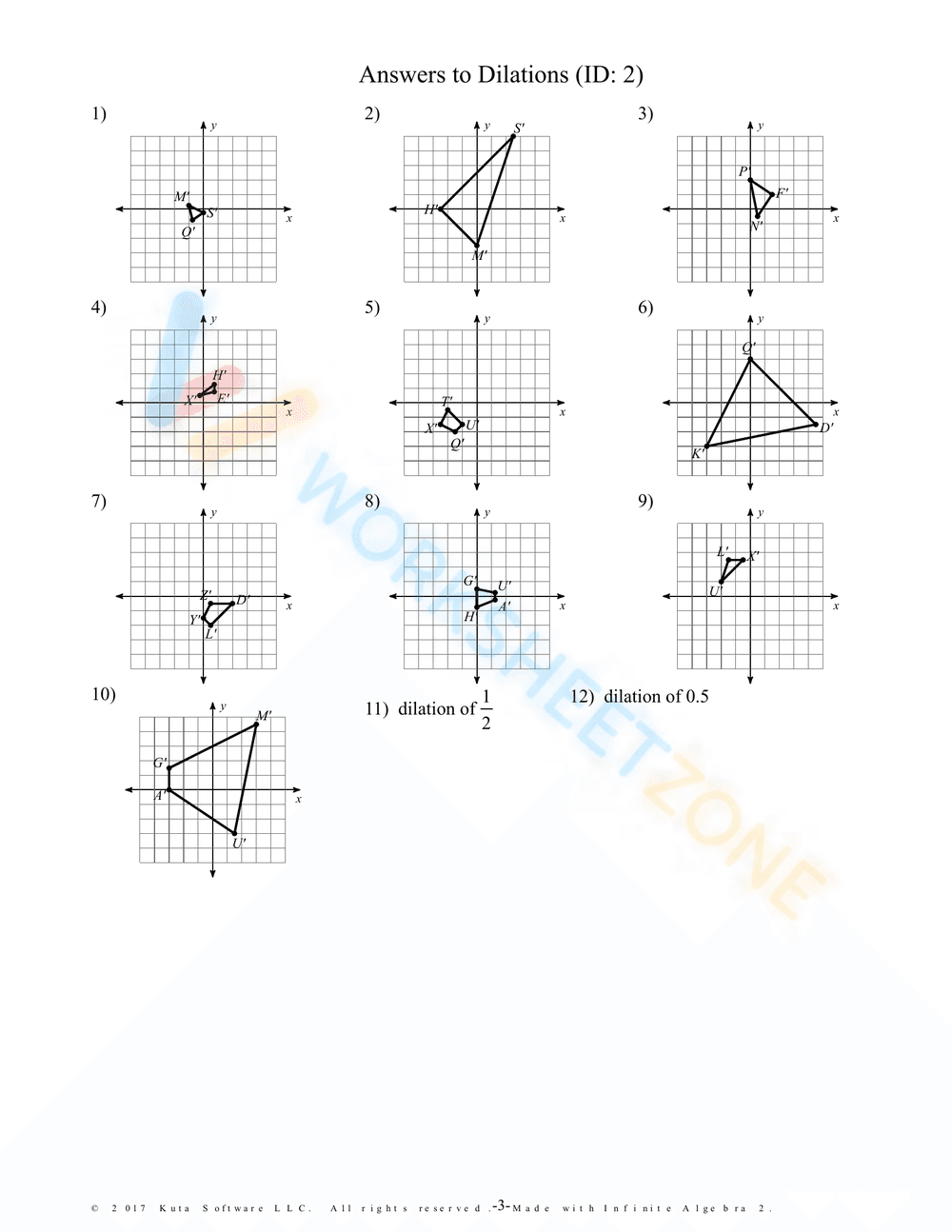
This resource includes two distinct 12-problem worksheet versions (ID: 1 and ID: 2), providing 24 total problems across four student pages, plus two pages of complete answer keys. Each version features three problem types: graphing dilations directly onto coordinate grids using a scale factor, plotting figures from vertex coordinates before dilating, and analyzing completed graphs to write algebraic transformation rules. Having two parallel versions prevents wandering eyes during independent work and allows one version to be used for practice and the other for assessment.
Zero-Prep Classroom Workflow
Designed for immediate classroom deployment, this worksheet requires under two minutes of total teacher preparation time. The workflow operates efficiently:
- Print (1 minute): Select Version 1 or 2 and print the two-page student set.
- Distribute (30 seconds): Hand out worksheets with straightedges for precise line segments.
- Review (30 seconds): Use the visual answer keys to quickly verify student graphs or project them for self-grading.
Because instructions are direct, this packet serves as an ideal emergency sub plan or independent study packet.
Standards Alignment
This worksheet aligns to CCSS.MATH.CONTENT.8.G.A.3, requiring students to describe the effect of dilations, translations, rotations, and reflections on two-dimensional figures using coordinates. By executing dilations with scale factors (such as 2, 0.5, and 1.5) and extracting transformation rules from graphs, students connect algebraic scaling to geometric similarity. Both standard codes can be copied directly into lesson plans, IEP goals, or district curriculum mapping tools.
How to Use It
This resource functions effectively across multiple instructional moments. During direct instruction, teachers can utilize Version 1 as guided practice where students work through initial graphing tasks together. After direct instruction, Version 2 serves as independent homework or a formative assessment check. As a formative assessment observation tip, monitor whether students correctly multiply both coordinates by the scale factor, particularly with fractional scale factors like 0.25. Expected completion time ranges from 30 to 45 minutes.
Who It's For
This worksheet is designed for eighth-grade mathematics and high school geometry students studying transformations. For differentiation, assign whole-number scale factors to students requiring foundational support, while challenging advanced learners with rule-writing tasks and fractional dilations. This resource pairs naturally with classroom anchor charts detailing transformation notation.
Effective mathematical instruction in geometric transformations requires explicit practice connecting visual representations with algebraic rules. According to Fisher & Frey (2014), structured independent practice within a gradual release framework is essential for securing procedural fluency and conceptual retention. This worksheet directly supports CCSS.MATH.CONTENT.8.G.A.3 by providing targeted exercises where students describe the effect of dilations on figures using coordinates. By engaging with 24 distinct problems across two parallel versions, students transition from guided execution of scale factors to independent analysis of transformation rules. The inclusion of clear coordinate grids and immediate visual feedback via comprehensive answer keys ensures that students solidify their spatial reasoning skills. Providing high-quality, structured practice materials allows educators to maintain rigorous academic standards while maximizing active learning time.


