




























Views
Downloads



Printable Slope-Intercept Form Worksheet | Grade 8 Math

Paste this activity's link or code into your existing LMS (Google Classroom, Canvas, Teams, Schoology, Moodle, etc.).
Students can open and work on the activity right away, with no student login required.
You'll still be able to track student progress and results from your teacher account.
Mastering linear equations starts with the ability to manipulate their forms. This worksheet focuses exclusively on converting equations from standard form to slope-intercept form (y = mx + b), enabling students to identify slopes and y-intercepts efficiently. By solving for y, learners build the algebraic fluency required for graphing and advanced function analysis.
At a Glance
- Grade: 8 · Subject: Math
- Standard:
CCSS.MATH.CONTENT.8.EE.C.7— Solve linear equations in one variable with coefficients represented by letters- Skill Focus: Converting standard form to slope-intercept form
- Format: 4 pages · 20 problems · Answer key included · PDF
- Best For: Algebra 1 introduction or Grade 8 review
- Time: 30–45 minutes
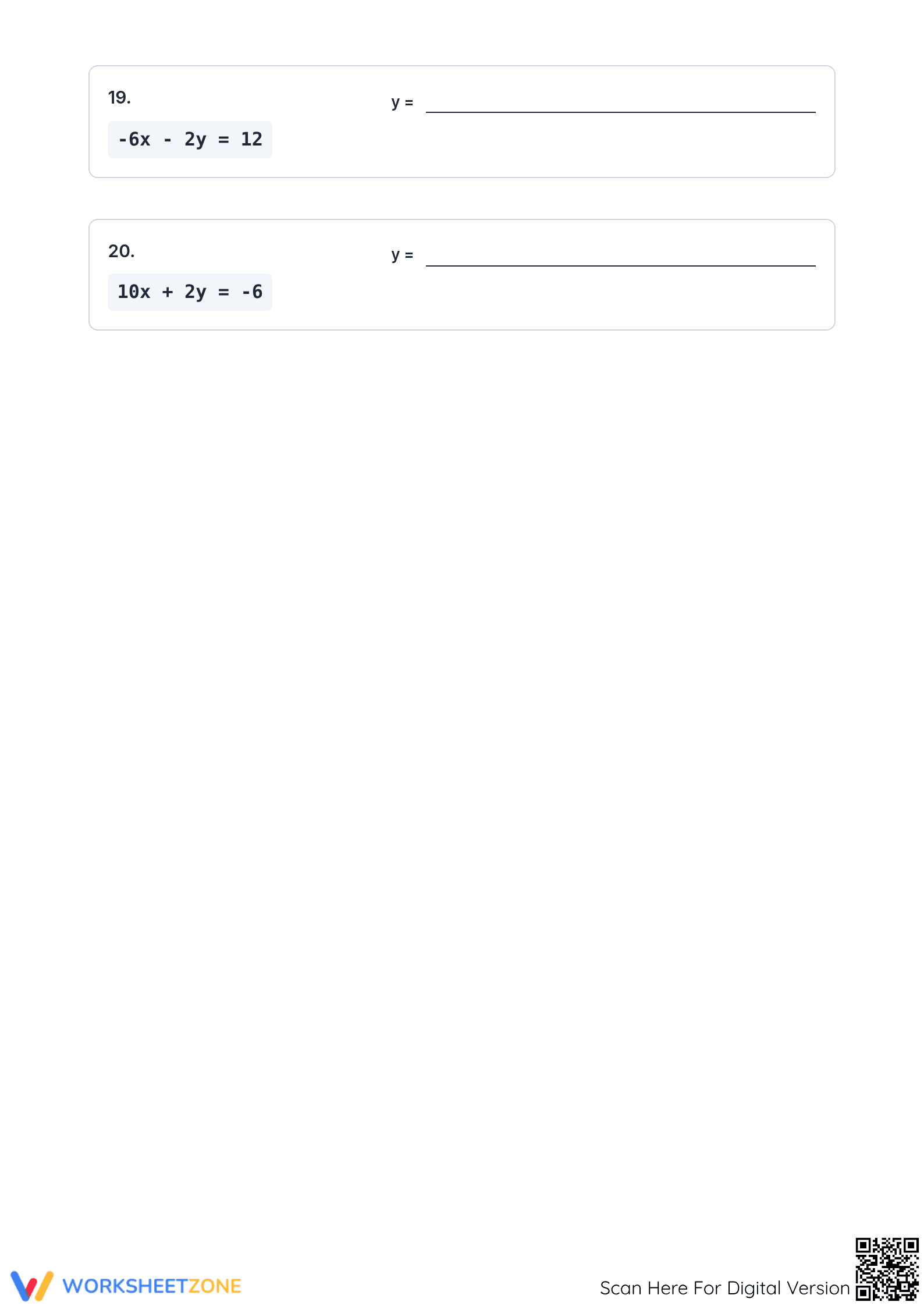
Inside this 4-page resource, you will find 20 carefully structured problems. The worksheet is divided into two sections: Standard Practice and Additional Practice. Each problem provides a dedicated workspace for the original equation and a long blank line for the final y = mx + b output. A comprehensive answer key is included to facilitate rapid grading or student self-correction.
Skill Progression
- Guided Practice: The first 5 problems use small integer coefficients to help students master the basic mechanics of moving terms across the equals sign.
- Supported Practice: Problems 6 through 15 introduce negative coefficients and literal terms that require careful sign management during the division step.
- Independent Practice: The final sets challenge students to simplify fractions and consolidate their understanding of the relationship between standard and slope-intercept forms.
This sequence follows a gradual-release model, ensuring students move from simple variable isolation to complex algebraic manipulation.
Standards Alignment
This resource is primarily aligned with CCSS.MATH.CONTENT.8.EE.C.7, which requires students to solve linear equations, including those with variables on both sides. It also supports CCSS.MATH.CONTENT.8.F.A.3 by helping students interpret the equation y = mx + b as defining a linear function. Both standard codes can be copied directly into lesson plans, IEP goals, or district curriculum mapping tools.
How to Use It
Use this worksheet as a primary practice set during your linear functions unit. It is particularly effective after a direct instruction session on the properties of equality. Teachers can use the first page as a formative assessment to identify students who struggle with isolating variables. The 30–45 minute completion time makes it an ideal choice for a full class period activity or a substantial homework assignment.
Who It's For
This practice set is designed for Grade 8 students and Algebra 1 learners who are transitioning from basic equation solving to coordinate geometry. It provides essential scaffolding for students who need repetitive, focused practice on literal equations. Pair this with a coordinate plane anchor chart to help students visualize the relationship between the algebraic conversion and the resulting line's graph.
Research by Fisher & Frey (2014) emphasizes that procedural fluency in algebra is built through purposeful, repetitive practice that isolates specific skills before integrating them into complex problem-solving. This worksheet addresses CCSS.MATH.CONTENT.8.EE.C.7 by providing 20 targeted opportunities for students to manipulate linear equations into the slope-intercept form. By focusing on the single student action of isolating the y variable, the resource reduces cognitive load and allows for the consolidation of algebraic rules. Studies from ScienceDirect TpT Analysis suggest that worksheets that combine standard practice with clear, simplified formatting lead to higher completion rates and better retention of procedural steps. This alignment ensures that students are not only solving for a variable but are also preparing for the interpretive demands of higher-level mathematics. This resource remains a staple for evidence-based math instruction in middle school classrooms.


