




























Views
Downloads


Slope Intercept Form Worksheet | Essential Grade 8 Math

Paste this activity's link or code into your existing LMS (Google Classroom, Canvas, Teams, Schoology, Moodle, etc.).
Students can open and work on the activity right away, with no student login required.
You'll still be able to track student progress and results from your teacher account.
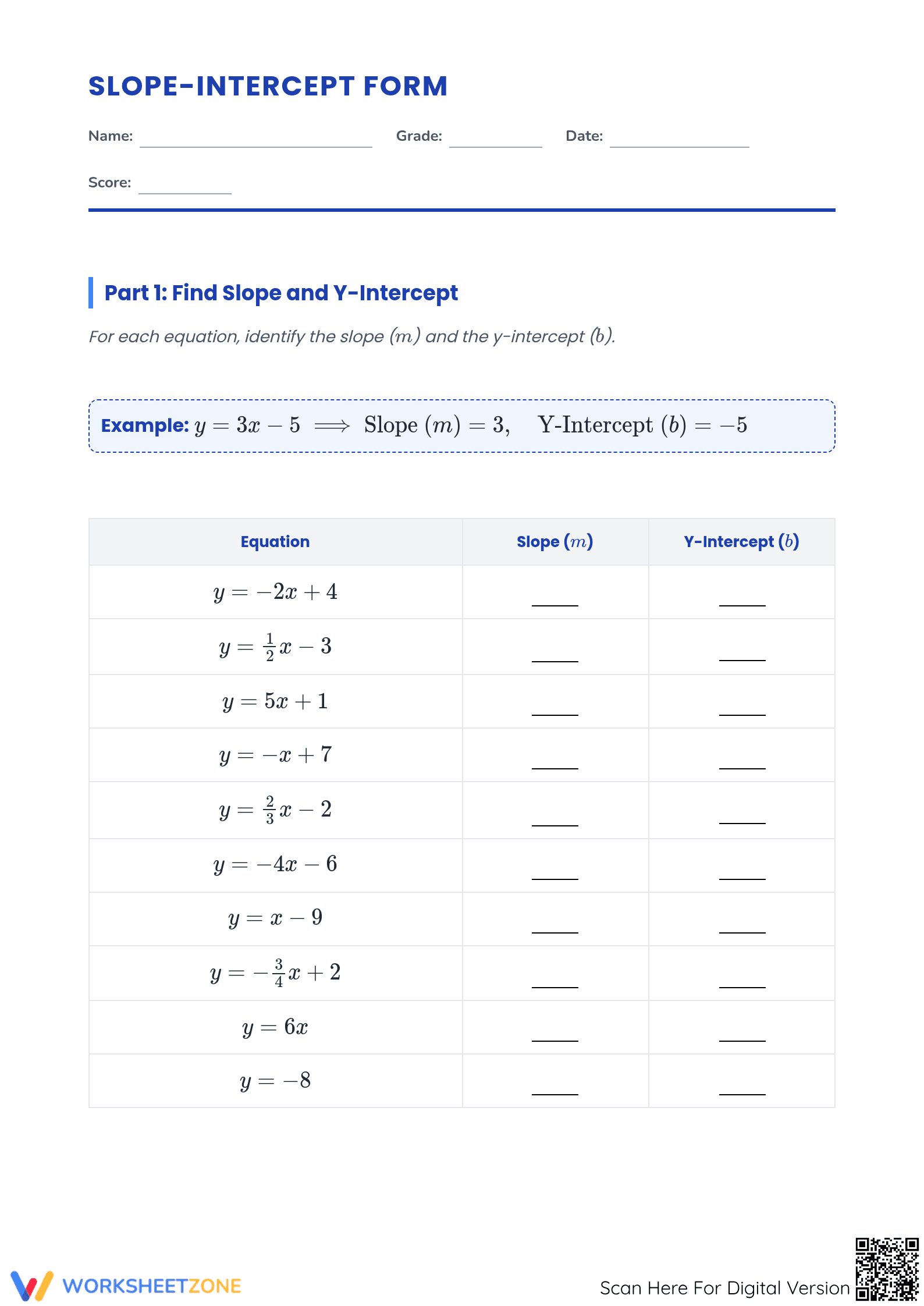
Mastering the relationship between variables is a fundamental milestone in middle school algebra. This Slope-Intercept Form worksheet empowers students to fluently identify, write, and graph linear equations. By bridging algebraic expressions and coordinate plane visualizations, learners develop the procedural fluency and conceptual depth required for success in higher-level math.
At a Glance
- Grade: 8 · Subject: Math (Algebra)
- Standard:
CCSS.MATH.CONTENT.8.F.A.3— Interpret the equation y = mx + b as defining a linear function- Skill Focus: Slope-intercept form identification, construction, and graphing
- Format: 3 pages · 20 problems · Answer key included · PDF
- Best For: Independent practice and formative assessment
- Time: 35–45 minutes
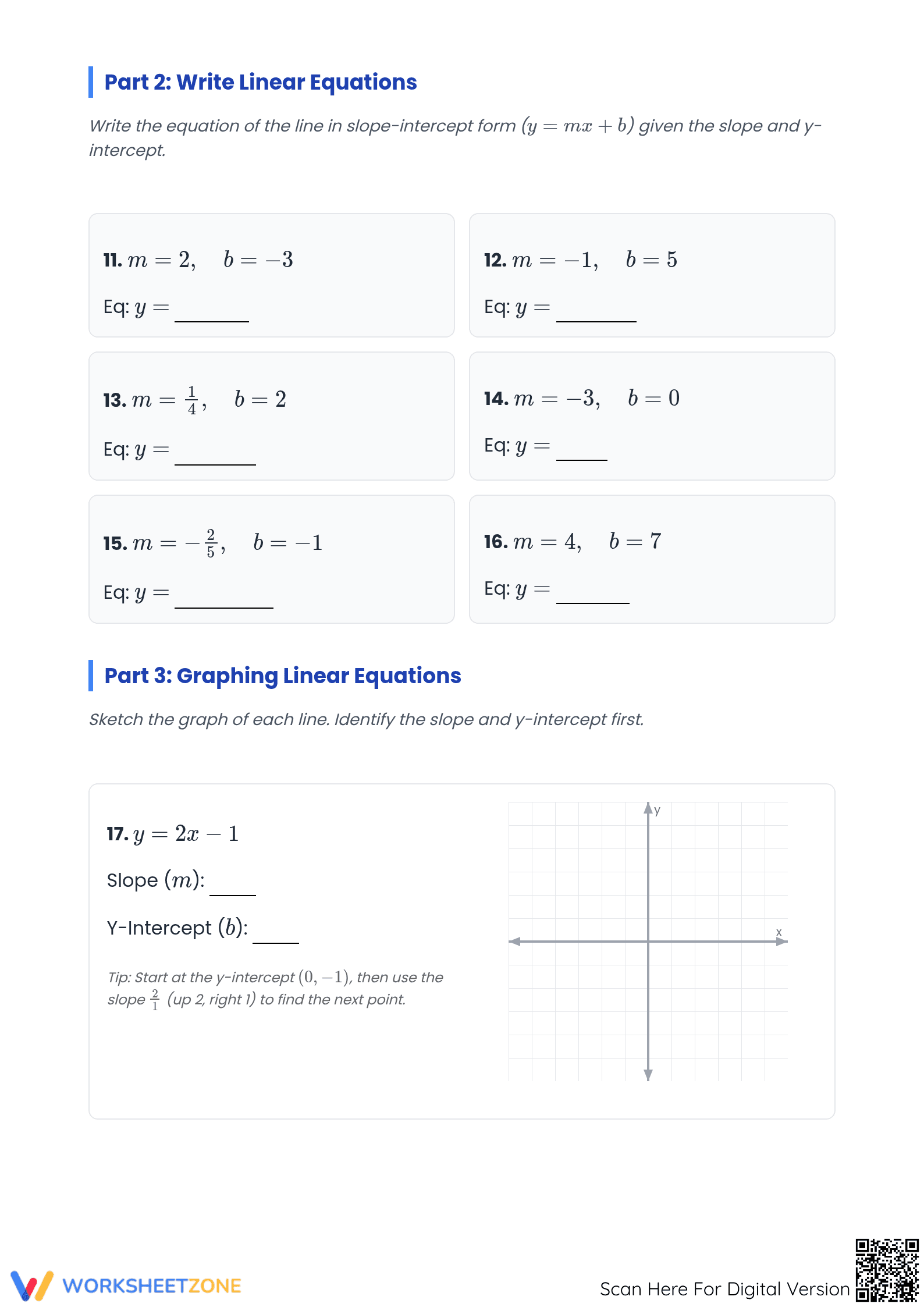
This 3-page resource features a structured progression across four parts. It begins with identifying slope (m) and y-intercept (b) from equations, followed by writing equations from parameters. Students then graph on coordinate planes, supported by helpful "Tip" boxes explaining the rise-over-run method. The final section challenges students to convert equations into slope-intercept form. A complete answer key is included.
The zero-prep design ensures immediate classroom implementation. Teachers can download and print the file in under 30 seconds. Distribution takes one minute, and because the worksheet includes worked examples and procedural tips, students begin working with minimal intervention. Reviewing the 20 problems using the included key takes approximately 5 minutes, making it ideal for sub plans or homework assignments.
The core alignment is CCSS.MATH.CONTENT.8.F.A.3, interpreting the equation y = mx + b as a linear function. Additionally, the graphing components support CCSS.MATH.CONTENT.8.EE.B.6. Both standard codes can be copied directly into lesson plans, IEP goals, or district curriculum mapping tools to ensure instructional compliance.
This worksheet is effective as independent practice following direct instruction. It also serves as a formative assessment during mid-unit reviews. Educators should observe students during graphing to ensure they correctly identify the starting y-intercept point (0, b) before applying slope. Completion usually takes 35 to 45 minutes, depending on prior knowledge of integer operations.
Designed for Grade 8, this resource is also suitable for Grade 7 advanced learners or high school remediation. The inclusion of "Tip" prompts provides scaffolding for diverse learners. For a complete cycle, pair this worksheet with a coordinate plane anchor chart to reinforce visual patterns.
The pedagogical structure of this resource aligns with the National Assessment of Educational Progress (NAEP) frameworks, which emphasize the importance of representing and analyzing mathematical situations using algebraic symbols. Research from NAEP indicates that students who can fluidly translate between multiple representations—such as equations, graphs, and numerical values—demonstrate significantly higher proficiency in algebraic reasoning. This worksheet directly addresses these requirements by forcing students to move from equation identification to coordinate graphing in a single session. By requiring the conversion of non-standard equations into slope-intercept form in the challenge section, the resource builds the procedural flexibility necessary for solving complex systems of equations. This alignment with evidence-based practices ensures that students are not merely memorizing formulas but are building a durable conceptual framework for linear modeling. The 20-problem set provides sufficient volume for mastery without inducing cognitive fatigue, supporting long-term retention of CCSS.MATH.CONTENT.8.F.A.3 standards.


