




























Views
Downloads



Slope-Intercept Form Worksheet | Essential Grade 8 Algebra

Paste this activity's link or code into your existing LMS (Google Classroom, Canvas, Teams, Schoology, Moodle, etc.).
Students can open and work on the activity right away, with no student login required.
You'll still be able to track student progress and results from your teacher account.
This Grade 8 algebra worksheet provides students with targeted practice in converting linear equations from various formats into slope-intercept form. By mastering the y = mx + b structure, learners develop a foundational understanding of how slope and y-intercept define the characteristics of a line, ensuring success in more complex algebraic graphing and modeling tasks.
At a Glance
- Grade: 8 · Subject: Algebra
- Standard:
CCSS.MATH.CONTENT.8.EE.B.6— Use similar triangles to explain slope and derive linear equations- Skill Focus: Slope-Intercept Form Conversion
- Format: 3 pages · 20 problems · Answer key included · PDF
- Best For: Independent algebra practice and formative assessment
- Time: 30–45 minutes
What's Inside
Inside this comprehensive 3-page PDF, you will find twenty carefully curated problems organized into two distinct sections. The first part focuses on standard conversion tasks, while the second part provides advanced practice with non-integer coefficients. A full answer key is included for rapid teacher review or student self-correction.
Skill Progression
- Guided Practice (Items 1-6): Students begin by rewriting standard-form equations where the y-variable is easily isolated, reinforcing the basic algebraic steps of transposition and simplification with integer coefficients.
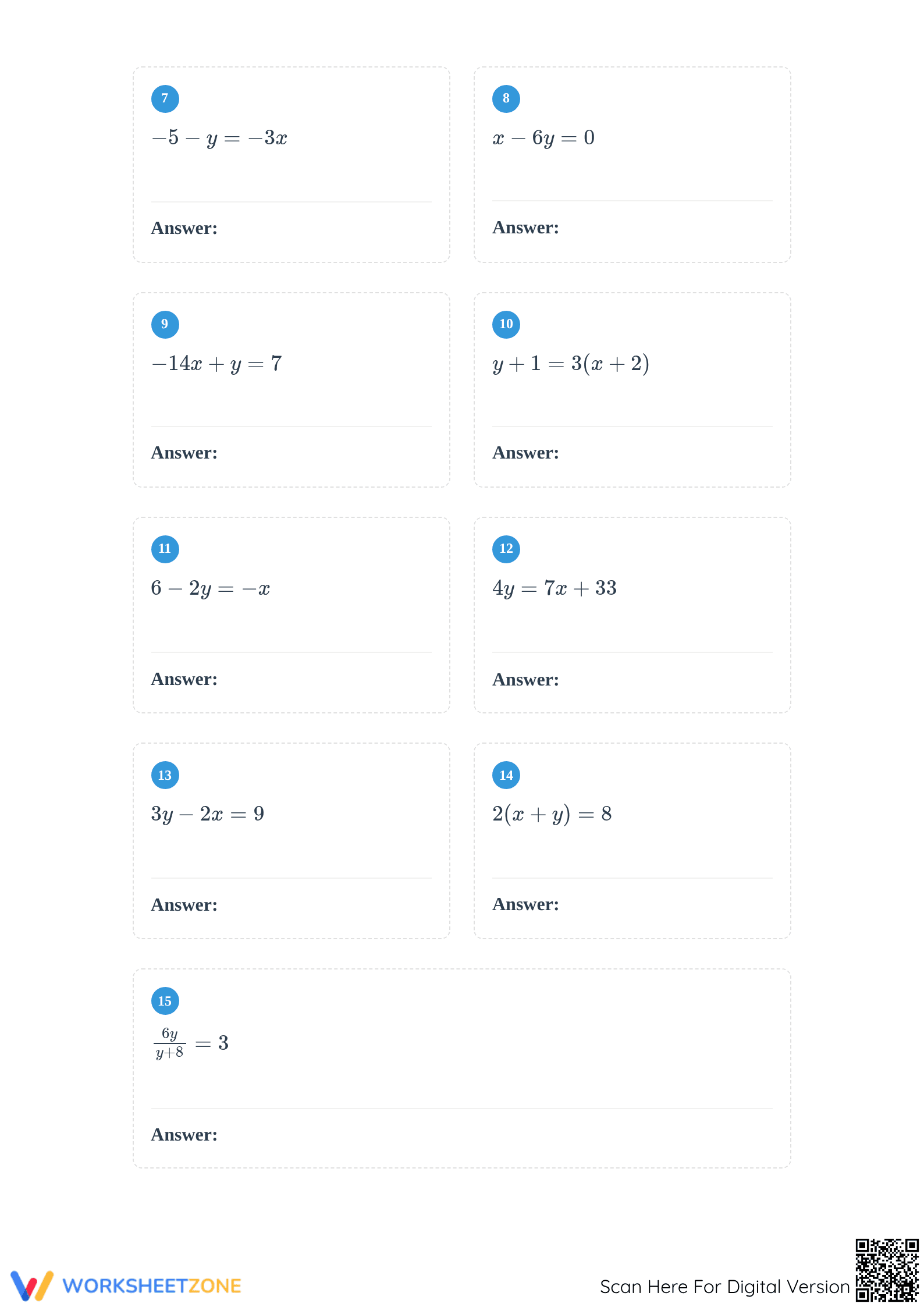
- Supported Practice (Items 7-15): The complexity increases as students encounter equations with negative coefficients and those requiring multiple inverse operations to isolate y, building procedural stamina.
- Independent Practice (Items 16-20): The "Advanced Practice" section introduces rational numbers, including fractions and decimals, challenging students to maintain precision while identifying the final slope and y-intercept values.
This instructional sequence follows the gradual-release model, transitioning students from simple transformations to higher-order algebraic manipulations.
Standards Alignment
This resource is primary aligned to CCSS.MATH.CONTENT.8.EE.B.6, which requires students to derive linear equations and interpret the slope-intercept form. It also supports CCSS.MATH.CONTENT.8.F.A.3 regarding linear function interpretation. Both standard codes can be copied directly into lesson plans, IEP goals, or district curriculum mapping tools for seamless administrative integration.
How to Use It
Use this worksheet as a quiet independent practice session following a direct instruction lesson on linear equations. Teachers should observe students during the transition to the advanced section to identify misconceptions regarding negative signs or fractional slopes. Expect completion within a single class period of approximately 40 minutes.
Who It's For
This practice set is ideal for Grade 8 students and early high school algebra learners. It serves as an excellent companion to an anchor chart illustrating the components of a linear equation or as a remedial tool for students needing extra support with variable isolation.
This instructional resource aligns with CCSS.MATH.CONTENT.8.EE.B.6, focusing on the critical algebraic skill of rewriting linear equations into slope-intercept form (y=mx+b). According to Fisher & Frey (2014), the use of structured practice sets facilitates the gradual release of responsibility model, moving students from guided conversion tasks to independent identification of slope and y-intercept parameters. By providing 20 unique problems, this worksheet ensures sufficient repetition for procedural fluency while the advanced section introduces fractional and decimal coefficients to challenge students' computational accuracy. Research from the RAND AIRS 2024 report emphasizes that consistent exposure to varied equation structures—including those requiring multiple algebraic steps to isolate the variable—is essential for developing the deep conceptual understanding required for high school algebra readiness. Educators can utilize this three-page PDF as a primary formative assessment tool to monitor student mastery of linear relationship representations in various mathematical contexts.


