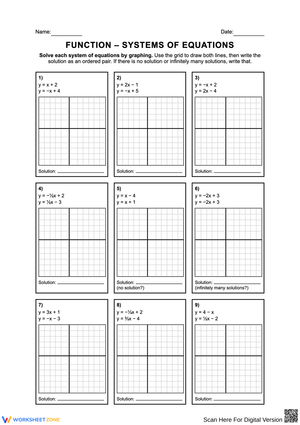
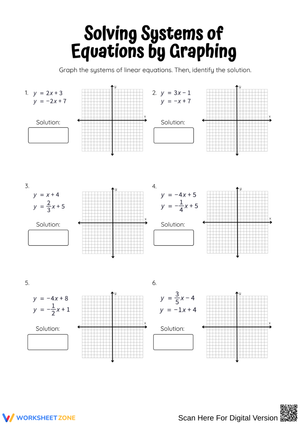
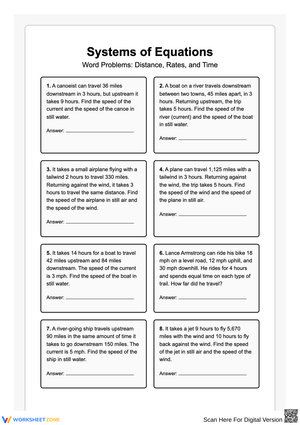
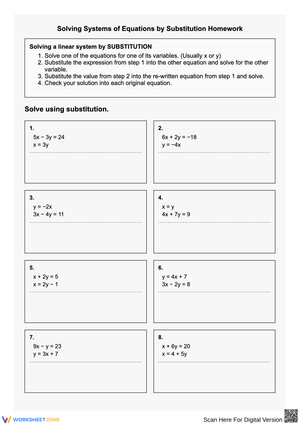
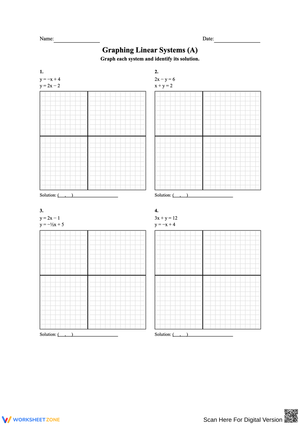
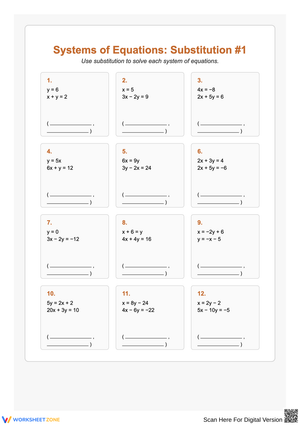
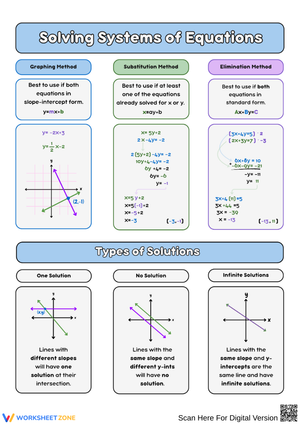
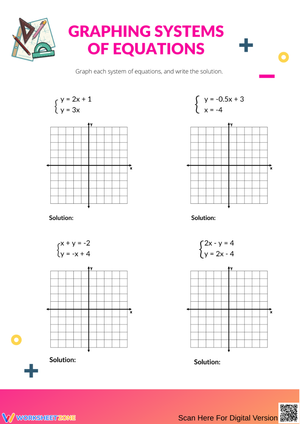
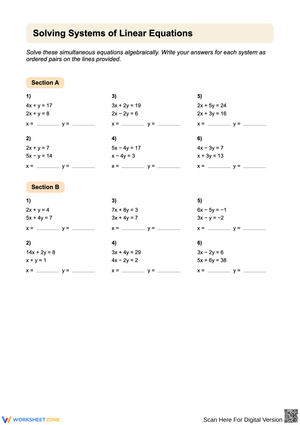
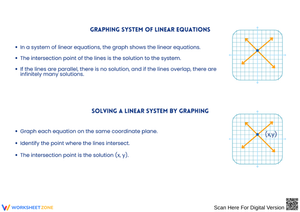
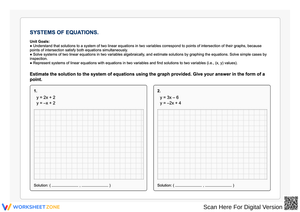
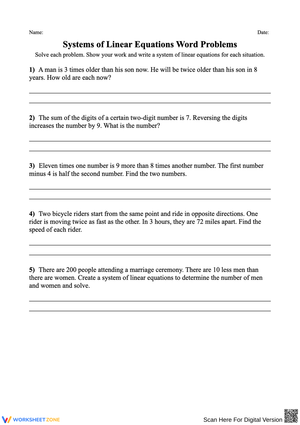
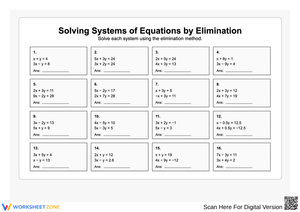
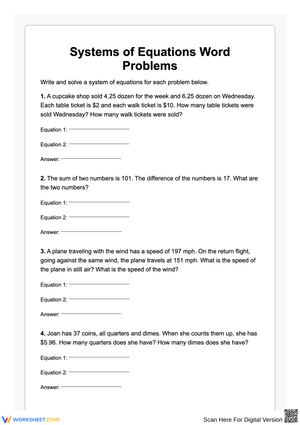
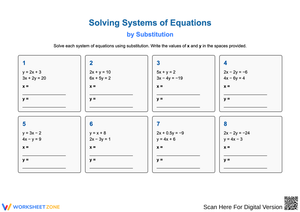
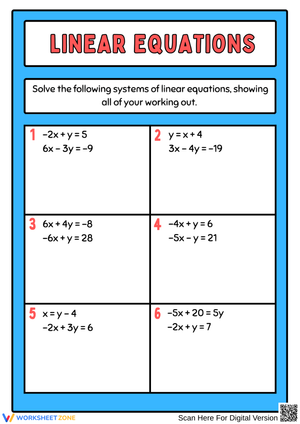
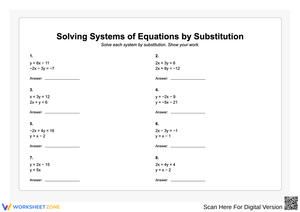
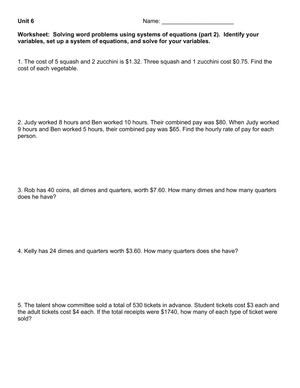
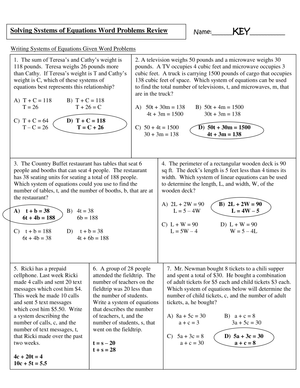
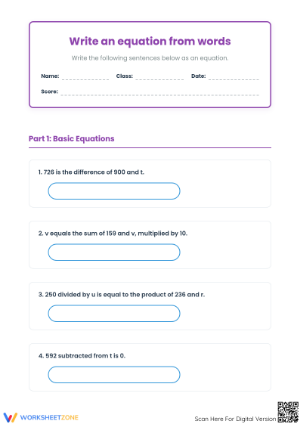
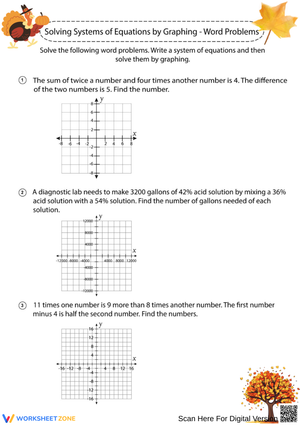
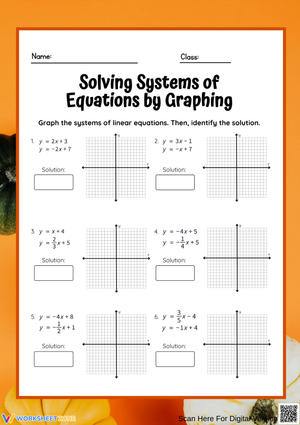
These 8th grade systems of equations printable worksheets give algebra teachers targeted, method-specific practice that fits the actual rhythm of an eighth-grade math class — organized by skill, with clear work space, and ready to run without extra prep. The set covers graphing, substitution, and elimination as separate strands before bringing them together in mixed review and word problem formats that ask students to choose a strategy rather than follow a prompt.
What the Set Covers, Method by Method
Grade 8 is where students encounter systems as a formal topic for the first time, and the order in which methods appear matters. Graphing comes first because it makes the solution visible — students see that a solution is the intersection point before they can prove it algebraically. Substitution follows, typically with equations already solved for one variable or easy to rearrange. Elimination arrives later, once students are comfortable with the idea that both equations in a system describe the same relationship.
Each worksheet targets one method or asks students to navigate across them:
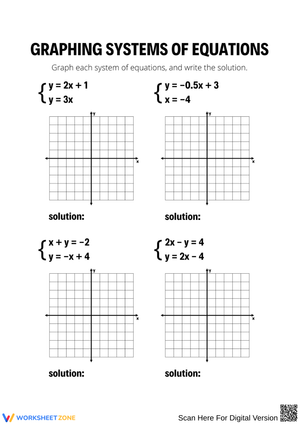
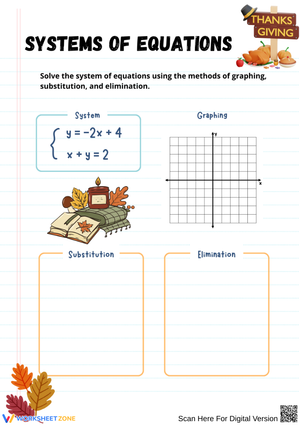
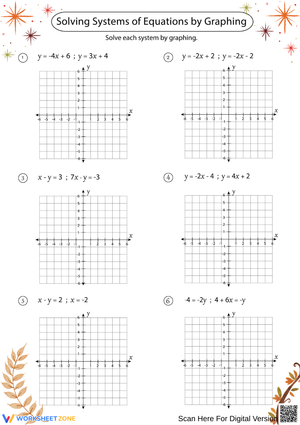
- Graphing: plotting two lines from slope-intercept form, reading the intersection, and verifying the solution in both equations
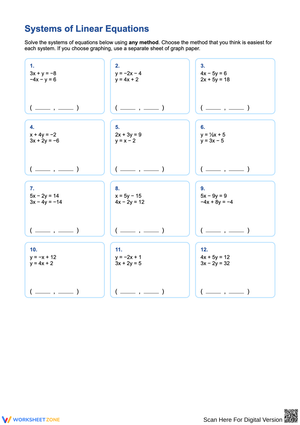
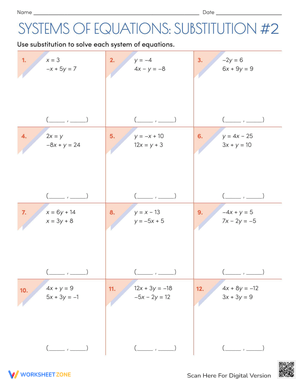
- Substitution: isolating a variable, replacing it in the second equation, and solving — with and without rearranging first
- Elimination: adding or subtracting to cancel a variable, starting with matching coefficients before moving to problems that require multiplication
- Strategy choice: mixed sets where no method is labeled, so students decide which approach is most efficient
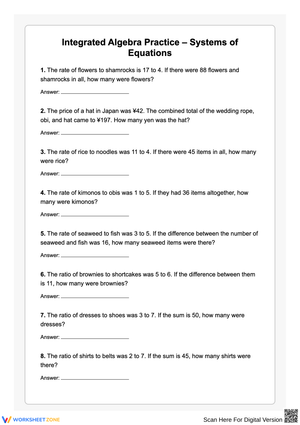
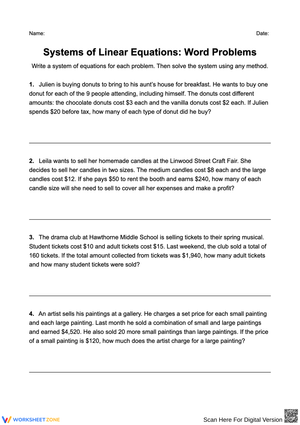
- Word problems: writing two equations from a scenario, solving the system, and interpreting the ordered pair in context
- Error analysis: reviewing worked solutions that contain a specific mistake, locating it, and explaining what went wrong
Errors That Show Up Consistently Across All Three Methods
The most common substitution mistake isn't algebraic — it's interpretive. Students solve correctly for x, then stop. They record a single number and move on, missing that a system solution is an ordered pair. That error reappears in word problems when students find one value, declare the problem finished, and never solve for the second variable before writing a contextual answer. Pointing this out once usually fixes it for graphing and substitution practice, but the word problem version requires a separate instructional moment.
Elimination produces a different recurring problem: sign errors during subtraction. When students subtract one equation from another, they routinely drop the negative sign on the second or third term. The expression 2y minus negative 3y becomes 2y minus 3y in student work far more often than most teachers expect. Having students circle the sign on every term before subtracting — and then check the eliminated variable before solving — catches this before it becomes a habit. The error analysis worksheets in this set are built for exactly this moment: students see a solved problem with the sign error intact and have to locate and explain it.
Graphing produces a subtler error. Students who plot accurately still misread the intersection, particularly when the solution falls between gridlines or when they reverse the coordinates and write (3, 5) instead of (5, 3). Requiring students to check their intersection by substituting back into both original equations turns that verification step into a built-in self-correction habit rather than extra work.
Working These Worksheets Into a Week of Instruction
A useful planning approach: spend the first day establishing graphing as the conceptual foundation. A set of 8th grade systems of equations printable worksheets focused on graphing — six problems, each with a pre-drawn grid — works well as guided practice during a lesson introduction. Students who can see why (3, 2) satisfies both 2x + y = 8 and x − y = 1 are better positioned to trust algebraic methods when those produce the same answer later.
By mid-week, move to substitution. One worksheet with eight problems — where the first four have one equation already solved for a variable and the last four require students to rearrange first — builds fluency before adding the extra step. That progression happens within a single worksheet rather than requiring two separate assignments, which keeps planning manageable. Elimination fits well on Thursday or Friday once substitution is solid, because both methods rest on the same core idea: reduce a two-variable system to one equation with one variable. End the week with a mixed review that gives students three or four problems and no method labels. That exercise reveals readiness more honestly than any single-method quiz.
Standard Alignment
These worksheets align to CCSS 8.EE.C.8, which addresses analyzing and solving pairs of simultaneous linear equations. The standard has three sub-parts: understanding that solutions are intersection points of lines (8.EE.C.8a), solving systems algebraically (8.EE.C.8b), and solving real-world problems using systems (8.EE.C.8c). Each sub-part gets its own worksheet focus here rather than being mixed prematurely — teachers can assign the graphing set to address 8.EE.C.8a, the substitution and elimination worksheets for 8.EE.C.8b, and the word problem set for 8.EE.C.8c. The 8th grade systems of equations printable worksheets in this set connect directly to the algebraic reasoning strand that carries into high school Algebra I, where students revisit systems with more complex coefficients and non-integer solutions.
Adjusting the Worksheets for a Range of Learners
The most practical differentiation move with this set is adjusting entry point rather than changing the topic. A student still shaky on slope-intercept form should not be handed an elimination worksheet — a graphing review with integer-only coordinates gets them back to the concept without skipping ahead. A student with graphing solid can move directly to substitution with equations in standard form.
- Students who need more support: use graphing worksheets with pre-drawn grids, substitution worksheets where one equation is already solved for y, and word problems with the variables defined in the problem statement
- On-level students: move through the single-method worksheets in sequence, then transition to the strategy-choice worksheet before the unit assessment
- Students ready for more challenge: assign the error analysis worksheet alongside method-choice problems that produce fractional or negative solutions
- Small intervention groups: pull the worksheet that targets the specific method that broke down, work two problems together at the table, then have students complete the remaining items independently
Printing two versions of the same skill worksheet — one with prompting phrases like "start by solving the first equation for y" and one without — gives the whole class the same objective while quietly adjusting the level of independent reasoning required. That approach tends to be more manageable than building entirely separate lessons for each group, especially when planning time is tight.
Word Problems as the Real Diagnostic
Most eighth graders can solve a system algebraically before they can set one up from a scenario. Application worksheets expose that gap fast. Classic Grade 8 contexts — ticket sales with adult and child pricing, two trains leaving stations at different speeds, mixture problems with percentages — require students to do the hardest work first: define variables and write two accurate equations. The solving step becomes almost mechanical once the system is correctly constructed.
A pattern worth noting: students who define variables vaguely ("let x = tickets") run into trouble when they try to interpret the solution. If x means adult tickets sold, the statement "x = 150" has a clear meaning. If x is just "tickets," the answer is ambiguous. Word problem worksheets that require students to write a full sentence interpreting the solution catch this reasoning gap far more reliably than worksheets that ask only for a numerical answer.
Frequently Asked Questions
Do these worksheets include answer keys?
Yes. Every worksheet comes with a complete answer key, including full worked solutions for the algebraic sets and annotated graphs for the graphing worksheets. This makes the resources usable for self-checking, peer review, and station work without requiring the teacher to circulate continuously.
In what order should the three methods be introduced?
Graphing first, then substitution, then elimination is the sequence most teachers find effective. Graphing builds the conceptual picture. Substitution introduces algebraic reasoning with less manipulation. Elimination requires the most procedural steps and sits better once students trust the algebraic process. Mixed review and word problems come after all three methods have been practiced separately.
Are these appropriate for Algebra I classes that revisit systems early in the course?
The 8th grade systems of equations printable worksheets in this set work well for Algebra I review because problems begin with clean coefficients and straightforward setups before moving to more complex examples. Teachers who want to move faster can skip the graphing worksheets and go directly to the algebraic methods, then use the error analysis and word problem worksheets as the challenge layer.
How many problems does each worksheet include?
Graphing worksheets include six to eight problems — fewer items because each takes longer to execute. Substitution and elimination worksheets include eight to twelve problems. Word problem worksheets include four to six scenarios with space for variable definitions, two equations, the solution, and a written interpretation sentence. Mixed review worksheets include ten to twelve problems with no method labels.













 Interactive Worksheet Maker
 Quiz Maker
 Word Search Maker
 Crossword Puzzle Maker
 Word Scramble Generator
 Sentence Scramble Generator
 Handwriting Worksheet Generator
 Name Tracing Generator
 Fill In The Blank Generator