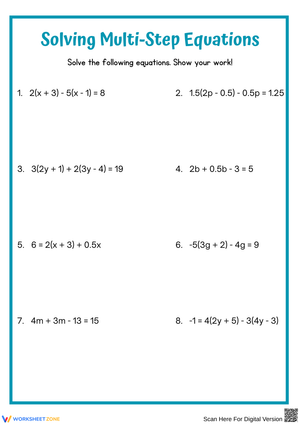
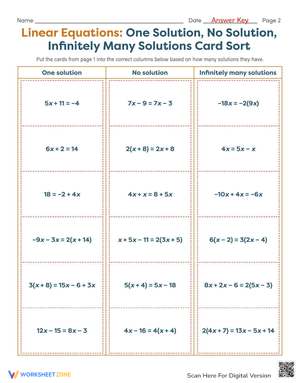
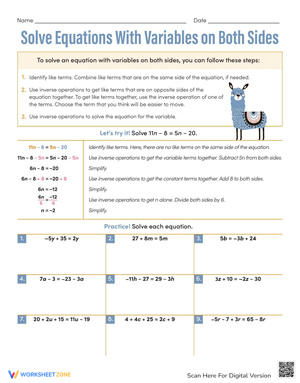
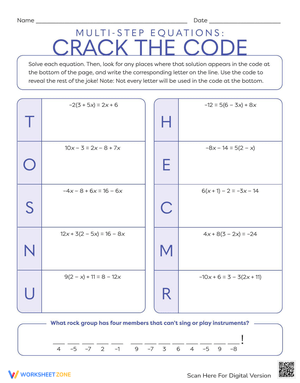
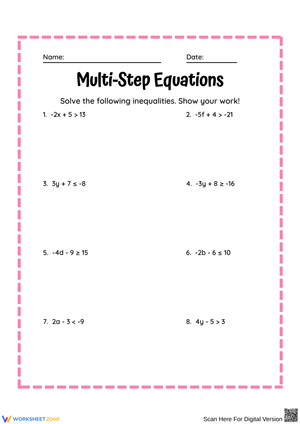
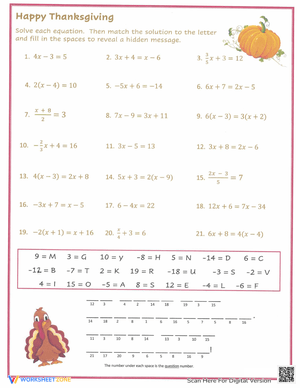
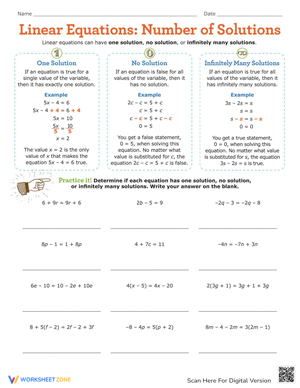
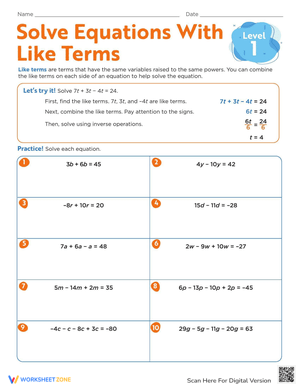
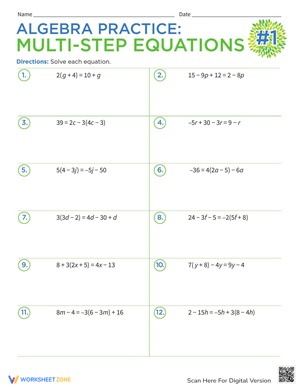
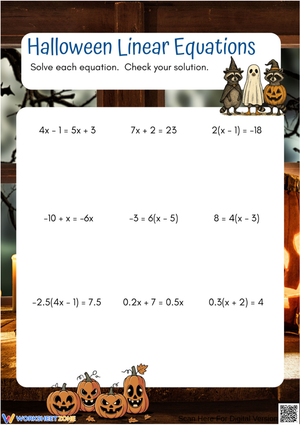
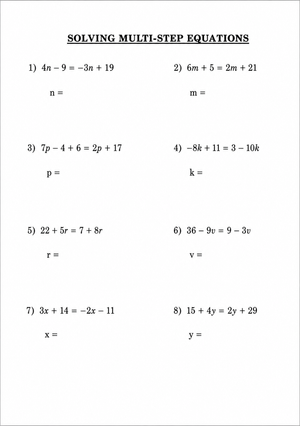
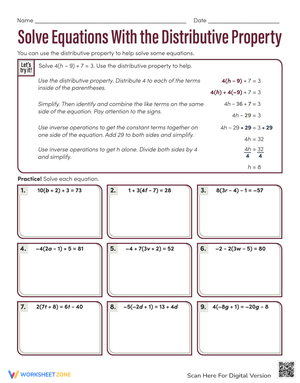
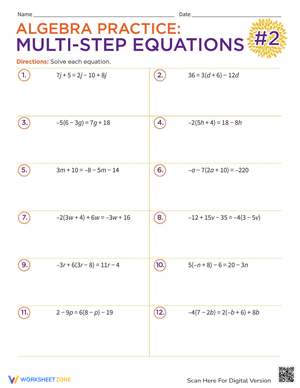
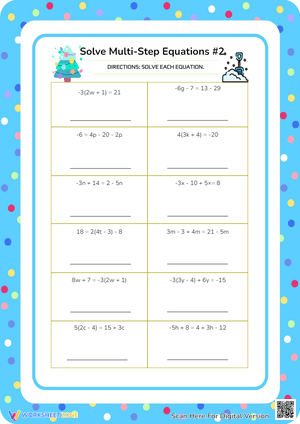
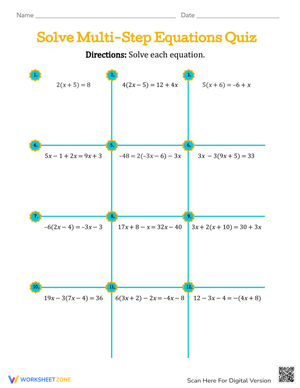
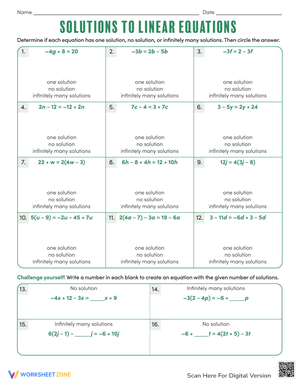
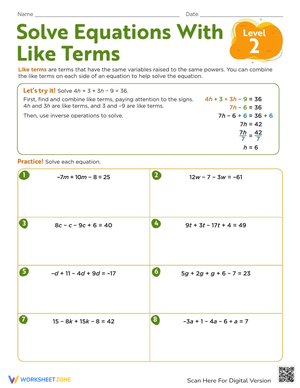
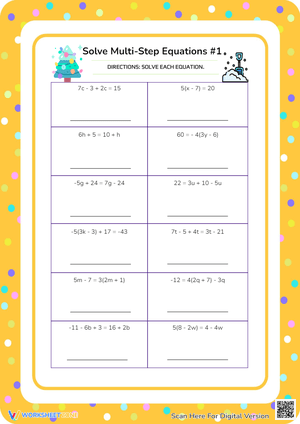
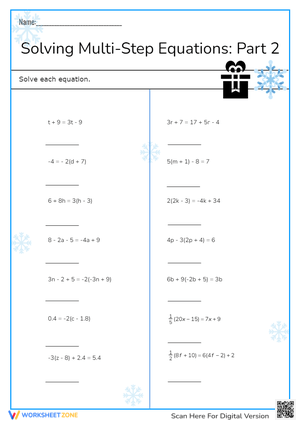
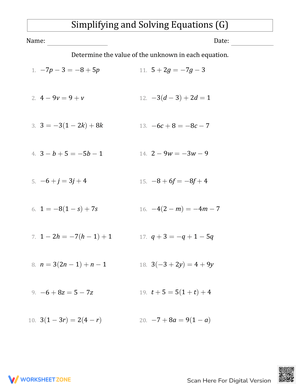
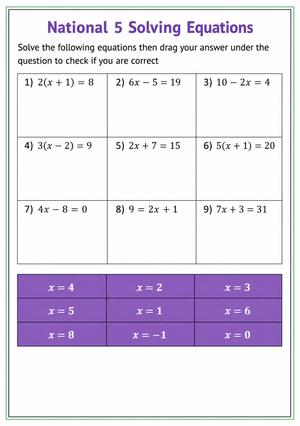
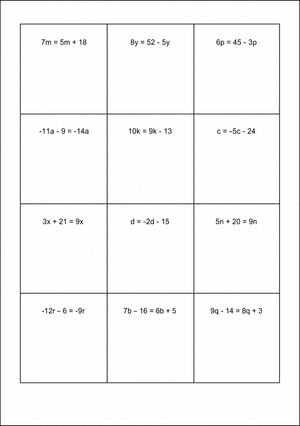
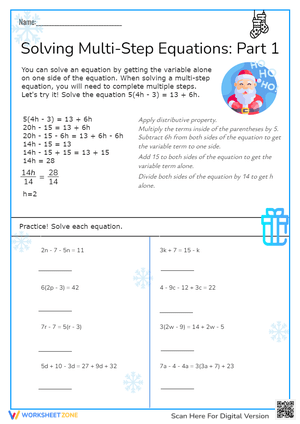
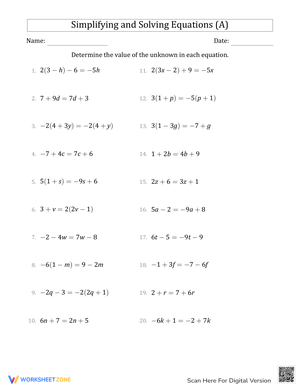
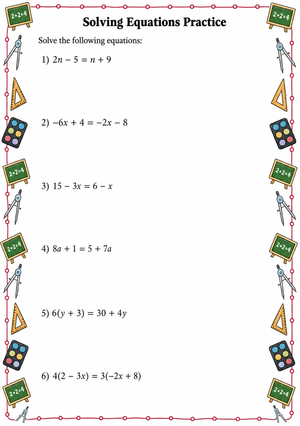
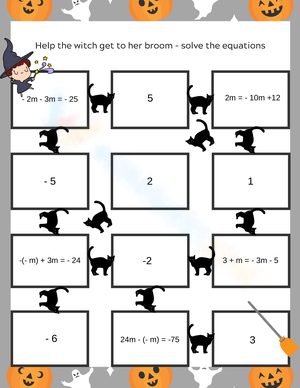
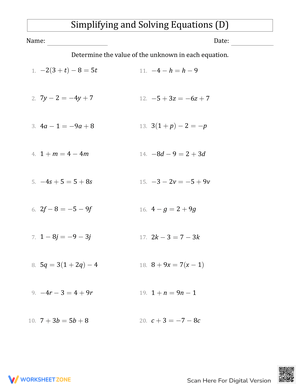
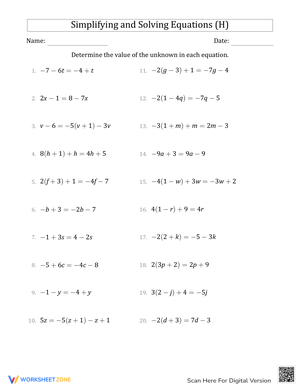
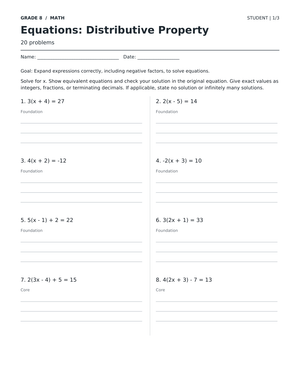
These 8th grade multi step equations pdf worksheets give math teachers a printable set organized by problem structure, formatted with room for students to show every algebraic step, and paired with answer keys that make independent and station-based practice manageable without constant teacher involvement. Grade 8 is the grade where equation work is supposed to consolidate — students have seen one- and two-step equations in 7th grade, and the expectation now is accuracy across longer, more complex solving sequences — so the format needs to support that kind of sustained, visible step-by-step work.
What Students Practice Across the Set
The worksheets follow the natural learning progression of Grade 8 algebra. Problems start with combining like terms and applying the distributive property with all variable terms on one side, then build toward equations with variables on both sides and rational-number coefficients. Each worksheet stays within one or two structural categories rather than mixing every type at once, which helps teachers identify exactly where a student's reasoning breaks down rather than getting a blurry picture from a fully mixed review.
The skills covered across the set include:
- Simplifying each side before applying inverse operations
- Distributing correctly through subtraction — 3(x − 5) is a predictable sticking point
- Moving variable terms from both sides while keeping signs intact
- Solving equations with fraction and decimal coefficients
- Verifying solutions by substituting back into the original equation
- Translating brief word problems into equations and solving
That last skill deserves separate attention. Students who handle purely symbolic equations fluently can still stall when the same operation is embedded in a sentence. Word problems — even two-sentence items — require students to construct the equation rather than execute a procedure, and that transfer is exactly what unit assessments and standardized math tests measure.
Mistakes Teachers Should Anticipate and Address Before They Compound
The most consistent error pattern in multi-step equation work is partial distribution. A student solving 4(x − 3) = 20 frequently writes 4x − 3 = 20 — multiplying the variable term but leaving the constant inside the parentheses unchanged. The result looks superficially reasonable, so students often don't catch it when reviewing their own work. A concrete classroom response: ask students to underline every term inside the parentheses before distributing, so they can see at a glance how many separate multiplications the step requires.
Sign errors when moving variable terms across the equals sign are the second major pattern. Students who handle 2x + 6 = 10 correctly will often write 5x = 10 instead of 5x = −4 when moving a term that produces a negative constant. Asking students to circle the sign attached to each term — not just the numeral — before performing any operation catches this category of mistake earlier than waiting to mark a final answer wrong.
Two more patterns are consistent enough to plan for. The first is combining unlike terms — treating a coefficient and a constant as the same type, then adding them as if they were. The second is stopping after simplifying both sides without completing the final isolation step, which tends to appear in the last few problems of a set when students are rushing to finish rather than thinking through the full sequence.
Fitting These Worksheets Into Weekly Lesson Plans
The strongest organizational move is to sort worksheets by error type rather than by difficulty level alone. Keep one group focused on distribution problems, a second on sign management when moving variable terms, and a third on equations with variables on both sides. When a quiz shows that a cluster of students dropped points on every distribution item, pulling the right worksheet takes seconds rather than requiring a new lesson or a from-scratch activity.
For warm-up use, two or three problems from a worksheet at the start of class are enough to revisit the prior day's structure without consuming instruction time. The 8 to 10 minutes immediately after transition — when students are settling and pencils are already out — is the natural slot. Keeping the warm-up routine stable across the unit matters: when students already know the format, their attention stays on the algebra rather than on figuring out what they're supposed to do with the worksheet in front of them.
Small groups respond well to a three-pass approach with each worksheet: first, students solve with teacher support; second, they compare answers using the included answer key; third — and this is the step worth protecting — they name the specific operation most likely to generate an error and explain why. That reflection pass is what separates mechanical practice from reasoning that sticks. These 8th grade multi step equations pdf worksheets support that structure because each worksheet stays narrow enough that the error conversation stays focused too.
Standard Alignment
The set aligns to CCSS 8.EE.C.7, which requires eighth graders to solve linear equations in one variable. The directly relevant sub-standard is 8.EE.C.7b: solving linear equations with rational-number coefficients, including equations requiring the distributive property and collecting like terms. Those two skills — distribution and combining like terms — are the structural core of most problems in the set, so the alignment is substantive rather than nominal.
8.EE.C.7a asks students to recognize equations with one solution, no solution, or infinitely many solutions — a concept that becomes accessible once students have solid procedural footing with multi-step solving. Word-problem items in the set create a natural opening to introduce those cases: when a student builds an equation from a verbal description and the variable terms cancel out on both sides, the result is a built-in prompt to discuss what happens when an equation has no unique solution.
Adjusting the Set for Different Student Levels
Students who need more support begin with integer-only equations where all variable terms appear on one side. The immediate goal is to automate the two-move sequence — simplify, then isolate — before adding distribution or variables on both sides. Having those students write the name of the operation they plan to use before they apply it slows the impulse to operate randomly and builds deliberate, step-by-step reasoning. Teachers using 8th grade multi step equations pdf worksheets with a wide ability range often treat the first few worksheets in the set as diagnostic tools — seeing where each student's thinking breaks down before deciding which problems to assign next.
On-level students work through mixed sets that require both combining like terms and distributing, a combination that better reflects what they encounter on unit assessments. Keeping the worksheet format consistent here matters: when students aren't also decoding a new structure while navigating harder algebra, cognitive attention stays where it belongs.
Advanced students are ready for fraction and decimal coefficients, two-step word problems, and problems that ask them to verify whether a given solution is correct before solving independently. A practical extension that requires no separate materials: assign the same worksheet to everyone, but ask advanced students to write one or two sentences identifying which step is most likely to cause a peer to make an error and why. That writing demand produces genuine algebraic thinking without pulling those students into a separate curriculum track.
Frequently Asked Questions
What equation types should 8th graders handle by end of unit?
By the close of a multi-step equations unit, students should solve equations requiring combining like terms, distributing, moving variables from both sides, and working with rational coefficients. Verifying solutions by substitution should be a routine step rather than an occasional add-on. Students who can solve only one structural type reliably are not yet at mastery — a short mixed review at unit's end surfaces that gap quickly.
Do the worksheets include answer keys?
Yes. Answer keys come with the set, and they're the feature teachers mention most often when explaining why these resources get used repeatedly rather than once and filed. For homework review, station rotations, peer-checking in small groups, and substitute coverage, having an answer key in hand is the difference between a practice resource that functions independently and one that requires teacher presence to confirm every result.
How many problems is a realistic amount for a 20-minute independent practice block?
Ten to twelve problems is the practical range for most 8th grade students during a standard practice block. More than fifteen and the final few problems get rushed or skipped entirely; fewer than eight and there is not enough variety across problem types to surface different error patterns. Short, focused sets consistently produce more readable evidence of student understanding than longer ones where the back third reflects speed more than skill.
Can these worksheets be used alongside a unit that also covers one- and two-step equations?
Most Grade 8 sequences treat one- and two-step equations as 7th grade content, so the expectation in 8th grade is consolidation and extension rather than reintroduction. For students who still need that foundation, the progressive structure of 8th grade multi step equations pdf worksheets lets teachers assign the entry-level worksheets in the set to those students — using them diagnostically to find the right starting point — without separating those students into an entirely different curriculum track.













 Interactive Worksheet Maker
 Quiz Maker
 Word Search Maker
 Crossword Puzzle Maker
 Word Scramble Generator
 Sentence Scramble Generator
 Handwriting Worksheet Generator
 Name Tracing Generator
 Fill In The Blank Generator