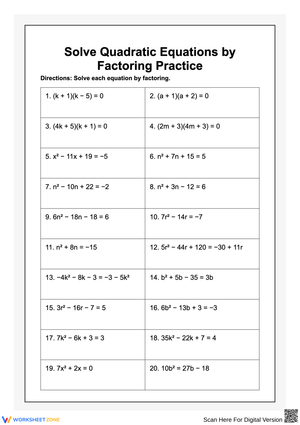
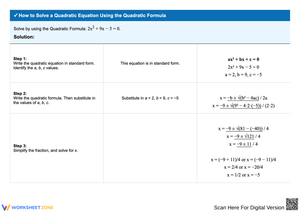
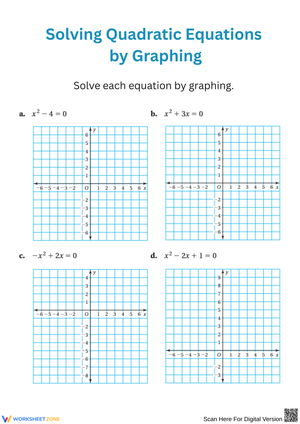
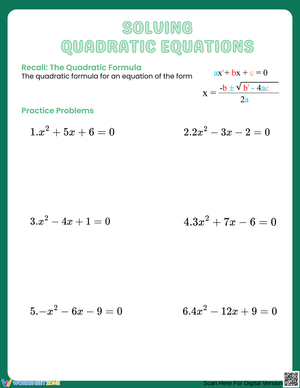
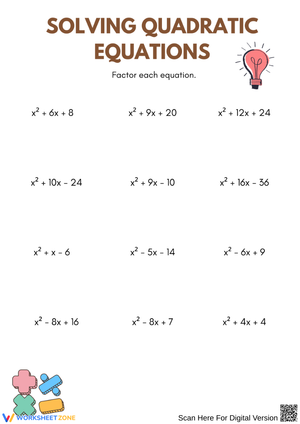
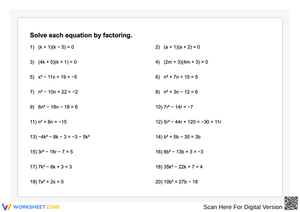
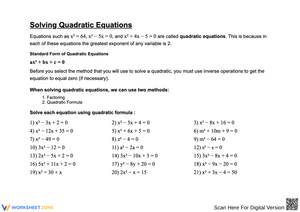
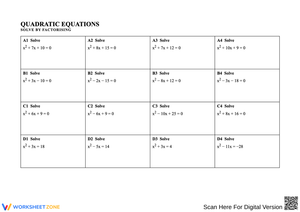
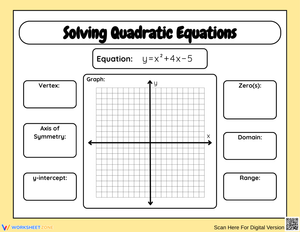
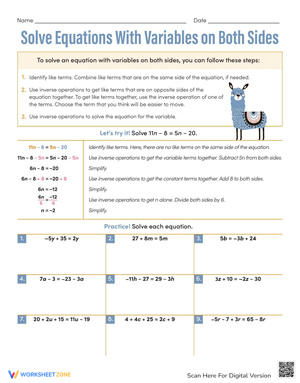
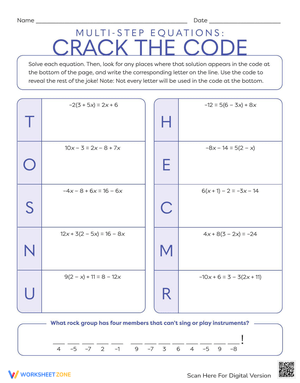
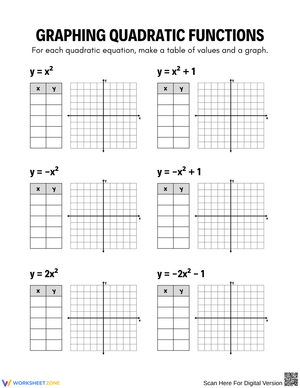
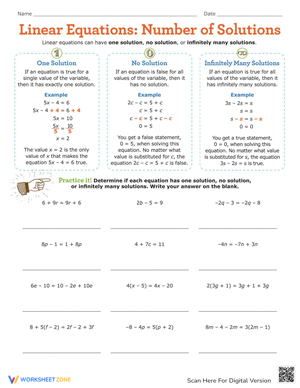
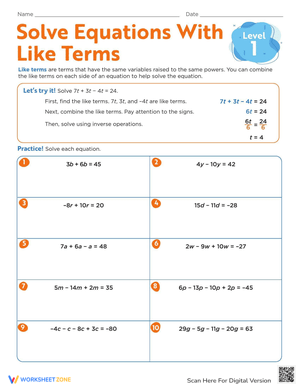
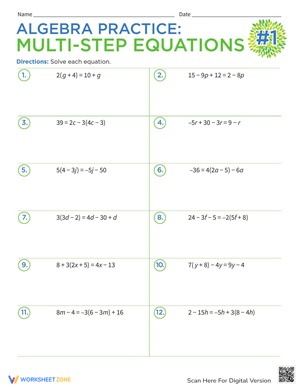
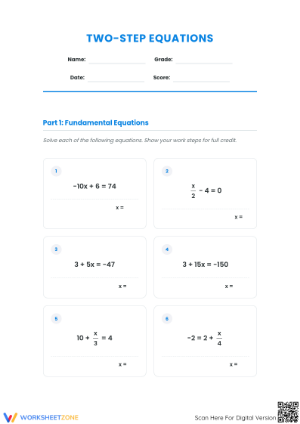
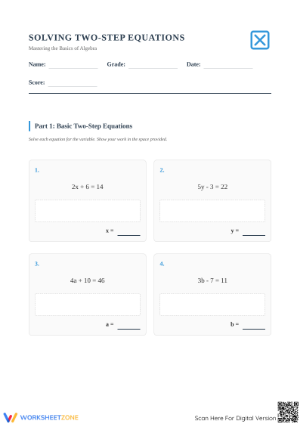
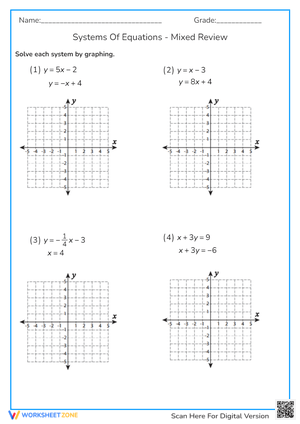
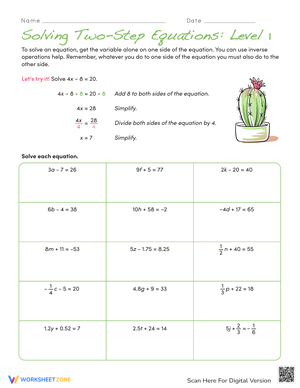
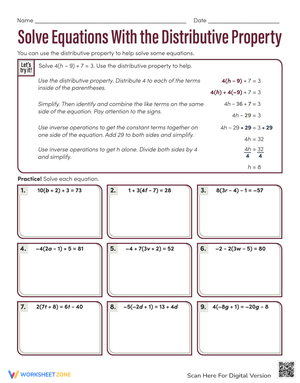
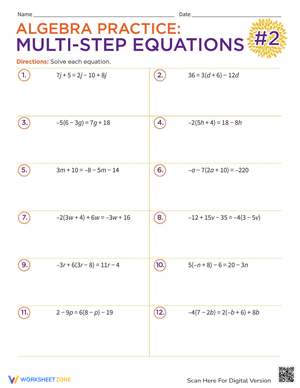
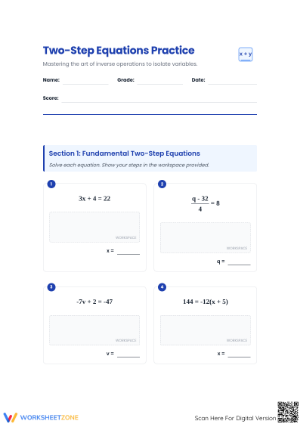
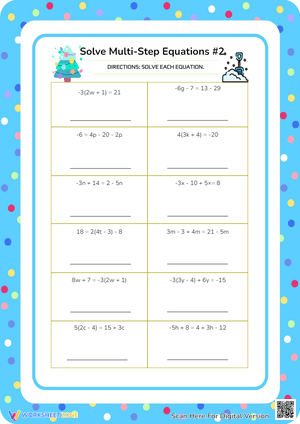
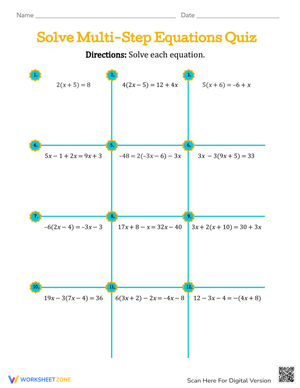
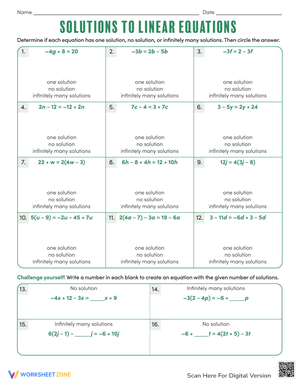
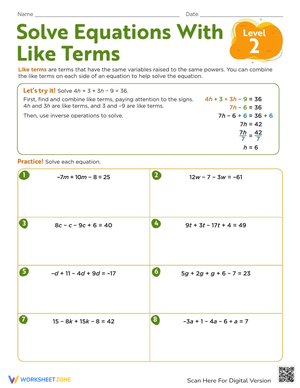
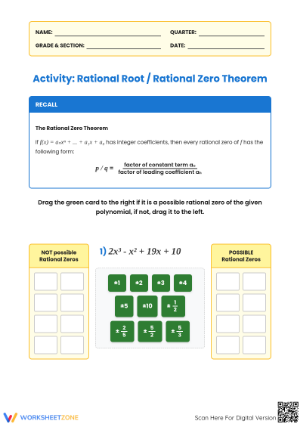
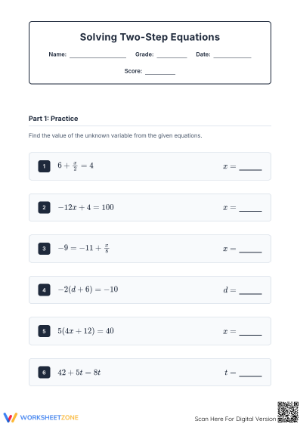
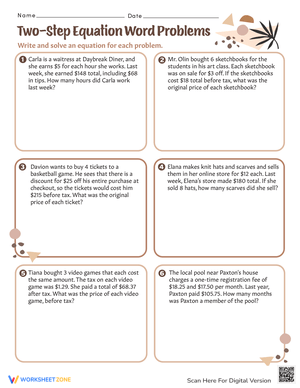
These 8th grade solving equations printable worksheets resources cover the full range of equation types teachers work through in a typical pre-algebra unit: one-step review, two-step with inverse operations, multi-step with like terms, the distributive property, and variables on both sides. Each worksheet targets a specific structure, so teachers can assign exactly what a class needs without sorting through a general mixed set. The formatting keeps workspace open because equation solving is inherently step-based — students need room to distribute, cancel, and annotate their way to a solution.
What Each Worksheet in the Set Covers
The set moves through equation types in a deliberate order that mirrors how most Grade 8 teachers sequence the unit. One-step and two-step worksheets come first, reinforcing inverse operations before students face problems that demand more than two moves. Multi-step worksheets introduce combining like terms, where many students begin to lose the thread. Distributive property worksheets require students to expand before solving, and the final tier — variables on both sides — demands strategic movement of terms while keeping equality intact across every step.
Within each type, the worksheets include integer-only problems and mixed problems with fractions and decimals. Integer-only worksheets work well early in a unit or with students still building procedural confidence. Mixed worksheets add numerical complexity once the solving process feels routine. Answer keys accompany each worksheet, and a strong key does more than confirm the final value — it shows the expected sequence of steps, which matters when students arrive at a correct answer through a non-standard path.
Student Error Patterns Worth Catching Before They Cement
The most persistent error in distributive property equations is the dropped negative. When students see −3(x − 4), they distribute correctly to −3x, then write −12 instead of +12 — or reverse that mistake. The second term inside the parentheses catches them because distributing a negative across a subtraction requires two sign changes in quick succession. This is worth an explicit heads-up before independent practice, or the same mistake will appear across the whole class in the same place every time.
A second pattern surfaces when equations have variables on both sides. Students who get to 5x − 2 = 3x + 8 will subtract 3x from the right but forget the left, or they skip subtracting the variable term entirely and just move the constant. The gap here is not arithmetic — it is the idea that whatever you do to one side applies to the other, including variable terms. Students who have been solving equations with constants only sometimes treat variable terms as if they exist outside the equation's balance. A single worked example before students open their worksheets catches this before it hardens into habit.
Fitting These Worksheets Into Your Weekly Lesson Plan
These worksheets hold up across multiple classroom moments without any adjustment: warm-up review in the opening five minutes, guided practice after direct instruction, independent seat work, partner checking, and end-of-week quiz-style review. A single-type worksheet — say, multi-step with combining like terms — works cleanly as Tuesday guided practice when it feeds directly into the day's lesson. A mixed-type worksheet lands better on Thursday, when students should be selecting strategies without teacher prompting before the week's assessment.
For sub plans, a well-organized worksheet requires almost no setup. Leave the key, mark which problems to complete, and students can self-check. For reteach groups pulled during class, trimming a worksheet to six or eight targeted problems is more productive than running the full set — the goal is re-establishing the process, not volume. The 8th grade solving equations printable worksheets format means a teacher can keep a ready stack without depending on a digital tool being available or a student device being charged.
For intervention, the week might run like this: Monday uses a short two-step integer set as a reentry point. Wednesday uses a multi-step worksheet as guided practice with pauses for class discussion. Friday uses a mixed set as an informal assessment the teacher scans before planning Monday's approach. That rotation does not require new materials each time — just intentional choices about which worksheet fits which moment.
Matching These Worksheets to Where Students Actually Are
Differentiation in equation practice works best when the adjustment is structural rather than just assigning fewer problems. One approach: print three versions of the same multi-step worksheet. The first includes a boxed step reminder at the top — something like Step 1: Distribute. Step 2: Combine like terms. Step 3: Isolate the variable. The second version has standard directions. The third swaps in fraction coefficients or variables on both sides, raising the mathematical demand without changing the skill focus. Students work on the same concept at different levels of complexity — no one is doing a different lesson, just a version that matches their readiness.
Students still working on two-step equations benefit from integer-only practice where the process itself is the challenge. Students who have that down can move to multi-step sets with rational coefficients. Students ready for extension can verify their solutions by substituting back into the original equation — a second layer of algebraic thinking that doesn't require a separate worksheet. The 8th grade solving equations printable worksheets set covers enough types and number ranges that most classes can run three or four readiness-matched tracks without the teacher building additional resources from scratch.
Frequently Asked Questions
What equation types matter most for 8th grade algebra readiness?
Students at this level need regular practice with two-step equations, multi-step equations involving like terms, the distributive property, and variables on both sides. One-step equations belong in the set too, as quick review and confidence resets at the start of a unit or after a break. Variables on both sides carries the heaviest weight for transition to high school algebra.
How do these worksheets work in a mixed-ability class?
Well — when assigned by problem type rather than all at once. Giving every student the same general review worksheet each day limits how much you can adjust on the fly. Organizing practice by equation type lets one group work integer-only two-step equations while another group tackles multi-step problems with rational coefficients. The worksheets don't differentiate automatically, but the structure makes it manageable to run parallel tracks in the same class period.
When should fractions and decimals enter equation practice?
After students have a reliable process with integer equations. Rational number coefficients raise the arithmetic demand without changing the equation-solving steps — but if students are still unsure whether to add or subtract first, adding fractions creates two overlapping sources of confusion. Once the process is solid, mixed-number problems add appropriate rigor and prepare students for the numerical range they will encounter on grade-level assessments.
What makes a useful answer key for this type of practice?
A key that shows intermediate steps, not just final values. For multi-step and variables-on-both-sides problems, a step-level key lets teachers identify exactly where a student's work diverged — at distribution, at combining, or at the final isolation move. An 8th grade solving equations printable worksheets set with that kind of key cuts the time spent tracing individual errors significantly, which matters most during reteach sessions when the teacher is moving between groups.













 Interactive Worksheet Maker
 Quiz Maker
 Word Search Maker
 Crossword Puzzle Maker
 Word Scramble Generator
 Sentence Scramble Generator
 Handwriting Worksheet Generator
 Name Tracing Generator
 Fill In The Blank Generator