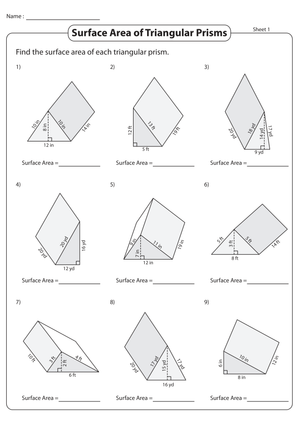
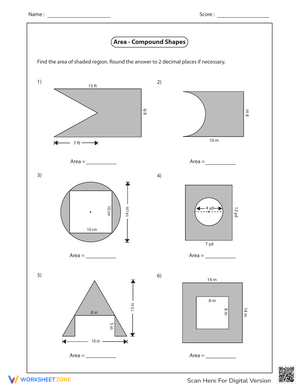
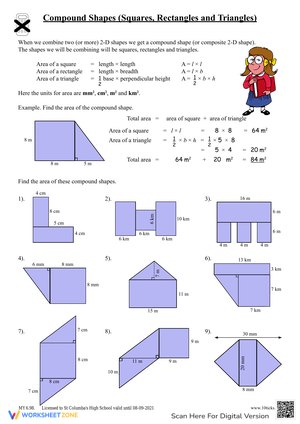
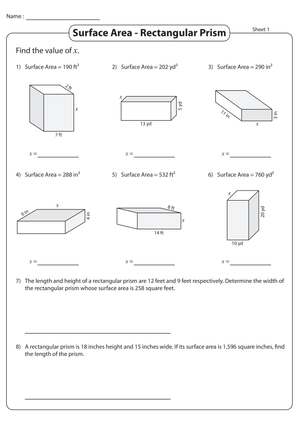
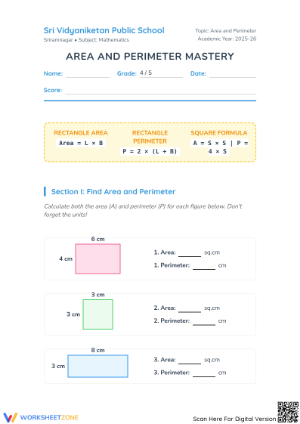
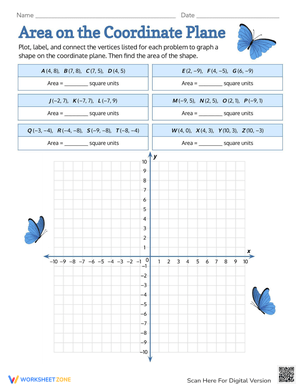
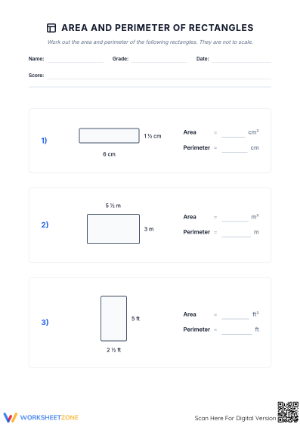
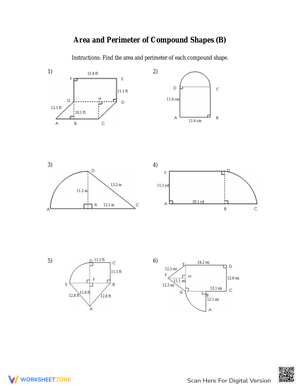
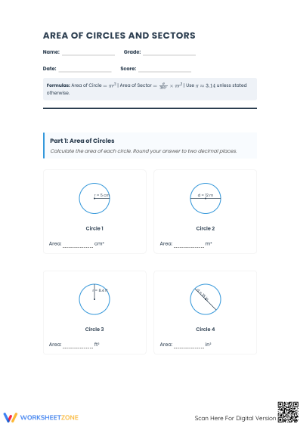
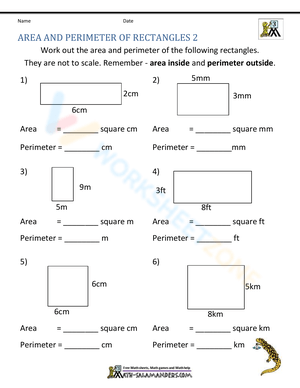
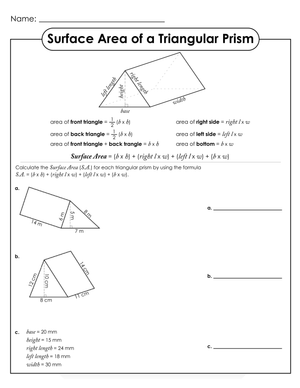
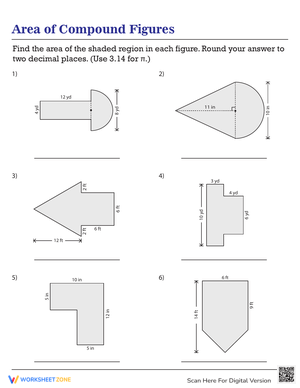
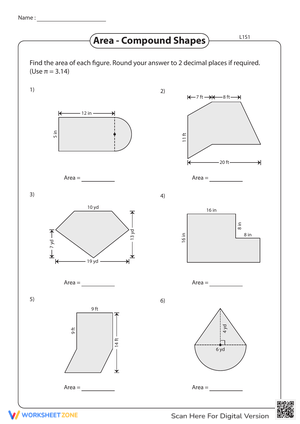
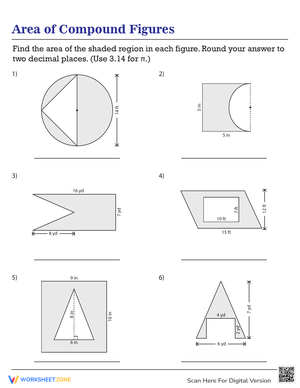
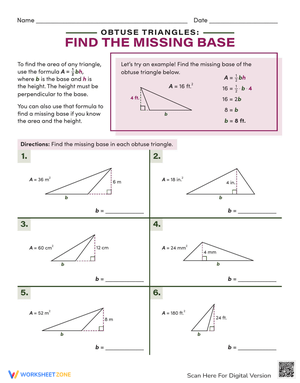
These area printable worksheets for 7th grade give teachers a ready-to-use practice sequence spanning the full geometry strand — triangles, parallelograms, trapezoids, circles, and composite figures — with diagrams clean enough that students can focus on the math rather than interpreting a cluttered drawing. The set moves from single-formula fluency to multi-step reasoning, which makes it useful whether you're opening a geometry unit or consolidating skills before an assessment.
Skills and Figure Types Across the Set
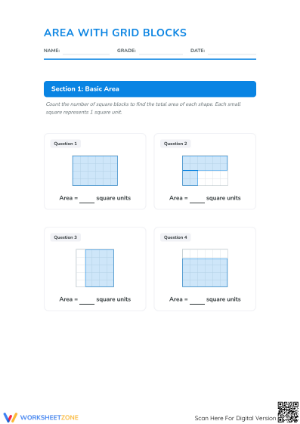
Each worksheet in this set of area printable worksheets for 7th grade targets a specific part of the area progression students work through in a standard geometry unit. The sequence doesn't skip from rectangles to composite figures — it builds through each major figure type before bringing them together in mixed review.
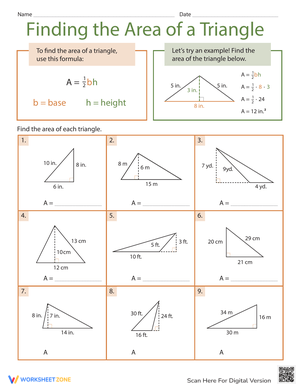
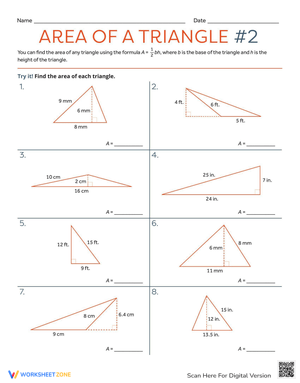
- Triangles: Students identify the perpendicular height — not the slant side — and apply A = ½bh across multiple orientations, including rotated and obtuse triangles where the height falls outside the figure.
- Parallelograms: Problems reinforce that the labeled leg is not automatically the height. Students use the perpendicular distance between bases, not the slant side length, across each worksheet in this strand.
- Trapezoids: Students work with both parallel bases and connect the average-base idea to the formula before applying it to labeled diagrams.
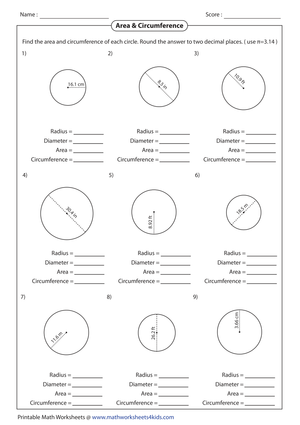
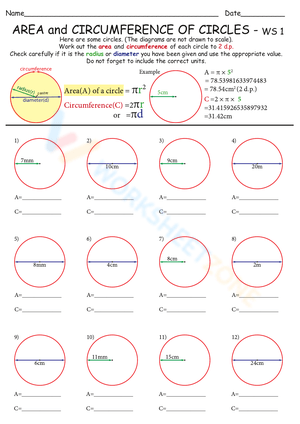
- Circles: Problems are written with either the radius or diameter labeled, so students must decide which value to substitute into A = πr² before computing. Reasonable approximations for π are used throughout.
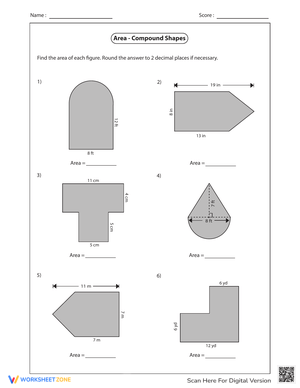
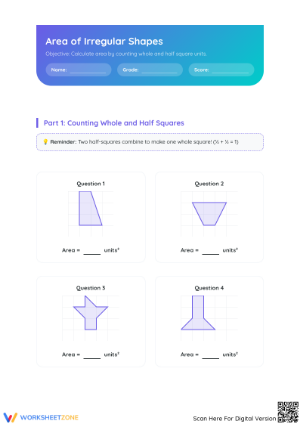
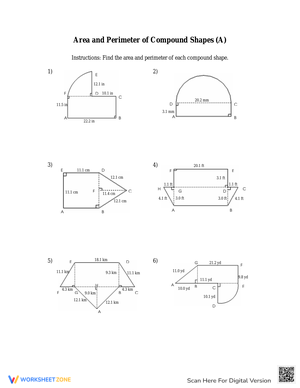
- Composite figures: Students decompose larger shapes into familiar parts and either add region areas or subtract a missing section from a whole. Figures range from rectangles combined with triangles to shapes that require removing a circular region.
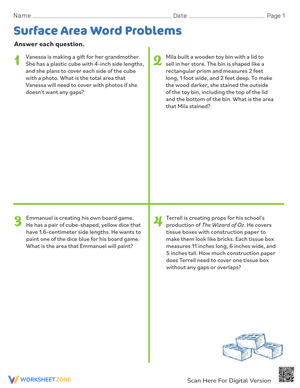
- Word problems: Real-world contexts ask students to identify which measurements matter, apply the correct formula, and check whether the result makes sense for the situation described.
Student Errors That Show Up Reliably in This Unit
The most frequent area mistake in 7th grade isn't forgetting a formula — it's using the wrong measurement. In parallelograms and triangles, students consistently grab the labeled slant side as the height because it's printed on the diagram and looks like it measures how tall the shape is. A parallelogram with a base of 8 cm, a slant side of 5 cm, and a perpendicular height of 4 cm will generate answers of 40 sq cm far more often than 32 sq cm in any mixed classroom. The worksheets address this directly by presenting diagrams where the perpendicular height is marked with a separate dashed line, and students must locate it before writing the formula.
Triangle problems expose a different error: students who correctly write A = ½bh will still compute b × h and drop the ½ when they shift into calculation mode. This happens most often when students are working quickly or without checking back at the formula. Enough triangle problems across different orientations — including triangles where the height line falls outside the figure — give this error time to surface before it disappears into a wrong test answer.
Circle problems introduce a third predictable mistake. Students who see a diameter of 10 cm will compute π × 10² rather than halving first. This isn't a formula-recall failure; most of them know r stands for radius. It's a reading habit — they grab the most visible number without verifying what it represents. A few worksheets that label diameter rather than radius catch this pattern early, when there's still time to correct it.
Fitting These Worksheets Into the Instructional Week
The most effective use of this set is targeted rather than broad. Each worksheet works best when assigned with a specific instructional purpose, not dropped in as filler practice.
- Day-after warm-up: After introducing a new shape type, open the following class with 3–4 focused problems from the matching worksheet before new content begins.
- Annotation routine: Before students calculate anything, direct them to circle the base, box the height, and write the formula. This makes thinking visible and slows down the guessing that produces slant-side errors.
- Station rotation: Place single-shape fluency practice at one station and composite figure problems at another. The consistent format lets students work independently at both without needing separate sets of directions.
- Reteach pulls: Students who confuse height with slant side need targeted work — not another full mixed review. Pull one or two worksheets that isolate that distinction rather than burying it inside a longer set.
- Pre-assessment check: Run a short mixed worksheet before moving into surface area. Students who can't find the area of a triangle or trapezoid reliably will struggle immediately once three-dimensional figures enter the picture.
One limitation worth naming: the worksheet format works well for students who can read a diagram independently. Students who freeze when a height is unlabeled or positioned outside the figure will need direct, hands-on instruction before independent worksheet practice pays off for them. These resources consolidate understanding — they don't build it from scratch.
Standard Alignment
These worksheets align to CCSS 7.G.A.6, which asks students to solve real-world and mathematical problems involving the area of two-dimensional objects composed of triangles, quadrilaterals, and polygons. In most classroom sequences, this standard lands in the second half of the year — after proportional reasoning work is established and before instruction shifts to surface area and volume. Teachers who use these area printable worksheets for 7th grade as the practice layer for 7.G.A.6 will find that the figure range, from basic triangles through composite shapes, maps directly onto the problem types the standard describes, including the real-world context problems that appear on both classroom assessments and state tests.
Tiering the Set for Different Levels of Readiness
Most 7th grade groups include students still building confidence with basic formulas alongside students ready for multi-step problems. Printable sets make this manageable because teachers can assign different worksheets from the same collection without constructing a separate lesson for each tier.
Students who need additional support work best with whole-number dimensions, one shape category per worksheet, and a formula reference at the top of the page. Keeping the visual load minimal — one clearly labeled figure per problem — lets them build accuracy before complexity increases. On-level students benefit from mixed figure types, problems with fractional or decimal dimensions, and word problems that ask them to choose the correct formula without a prompt. For students ready for more challenge, use worksheets with missing-dimension problems where area is given and students solve for a base or height, composite figures combining three or more regions, and items that ask for a written explanation of why one figure has a greater area than another despite similar-looking side lengths. Because the format stays familiar across tiers, the debrief at the end of class can bring the whole group back together around the same core ideas.
Frequently Asked Questions
Do these worksheets include circle area problems, or only polygon types?
Circle area problems are included. Items are written with either the radius or diameter labeled, so students decide which value to substitute rather than always receiving the radius directly. Some worksheets also include composite figures that require subtracting a circular region from a rectangle or polygon.
How are composite figures handled — addition, subtraction, or both?
Both. Some composite figure worksheets ask students to add the areas of two or more regions. Others present a whole figure with a section removed, and students find the area by subtraction. Students are not told which method applies — reading the figure to determine the approach is part of the task, which reflects the reasoning demand in 7.G.A.6 rather than reducing the problem to a repeatable procedure.
Can these worksheets be used for test prep?
Running a short mixed worksheet from this set of area printable worksheets for 7th grade the week before a unit assessment gives teachers a fast read on which formula confusions still need attention. The mixed review worksheets include varied figure types, some word problem contexts, and problems where students must select the correct formula without visual cues pushing them toward one approach — conditions that match what students encounter on standardized assessments.
Do the worksheets come with answer keys?
Answer keys are included with the set. They support self-checking during independent practice, make intervention pulls easier without requiring pre-grading, and allow the worksheets to be used reliably for substitute coverage or homework review without extra teacher prep.













 Interactive Worksheet Maker
 Quiz Maker
 Word Search Maker
 Crossword Puzzle Maker
 Word Scramble Generator
 Sentence Scramble Generator
 Handwriting Worksheet Generator
 Name Tracing Generator
 Fill In The Blank Generator