




























Views
Downloads
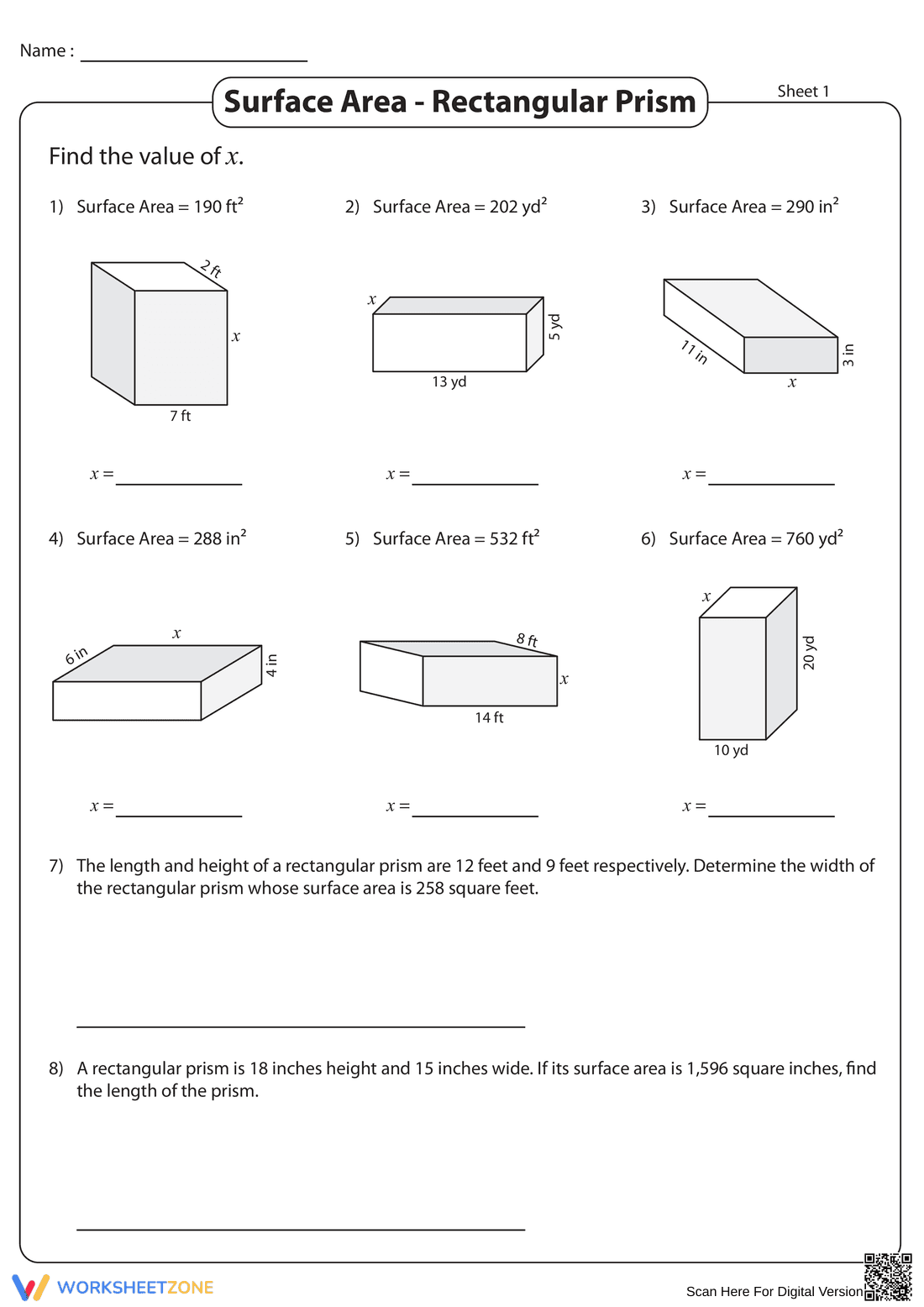

Missing Dimension Surface Area Worksheet | Grade 7 Ready

Paste this activity's link or code into your existing LMS (Google Classroom, Canvas, Teams, Schoology, Moodle, etc.).
Students can open and work on the activity right away, with no student login required.
You'll still be able to track student progress and results from your teacher account.
This Grade 7 geometry worksheet empowers students to master the relationship between surface area and linear dimensions. By working backward from a known area to find a missing length, width, or height, learners develop a deeper conceptual understanding of three-dimensional space and algebraic substitution. This resource is designed to move students from basic calculation to higher-order problem solving.
At a Glance
- Grade: 7 · Subject: Math
- Standard:
CCSS.MATH.CONTENT.7.G.B.6— Solve real-world problems involving surface area of three-dimensional objects- Skill Focus: Finding missing dimensions
- Format: 1 page · 8 problems · Answer key included · PDF
- Best For: Independent practice or formative assessment
- Time: 20–30 minutes
The resource contains 8 rigorous problems designed to test geometric fluency. The first 6 problems provide clear 3D diagrams of rectangular prisms with two dimensions and the total surface area labeled, requiring students to solve for the variable x. The final 2 problems transition into text-based word problems, challenging students to visualize the shapes without visual aids. A full answer key is provided for immediate feedback and grading efficiency.
Skill Progression
- Guided practice: The first two problems use simple integers and clear labels to help students set up the surface area formula SA = 2(lw + lh + wh).
- Supported practice: Problems 3 through 6 introduce varying orientations and different units of measurement, such as inches, yards, and feet, to ensure unit consistency.
- Independent practice: The concluding word problems require students to extract data from text and apply the formula independently without a visual scaffold.
This sequence follows a gradual-release model, moving from visual identification to abstract problem-solving.
Standards Alignment
This worksheet is specifically aligned to `CCSS.MATH.CONTENT.7.G.B.6`, which focuses on solving real-world and mathematical problems involving area, volume, and surface area of two- and three-dimensional objects. It also supports Grade 6 standards for surface area and Grade 8 algebraic manipulation skills. Both standard codes can be copied directly into lesson plans, IEP goals, or district curriculum mapping tools.
How to Use It
Use this worksheet as a mid-unit check for understanding after students have mastered calculating total surface area. It serves as an excellent bridge to more complex algebraic geometry. During instruction, observe if students correctly distribute the 2 in the formula or if they struggle with isolating the variable; this provides a clear formative assessment of their algebraic readiness. Completion typically takes 25 minutes.
Who It's For
This resource is ideal for middle school students in Grades 7 and 8 who are ready to move beyond basic computation. It provides necessary rigor for advanced Grade 6 learners and serves as a helpful review for Grade 9 students. Pair this with a reference sheet or anchor chart showing the rectangular prism net for students requiring additional visual support.
According to the RAND AIRS 2024 report on mathematics instruction, the ability to manipulate geometric formulas is a critical predictor of success in high school algebra. This worksheet targets that specific intersection by requiring students to use the CCSS.MATH.CONTENT.7.G.B.6 standard to solve for unknown variables within a geometric context. Research from Fisher & Frey (2014) emphasizes that "working backward" problems, like finding a missing dimension from a total area, significantly increase cognitive load and lead to more durable learning compared to simple rote calculation. By providing 8 distinct opportunities to apply the surface area formula in reverse, this resource ensures that students move beyond surface-level memorization toward a functional mastery of spatial relationships and algebraic balance. This evidence-based approach helps bridge the gap between middle school geometry and the more abstract demands of secondary mathematics.


