




























Views
Downloads


Fractions, Decimals, & Percents: Essential Grade 6 Practice

Paste this activity's link or code into your existing LMS (Google Classroom, Canvas, Teams, Schoology, Moodle, etc.).
Students can open and work on the activity right away, with no student login required.
You'll still be able to track student progress and results from your teacher account.
This Grade 6 Math worksheet provides comprehensive practice for students to master the fluid conversion between fractions, decimals, and percentages. By engaging with multiple representations of rational numbers, learners build the conceptual foundation necessary for advanced algebraic thinking and real-world financial literacy. This resource ensures students can confidently navigate various mathematical contexts with precision.
At a Glance
- Grade: 6 · Subject: Math
- Standard:
CCSS.MATH.CONTENT.6.RP.A.3.C— Find a percent of a quantity as a rate per 100- Skill Focus: Rational number conversions and comparisons
- Format: 3 pages · 22 problems · Answer key included · PDF
- Best For: Mid-unit practice or formative assessment
- Time: 30–45 minutes
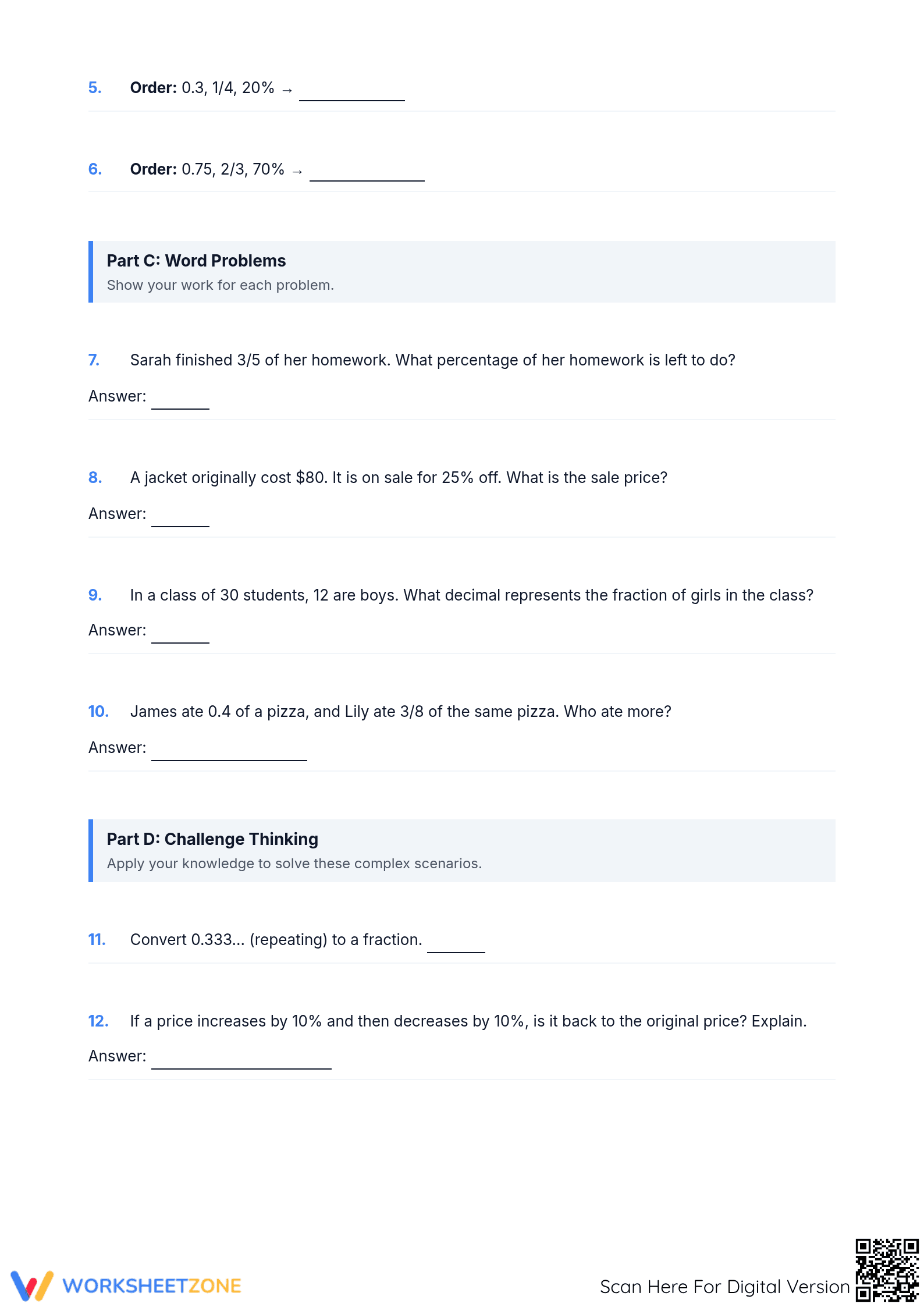
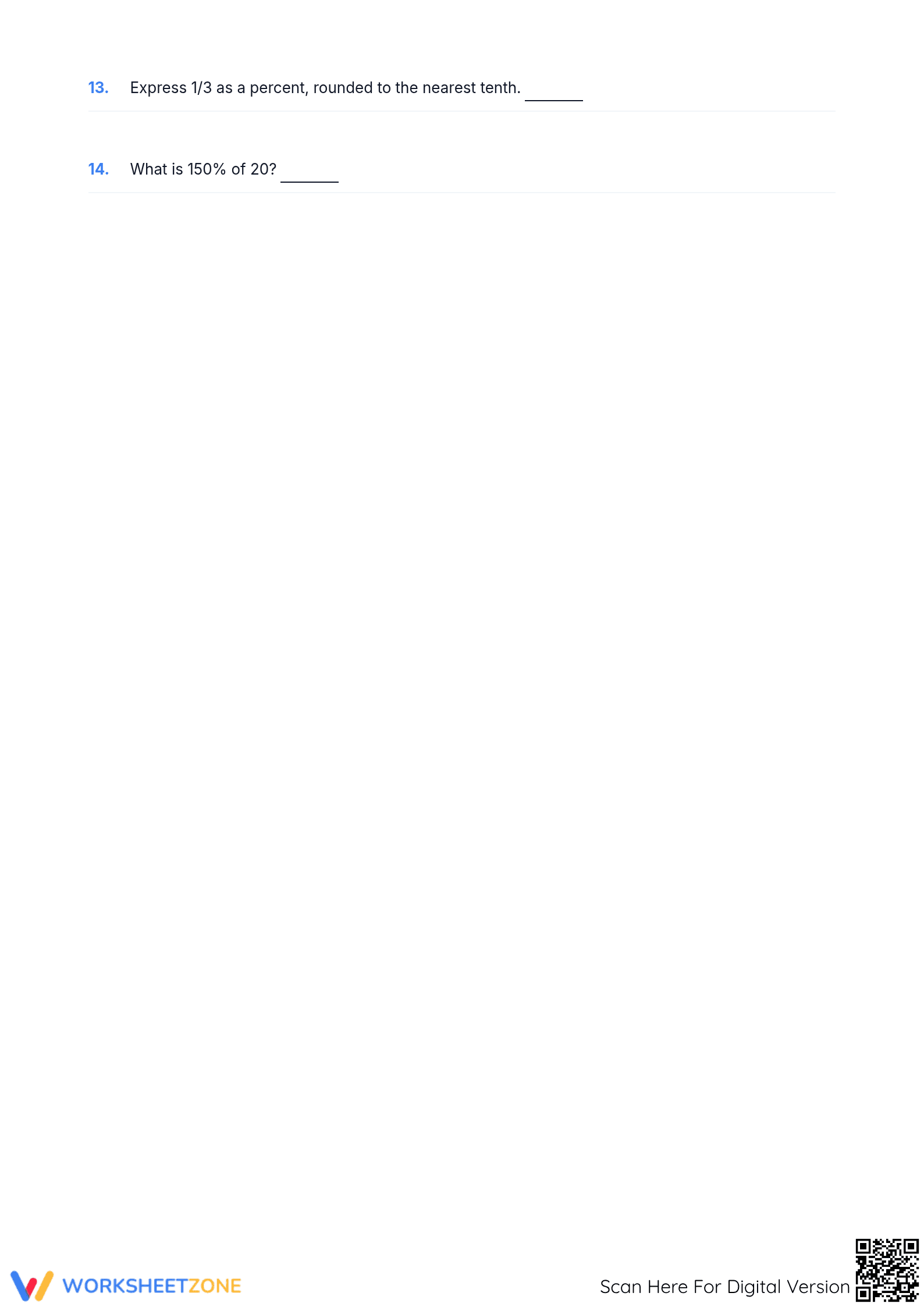
The worksheet is structured across three pages, beginning with a detailed conversion table that requires students to fill in missing simplest-form fractions, decimals, and percents. It transitions into inequality comparisons and ordering sets from least to greatest. The final sections present four contextual word problems and four challenge thinking scenarios involving repeating decimals and percentage changes, providing a rigorous check for understanding.
Skill Progression
- Guided Practice: The initial conversion table provides 8 structured entries, helping students use known benchmarks to anchor their understanding of equivalent values.
- Supported Practice: 6 comparison and ordering tasks require students to normalize different formats into a single representation before applying logical sequencing.
- Independent Practice: 8 multi-step word problems and challenge scenarios demand high-level application of skills to solve complex, non-routine mathematical situations without scaffolds.
This progression follows a gradual-release model to ensure students move from procedural fluency to conceptual mastery through increasingly difficult tasks.
Standards Alignment
This resource is specifically aligned to CCSS.MATH.CONTENT.6.RP.A.3.C, which focuses on finding a percent of a quantity as a rate per 100 and solving problems involving the relationship between parts and wholes. It also supports CCSS.MATH.CONTENT.7.NS.A.2.D regarding decimal representations of rational numbers. Both standard codes can be copied directly into lesson plans, IEP goals, or district curriculum mapping tools.
How to Use It
Deploy this worksheet as a summative assessment at the conclusion of a unit on rational numbers or as a targeted intervention for students struggling with decimal placement. Teachers should observe students during the conversion table phase to identify if errors stem from division mistakes or conceptual gaps. Expect completion within one standard class period of approximately 45 minutes.
Who It's For
This material is designed for Grade 6 and Grade 7 students, though it serves as an excellent remediation tool for Grade 8 learners preparing for linear equations. The inclusion of clear headers supports students with IEPs by providing a predictable structure for their mathematical reasoning. Pair this with a visual percentage bar model or a hundreds grid for maximum impact.
According to the RAND AIRS 2024 report on mathematics instructional materials, the ability to transition fluidly between numerical representations is a primary predictor of success in early algebra. This worksheet addresses that specific need by forcing students to reconcile fractional parts with their decimal and percentage equivalents across 22 distinct tasks. Research indicates that "interleaved practice"—mixing different problem types like conversions and word problems—leads to significantly higher long-term retention than blocked practice alone. By requiring students to apply conversion skills to real-world word problems and complex repeating decimal scenarios, this resource encourages the deep cognitive processing required for true mathematical fluency. Educators can use the included answer key to provide immediate corrective feedback, which is critical for addressing misconceptions before they become habitual. This rigorous approach directly aligns with evidence-based strategies for middle school mathematics instruction and standard-based mastery.


