




























Views
Downloads

Grade 7 Area and Perimeter — Essential No-Prep Worksheet

Paste this activity's link or code into your existing LMS (Google Classroom, Canvas, Teams, Schoology, Moodle, etc.).
Students can open and work on the activity right away, with no student login required.
You'll still be able to track student progress and results from your teacher account.
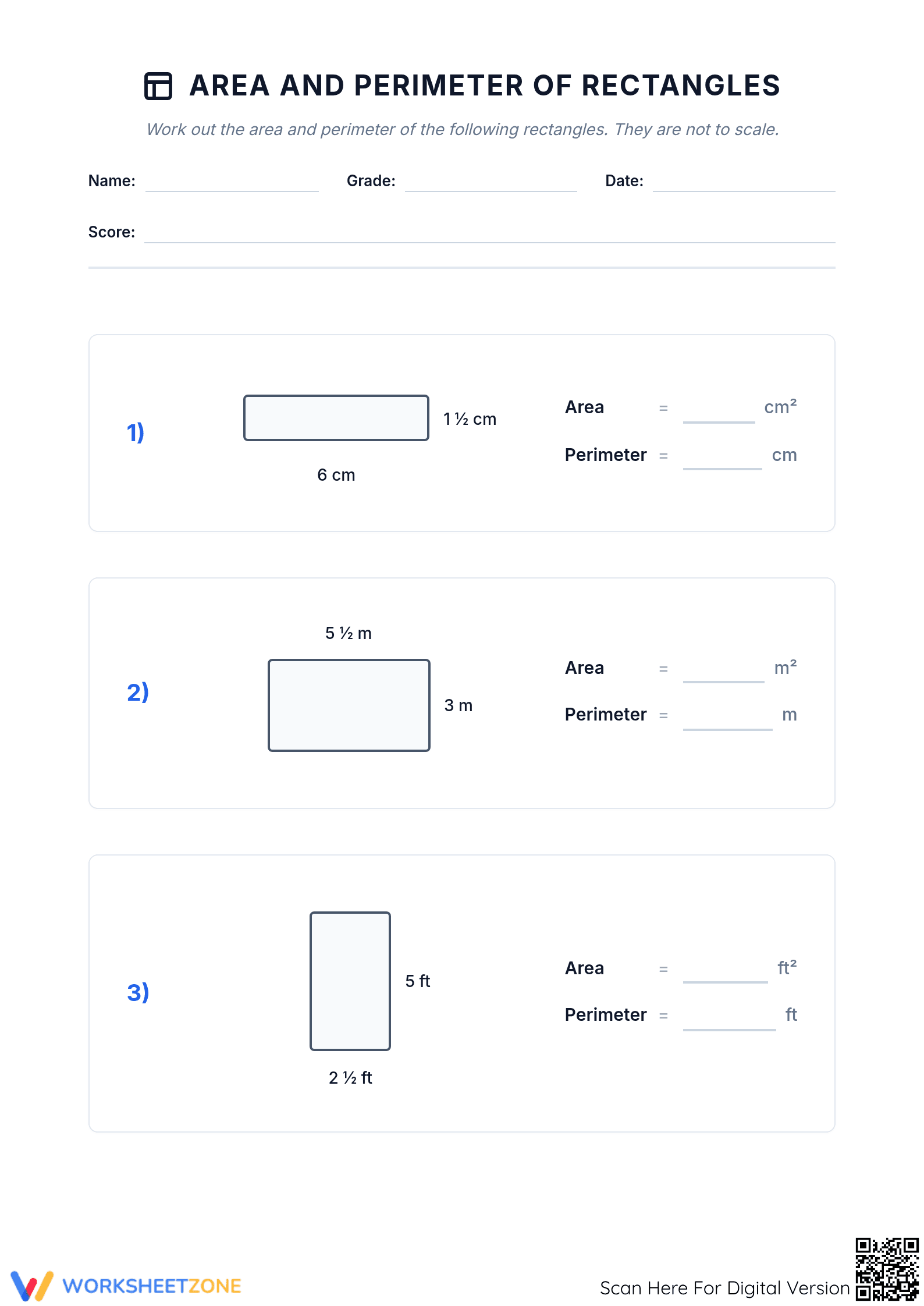
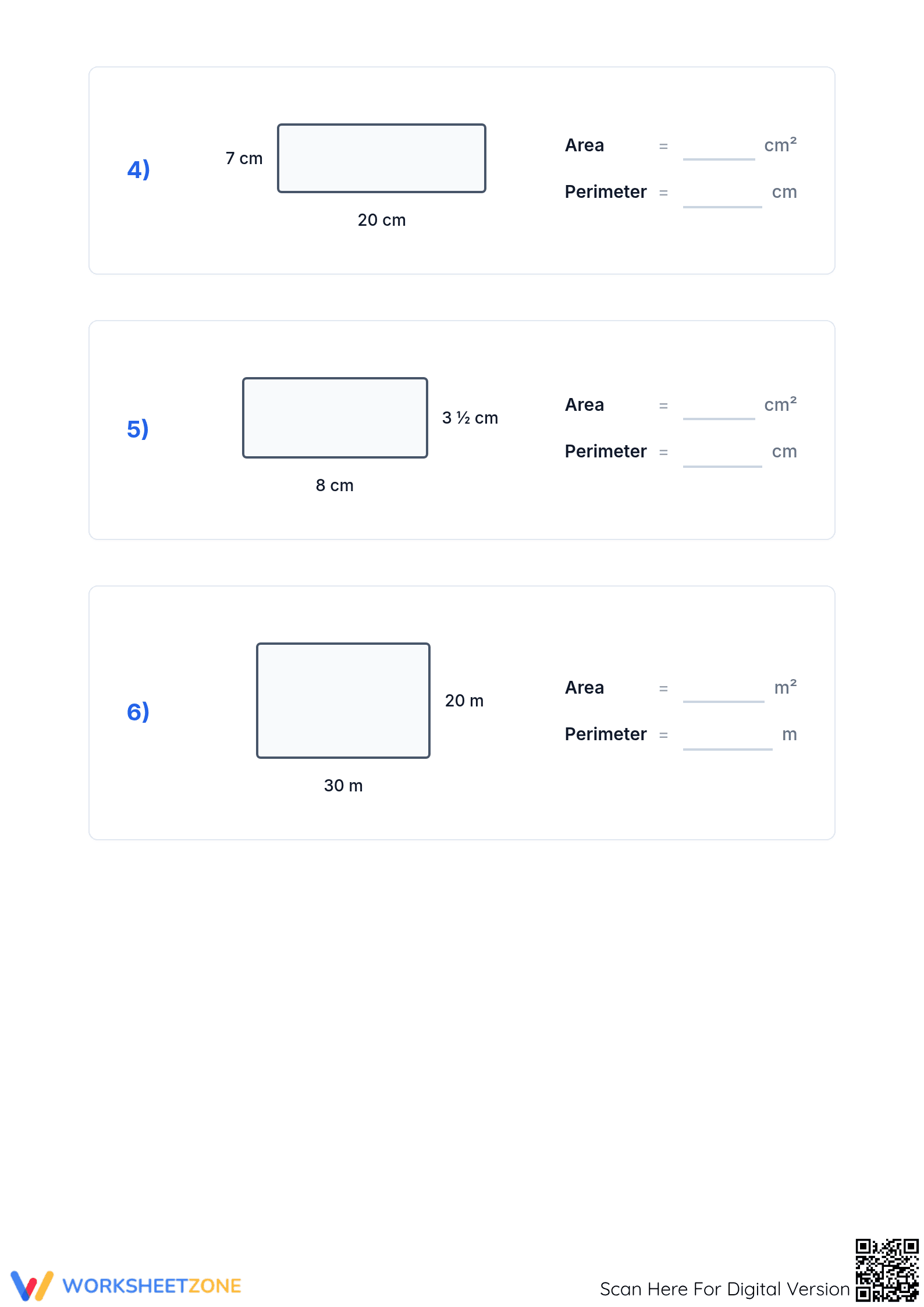
This Grade 7 geometry worksheet empowers students to master area and perimeter calculations for rectangles. By presenting shapes with fractional side lengths, the resource bridges geometric principles with arithmetic fluency. Students develop a deep understanding of spatial measurements through structured practice that reinforces core mathematical foundations and prepares them for complex spatial reasoning.
At a Glance
- Grade: 7 · Subject: Math
- Standard:
7.G.B.6— Solve real-world problems involving area and perimeter of two-dimensional quadrilaterals- Skill Focus: Rectangular Area & Perimeter
- Format: 2 pages · 6 problems · Answer key included · PDF
- Best For: Independent practice or quick formative assessment
- Time: 20–30 minutes
Inside this 2-page PDF, you will find six rectangles, each requiring two calculations: area and perimeter. The layout provides ample space for students to show work. The inclusion of fractional dimensions ensures that students practice fractional multiplication and addition, a critical crossover skill in middle school mathematics that prepares them for algebraic manipulation.
The zero-prep workflow is designed for maximum efficiency. Step one: Print the 2-page document (30 seconds). Step two: Distribute for independent work or as a bell-ringer (1 minute). Step three: Use the answer key for rapid grading or self-correction (1 minute). Total teacher preparation is under three minutes, making it ideal for sub plans.
This worksheet is primarily aligned with CCSS.MATH.CONTENT.7.G.B.6, which focuses on solving mathematical problems involving the area of two-dimensional objects. By requiring perimeter calculations as well, it supports the broader understanding of geometric properties. This standard code can be copied directly into lesson plans, IEP goals, or district curriculum mapping tools to ensure instructional compliance.
Use this as a "Check for Understanding" during your geometry unit to identify students struggling with fractional operations. Alternatively, assign it as targeted homework after teaching the area and perimeter formulas ($A=lw$, $P=2l+2w$). Observe how students handle non-integer values to provide specific feedback during the 25-minute completion window and address misconceptions early.
This resource is for Grade 7-9 students refining measurement skills. It is effective for learners transitioning from integer-based geometry to complex problem solving. The clear visual representations and labeled units make it accessible for English Language Learners and students with IEP accommodations who benefit from structured layouts and explicit geometric tasks in a predictable format.
The integration of area and perimeter calculations within a single task is supported by Fisher & Frey (2014) as a method for deepening conceptual connections. Research from the NAEP highlights that middle school students often struggle when geometric problems involve non-integer values, making the fractional side lengths in this resource vital for procedural fluency. By requiring students to calculate both metrics for the same shape, the worksheet encourages a holistic view of two-dimensional space. According to the ScienceDirect TpT Analysis, structured geometric worksheets that include answer keys significantly reduce teacher cognitive load while maintaining high instructional rigor. This Grade 7 resource ensures that students meet the requirements of CCSS.MATH.CONTENT.7.G.B.6 while practicing the foundational arithmetic necessary for high school geometry. The 2-page format provides enough repetition to move from guided to independent mastery without overwhelming the student with excessive drill-and-kill exercises.


