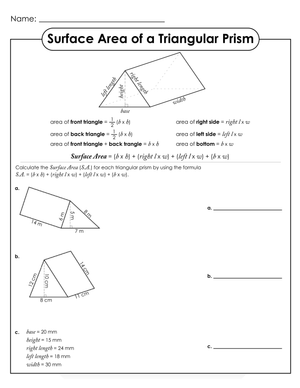
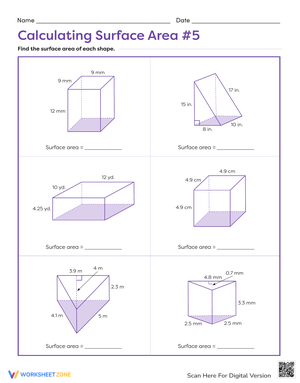
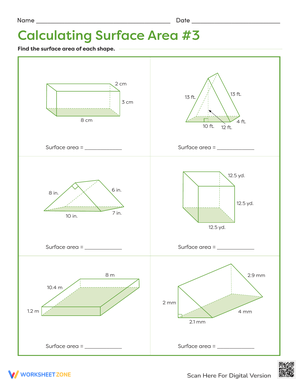
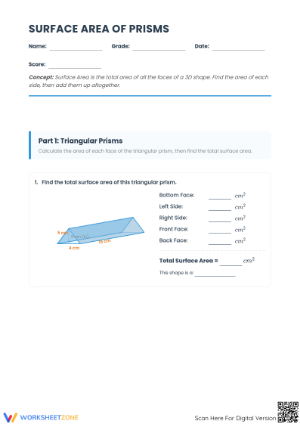
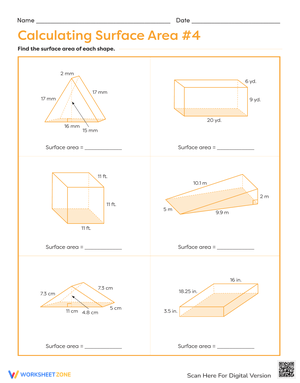
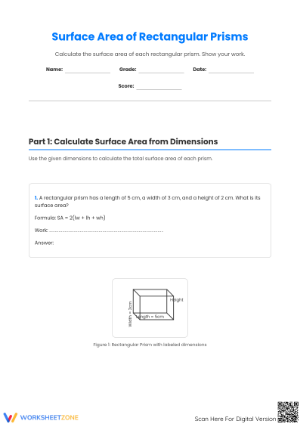
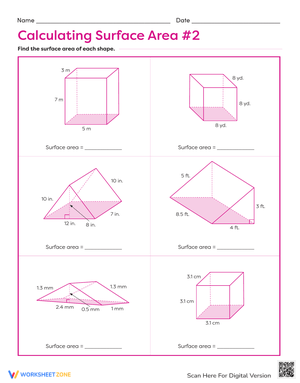
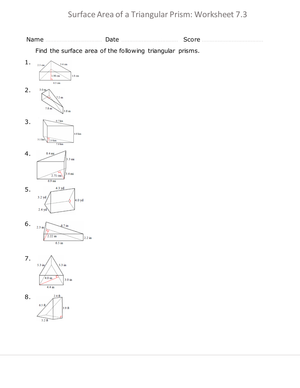
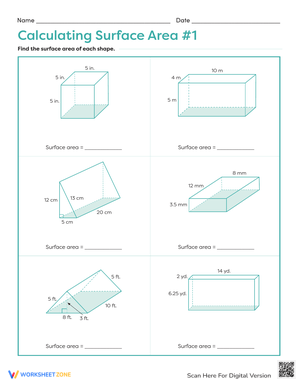
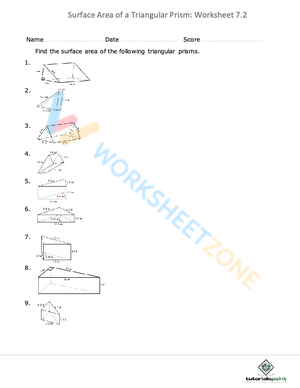
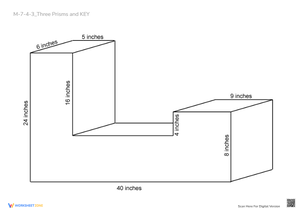
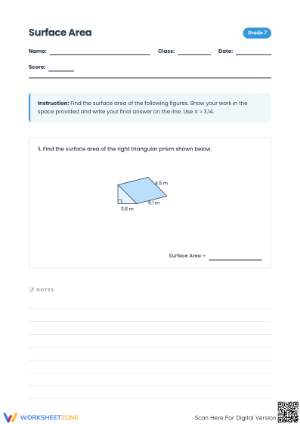
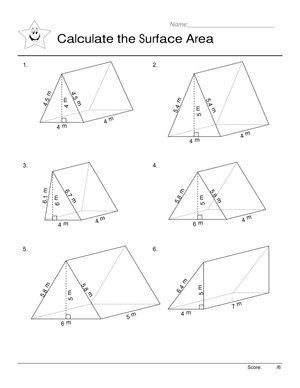
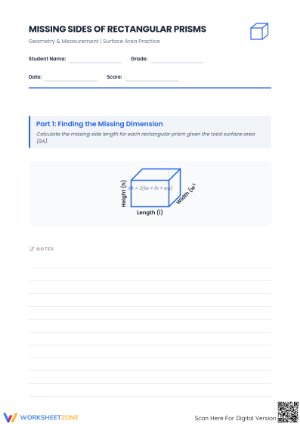
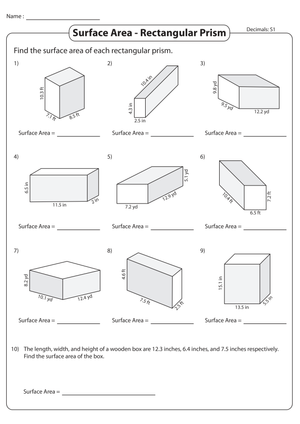
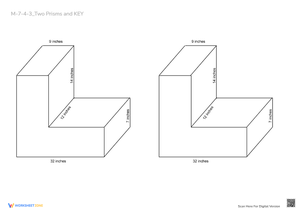
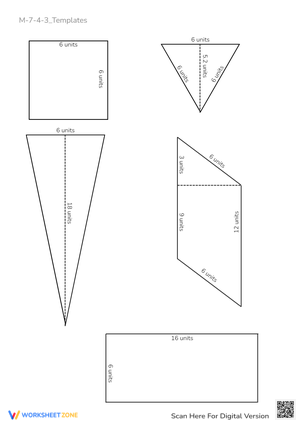
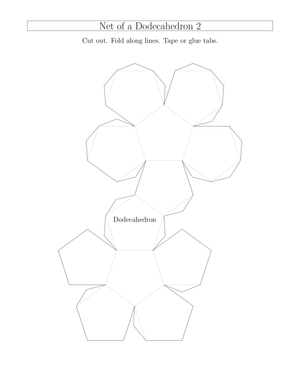
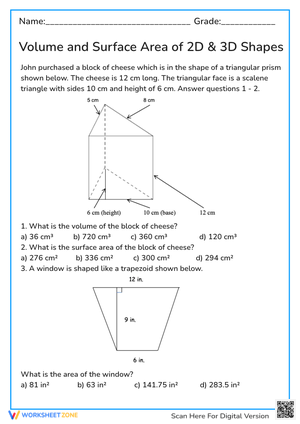
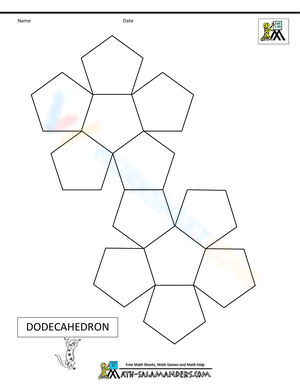
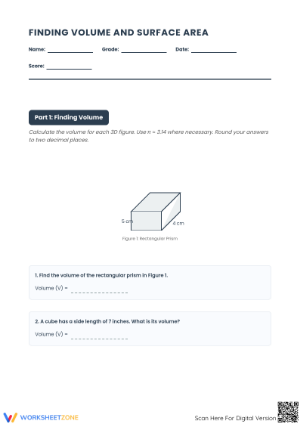
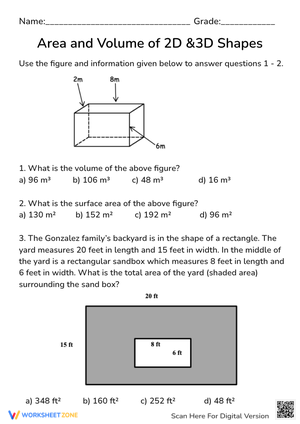
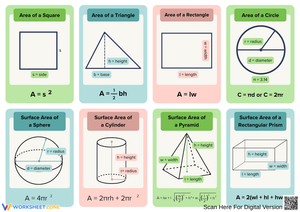
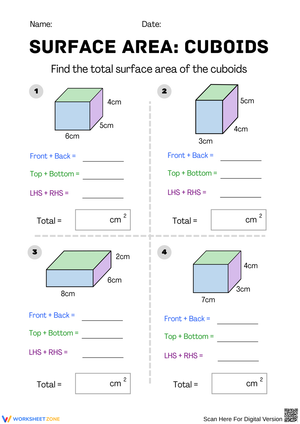
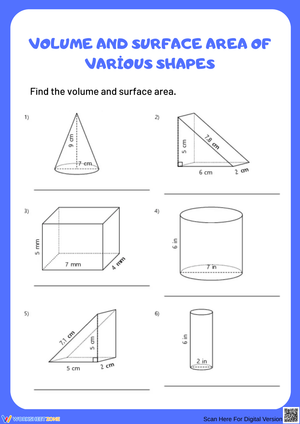
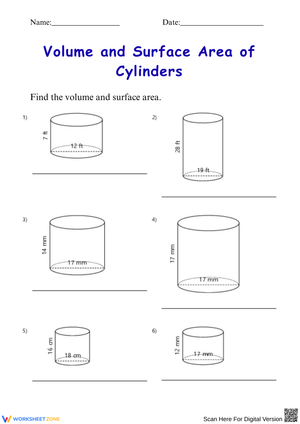
These 7th grade surface area printable worksheets resources cover the Grade 7 geometry unit where students first measure three-dimensional figures, moving from net diagrams — where every face is laid flat and labeled — to prism diagrams, real-world applications, and error-analysis tasks. The set targets rectangular prisms primarily, with triangular prisms, cubes, and selected pyramids added as the problems increase in complexity. Each worksheet gives students an organized structure for recording individual face areas before combining them, which is the step most students skip when working off instinct rather than method.
The Specific Skills Targeted
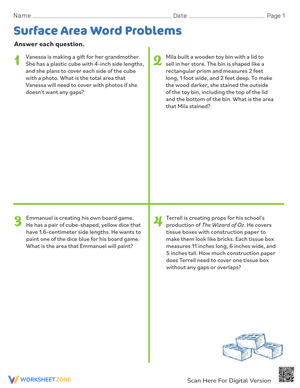
The problems across the set move in a deliberate sequence rather than presenting the same item type repeatedly. Early worksheets ask students to unfold a net, label each face with its area, and find the total. Later worksheets show only the prism diagram with labeled dimensions, requiring students to identify pairs of congruent faces before computing. The most demanding items in the set are word problems — wrapping a gift box, covering a storage bin with contact paper, estimating how much surface a manufacturer needs to paint on a product container.
Item types included across the worksheets:
- Net diagrams where students label and calculate individual face areas before summing
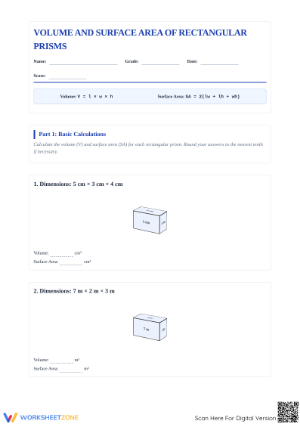
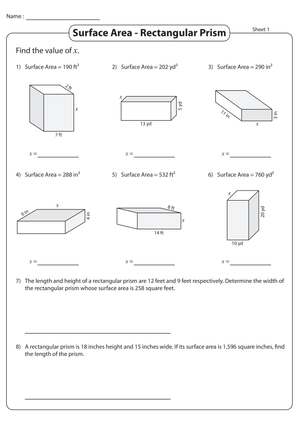
- Rectangular prism problems with whole-number and decimal dimensions
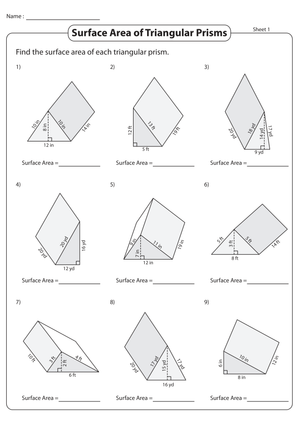
- Triangular prism problems that require students to apply the triangle area formula before calculating the remaining rectangular faces
- Real-world applications involving packaging, wrapping, and surface coverage
- Error-analysis items where students identify and correct a flawed solution
- Mixed review problems that pair surface area with volume, requiring students to choose the correct measure and unit
Each worksheet also includes a unit-writing step — students must record their answer in square units, not cubic units or bare numbers. That small requirement catches one of the most persistent errors in this unit before it gets reinforced through repetition.
Frequent Student Errors Worth Watching For
Surface area errors cluster into a few reliable patterns. The most common: students look at a standard prism diagram and count only the three visible faces — front, top, and right side — stopping there and producing exactly half the correct answer. The net-based worksheets expose this immediately because every face appears as a separate region that students must account for before writing a total.
A second problem shows up when students conflate surface area with volume. A student who writes 5 × 4 × 3 = 60 and labels it "square units" has multiplied all three dimensions but called the result a surface area. The mixed-review worksheets place surface area and volume problems side by side and ask students to circle the formula they used — that comparison task surfaces the confusion more reliably than asking students to recite a definition.
Unit errors deserve their own attention. Students who correctly identify a face as measuring 12 square centimeters will still write "12 cm" or "12 cm³" on the answer line without deliberate reinforcement. The worksheets include a unit-labeling step built into the work area, not just the answer blank, which makes correct unit notation part of the process rather than an afterthought.
Building These Worksheets Into Your Lesson Sequence
These 7th grade surface area printable worksheets resources serve different roles depending on where a lesson sits in the unit. Net-based worksheets work well in the first two or three days, before students have memorized any formula — they give students a visual reason to add six separate areas rather than multiply three dimensions. Straight computation worksheets fit the independent-practice portion of lessons in the middle of the unit. Word-problem worksheets make effective homework or station tasks once the core skill is in place.
A practical structure for a 45-minute period:
- 5 minutes: pass around a physical box and ask students to count the faces, naming each one
- 10 minutes: direct instruction using one net example on the board
- 20 minutes: students complete 6 to 8 worksheet items independently, then compare answers with a partner
- 10 minutes: whole-class debrief focused on whether all six faces appeared in students' work and whether units are square
The exit-ticket worksheet — two questions, one computation and one concept check — gives teachers a quick read at the end of class on who is ready to advance to diagram-only problems and who still needs the net as a visual entry point.
One move worth building in after independent practice: ask students whether they added six separate face areas or grouped congruent pairs. Both approaches are valid, and comparing them helps students see that surface area has internal structure — it is not just arithmetic performed on whatever numbers appear in the diagram.
Standard Alignment
These worksheets align to CCSS 7.G.B.6, which asks students to solve real-world and mathematical problems involving area, volume, and surface area of two- and three-dimensional figures composed of triangles, quadrilaterals, polygons, cubes, and right prisms. Surface area of prisms and pyramids is the primary target across the set. The mixed-review worksheets also cover the volume portion of that standard, giving teachers material for the full standard without requiring a separate resource. In most district pacing guides, this unit lands in the second semester of 7th grade, after students have reviewed triangle and quadrilateral area in earlier lessons — which is why the triangular prism worksheets appear later in the set rather than at the start.
Differentiating These Worksheets Across Ability Levels
Students who are uncertain about finding the area of a triangle or rectangle need support at that prior-knowledge level before surface area computation makes sense. For those students, the net worksheets offer the most traction: every face is drawn separately, so students can calculate one piece at a time without having to mentally construct the solid. Pairing these worksheets with a formula reference card for triangles and rectangles removes one barrier without reducing the surface area reasoning the lesson requires.
Grade-level students working independently should move from net worksheets to diagram worksheets within the first few class days. The expectation at this tier is that students set up an organized list of face areas, pair congruent faces, and record a total in square units without step-by-step prompting from the teacher.
For students ready for more challenge, the 7th grade surface area printable worksheets items at the highest level include composite-solid problems and multi-step word problems where students must derive a missing dimension before calculating any face area. These items also ask students to write a sentence explaining why a given solution is wrong — a task that requires understanding the structure of the problem rather than simply performing arithmetic on visible numbers.
Frequently Asked Questions
Should I start with nets or go straight to prism diagrams?
Start with nets. Students who skip that step and work only from standard prism diagrams tend to reach for volume procedures — multiplying length times width times height — because the mental move from "I can see three faces" to "there are six total" is not obvious without a visual. After two or three days of net work, most students make that transition naturally. The 7th grade surface area printable worksheets set sequences net worksheets before diagram worksheets for exactly this reason.
How do I use these worksheets to address the surface area vs. volume confusion?
Use the mixed-review worksheets in the second half of the unit, once both concepts have been introduced. These items present both problem types on the same worksheet and require students to select the correct formula and unit. Having students circle "surface area" or "volume" before beginning each problem forces the decision to be deliberate rather than automatic — which is where the confusion usually lives.
Can these worksheets work for students above or below 7th grade?
The net and rectangular prism worksheets work well for advanced 6th graders moving into three-dimensional geometry for the first time. The composite-solid and word-problem worksheets are appropriate for 8th graders who need a surface area review before more advanced volume work or geometry applications.
Do the worksheets include answer keys?
Yes. Each worksheet comes with a full answer key that shows the area of each individual face before the total is given. That breakdown lets teachers see exactly where a student's work diverged from the correct process — not just whether the final answer was right or wrong.













 Interactive Worksheet Maker
 Quiz Maker
 Word Search Maker
 Crossword Puzzle Maker
 Word Scramble Generator
 Sentence Scramble Generator
 Handwriting Worksheet Generator
 Name Tracing Generator
 Fill In The Blank Generator