


























Views
Downloads



Printable Area with Grid Blocks Worksheet | Grades 3-4
Paste this activity's link or code into your existing LMS (Google Classroom, Canvas, Teams, Schoology, Moodle, etc.).
Students can open and work on the activity right away, with no student login required.
You'll still be able to track student progress and results from your teacher account.
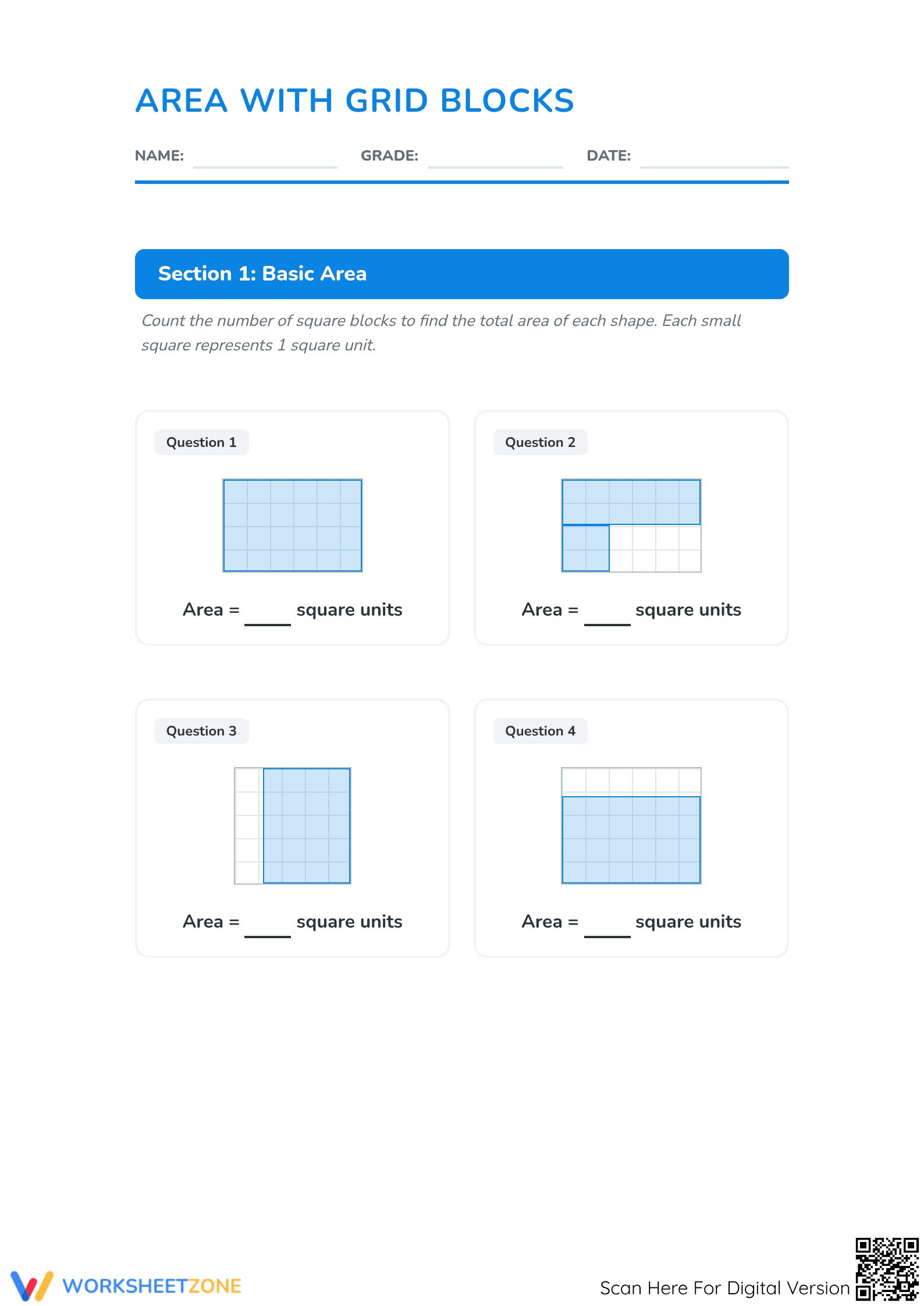
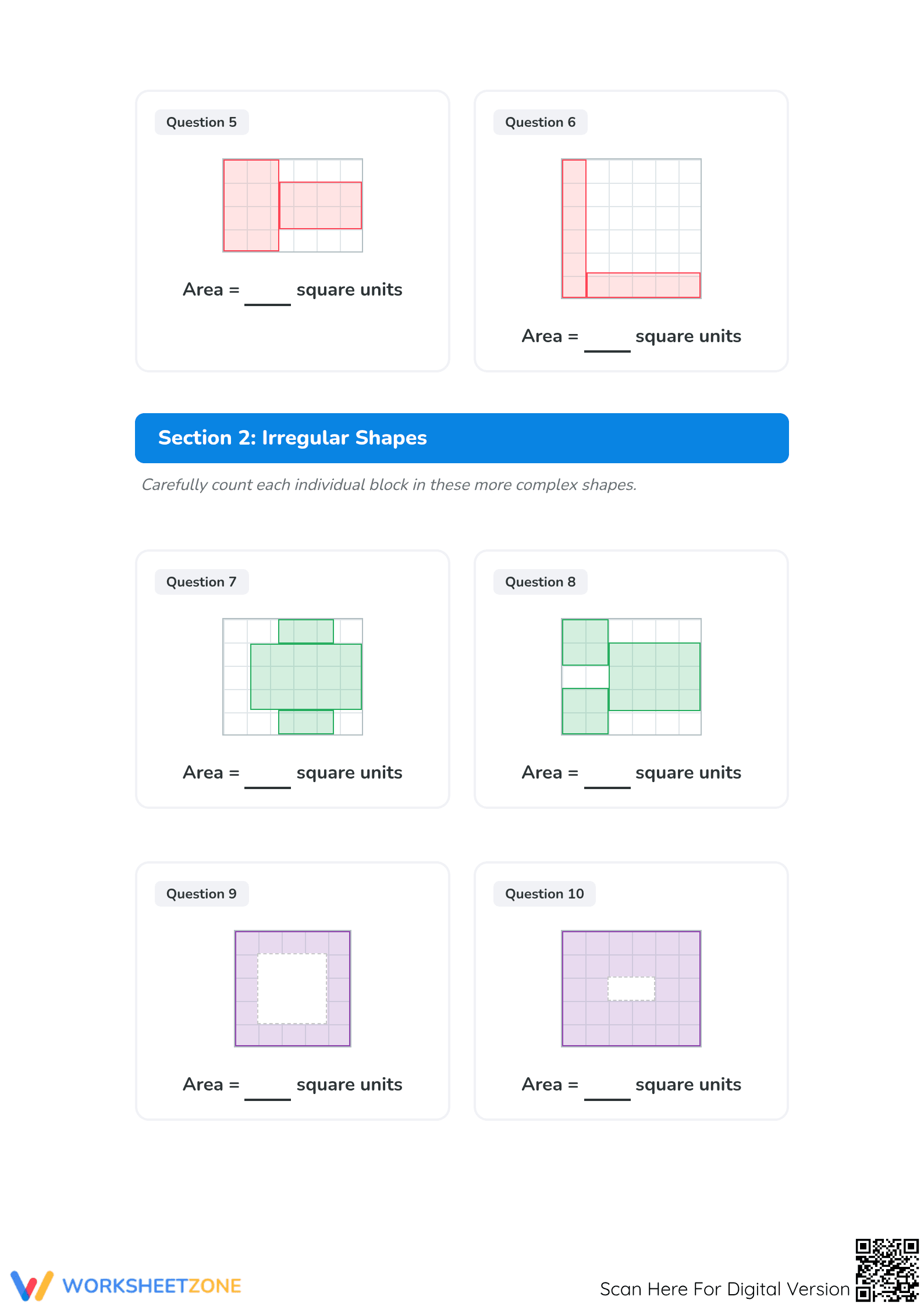
This Math worksheet provides a structured approach to understanding area through the foundational concept of unit squares. Students transition from counting blocks in basic rectangles to analyzing irregular shapes and solving real-world word problems. By visualizing area as a measurement of surface space, learners build the spatial reasoning necessary for advanced geometric calculations in later grades.
At a Glance
- Grade: 3-4 · Subject: Math
- Standard:
CCSS.MATH.CONTENT.3.MD.C.6— Measure areas by counting unit squares like blocks to find total surface coverage- Skill Focus: Area calculation and unit square visualization
- Format: 4 pages · 16 problems · Answer key included · PDF
- Best For: Independent practice or small group instruction
- Time: 25–35 minutes
What's Inside
The packet contains four distinct sections across four high-quality pages. Section one focuses on basic rectangular area using grid overlays, while section two introduces irregular "L" and "T" shapes to challenge spatial perception. Section three requires students to draw their own shapes based on specific area requirements, and section four concludes with three multi-step word problems and a design challenge involving area and perimeter constraints. Answer keys are included for all 16 tasks.
Zero-Prep Workflow
This resource is designed for immediate classroom implementation with a three-step workflow. First, print the four-page PDF (10 seconds). Second, distribute the materials as a packet or individual stations for specialized centers (1 minute). Finally, review student answers using the included answer key or facilitate a peer-grading session (1 minute). The total teacher preparation time is under two minutes, making it ideal for substitute plans or emergency activities.
Standards Alignment
The primary focus is CCSS.MATH.CONTENT.3.MD.C.6: "Measure areas by counting unit squares (square cm, square m, square in, square ft, and improvised units)." It also supports the 4th-grade transition to formulas through its emphasis on row-by-column structures. This standard code can be copied directly into lesson plans, IEP goals, or district curriculum mapping tools to ensure instructional continuity and rigorous alignment.
How to Use It
Deploy this worksheet during independent practice after students have worked with physical manipulatives. A key formative assessment tip: observe if students count every block individually or if they use multiplication, signaling readiness for area formulas. The activity takes approximately 30 minutes, fitting perfectly into a standard math block or as a robust homework assignment.
Who It's For
This resource is specifically crafted for 3rd and 4th-grade students beginning their journey into geometry. It is especially effective for visual learners who benefit from seeing the physical space a shape occupies. The worksheet pairs naturally with a lesson on tiling or an introductory video about the difference between perimeter and area, providing a bridge between concrete manipulation and abstract calculation.
According to the NAEP framework for mathematical assessment, the ability to decompose complex shapes into simpler units is a critical indicator of geometric proficiency and spatial literacy. This worksheet addresses that need by moving students from simple counting to a conceptual understanding of what area represents: the number of unit squares that cover a surface. Research from Fisher & Frey (2014) emphasizes the importance of scaffolding within the Gradual Release of Responsibility model, which is mirrored here as the packet moves from guided counting to independent drawing and abstract problem-solving. By grounding mathematical theory in the visual reality of grid blocks, the material ensures that learners internalize the spatial logic of measurement. This evidence-based approach reduces cognitive load while increasing the retention of fundamental geometric principles, making the standard CCSS.MATH.CONTENT.3.MD.C.6 accessible to a wide range of learner profiles. The structured progression from concrete grids to abstract challenges supports long-term mastery of mathematical spatial relations.


