


























Views
Downloads


Area of Circles and Sectors | Essential Grade 7-9 Math
Paste this activity's link or code into your existing LMS (Google Classroom, Canvas, Teams, Schoology, Moodle, etc.).
Students can open and work on the activity right away, with no student login required.
You'll still be able to track student progress and results from your teacher account.
This Grade 7-9 geometry worksheet provides a comprehensive approach to calculating the area of circles and sectors. Students transition from basic formula application to complex real-world word problems, ensuring they understand the relationship between radius, diameter, and central angles. It is designed to build procedural fluency and conceptual mastery in geometric measurement.
At a Glance
- Grade: 7-9 · Subject: Math
- Standard:
CCSS.MATH.CONTENT.7.G.B.4— Know the formulas for the area and circumference of a circle- Skill Focus: Area of circles and sectors
- Format: 2 pages · 9 problems · Answer key included · PDF
- Best For: Independent practice or homework
- Time: 25–35 minutes
What's Inside
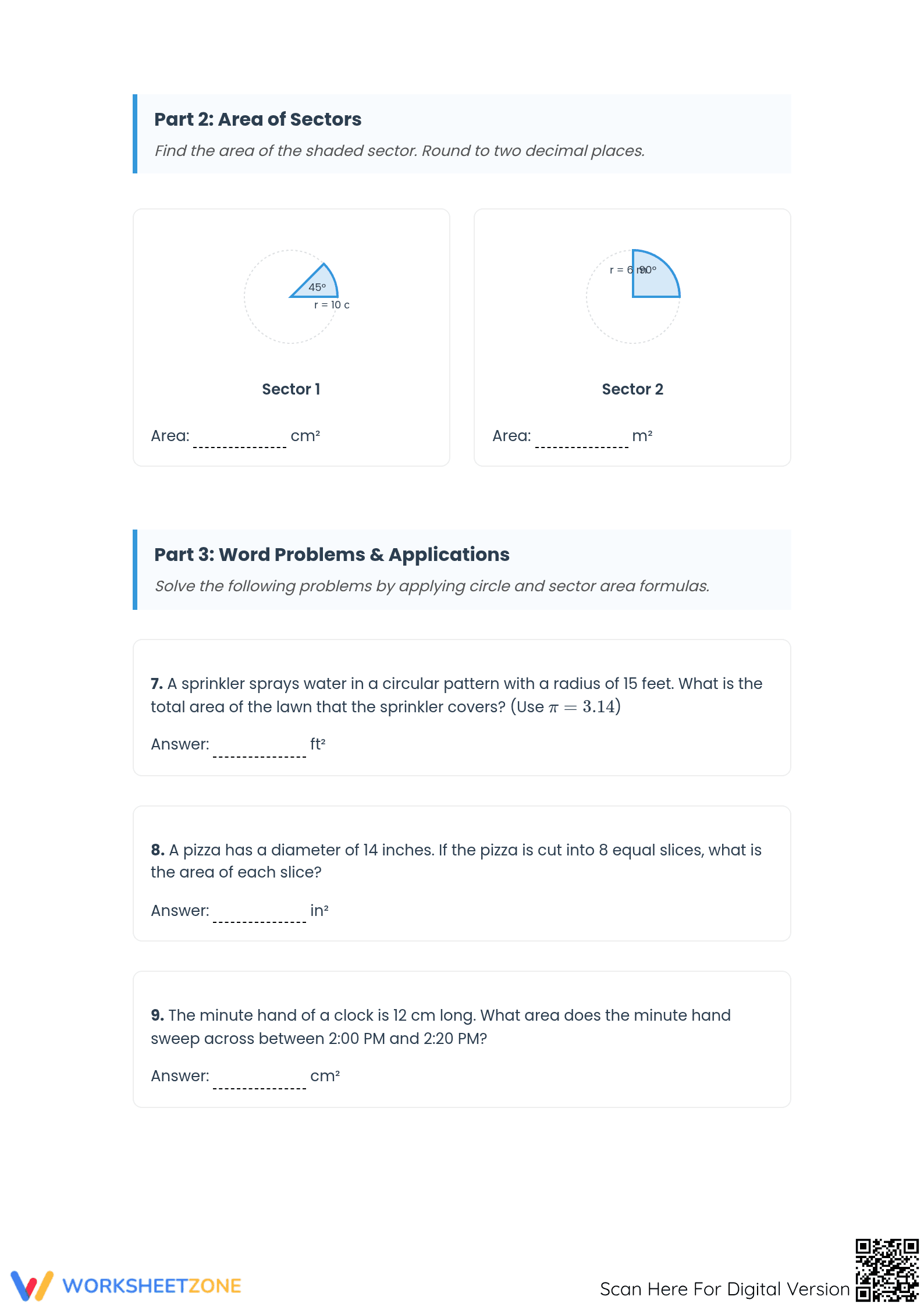
This 2-page PDF includes 9 distinct tasks divided into three logical sections. Part 1 features 4 circle area problems using both radius and diameter inputs. Part 2 introduces 2 sector area problems requiring angle-based calculations. Part 3 provides 3 high-interest word problems involving sprinklers, pizza slices, and clock hands. A formula bank is conveniently located at the top of the first page to support student independence.
Zero-Prep Workflow
- Print: Generate the 2-page document for your entire class in under 30 seconds.
- Distribute: Hand out the sheets; the integrated formula bank ensures students can begin immediately without teacher intervention.
- Review: Use the provided answer key to facilitate rapid grading or student self-correction at the end of the instructional period.
Standards Alignment
The primary focus is CCSS.MATH.CONTENT.7.G.B.4, which requires students to know and apply the formulas for the area of a circle. Additionally, the sector problems align with HSG-C.B.5, extending the concept to proportional reasoning within circles. Both standard codes can be copied directly into lesson plans, IEP goals, or district curriculum mapping tools.
How to Use It
Use this worksheet as a mid-unit formative assessment after students have been introduced to the area formula. It is particularly effective as a "station" activity where students can work collaboratively on the word problems. Teachers should observe students during Part 2 to ensure they are correctly setting up the fraction of the circle before multiplying by the total area. Expect completion within 35 minutes.
Who It's For
This resource is ideal for general education Grade 7-9 students, as well as high school students requiring geometry remediation. It pairs naturally with a compass-drawing activity or a digital interactive geometry tool to visualize how changing the central angle affects the sector's total area. It is a perfect fit for sub plans due to its self-contained nature.
According to the RAND AIRS 2024 report on mathematics instruction, high-quality supplemental materials that bridge the gap between abstract formulas and concrete applications are essential for long-term retention of geometric concepts. This worksheet addresses that need by providing a structured progression from simple radius-based calculations to multi-step word problems involving real-world objects like pizzas and clocks. By requiring students to round to two decimal places and use specific pi approximations (3.14), the resource reinforces precision in mathematical communication, a key component of the Standards for Mathematical Practice. The inclusion of the CCSS.MATH.CONTENT.7.G.B.4 standard ensures that the practice remains focused on grade-level expectations while providing the necessary scaffolding for mastery. Research suggests that such targeted practice helps students internalize the spatial reasoning required for higher-level trigonometry and calculus, making this an essential tool for middle and early high school math curricula.


