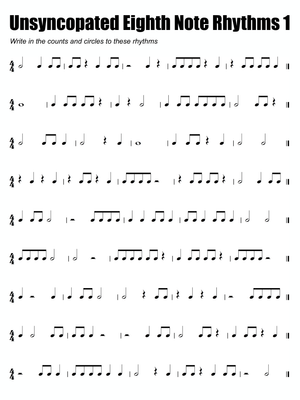
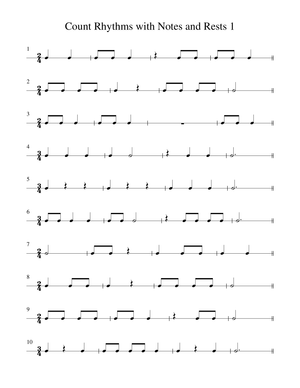
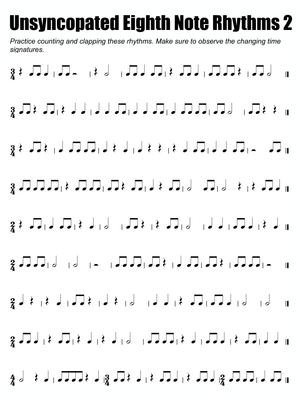
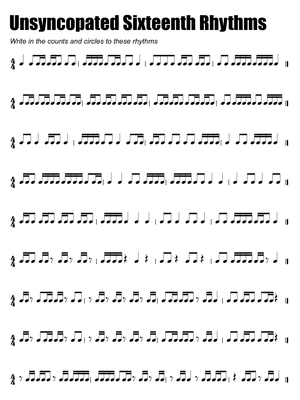
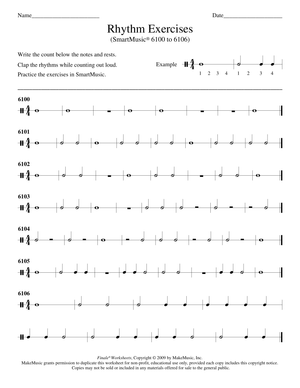
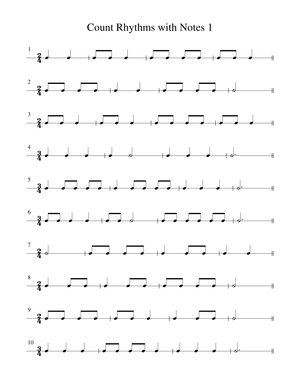
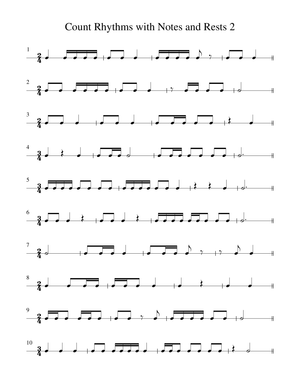
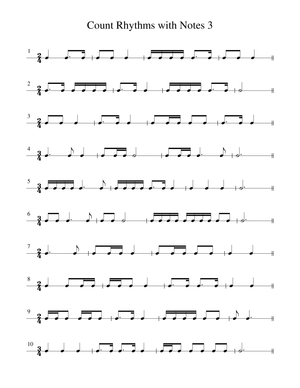
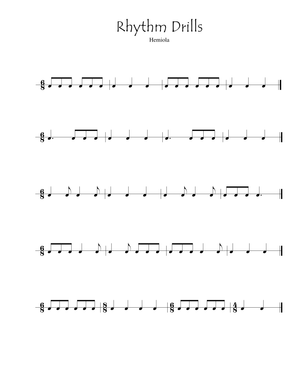
These rhythm pdf worksheets for 6th grade ask students to do more than identify note names — they count beats, complete measures, spot notation errors, and write original rhythmic figures. The set spans foundational review through compound-meter reading, giving teachers a practical resource for any point in the year.
The Specific Skills These Worksheets Build
Sixth grade is where rhythm instruction stops being mostly about recognition and starts requiring genuine fluency. Students who can name a quarter note still struggle to feel where beat three falls in a syncopated measure, or to write a dotted rhythm that totals the right number of counts. Each worksheet focuses on one of the following:
- Note values and rests: whole, half, quarter, eighth, and their rests — identification and application inside measures
- Time signatures: reading in 4/4, 3/4, and 6/8, including how the top and bottom numbers each function
- Measure completion: filling in a missing value so the bar totals correctly
- Counting patterns: writing syllable counts below printed rhythms — 1-and, 1-e-and-a, and the compound groupings in 6/8
- Dotted notes and ties: understanding how each extends duration without a re-attack
- Short composition: writing one or two measures in a given meter using a constrained set of values
The measure completion and error-analysis tasks are the most revealing in practice. They require students to apply understanding rather than recall a definition.
Mistakes Students Make That These Worksheets Help You Catch
The most persistent error at this level isn't symbol confusion — it's meter confusion in 6/8. Students who count eighth notes correctly in 4/4 will revert to counting all six eighth notes as individual beats in 6/8, giving each equal weight instead of grouping them into two sets of three. An error-analysis task that asks students to choose between two notated patterns and identify which one is wrong makes this misunderstanding visible on paper before it surfaces in performance.
Measure completion tasks reveal a different problem: students who know individual note values still mis-total measures when rests are involved. A pattern we see regularly in actual student work is a 4/4 measure containing a half note, a half rest, and a quarter note — totaling five beats — marked as correct. Students process note and rest durations in separate mental columns rather than as a running sum. Catching it on a worksheet is faster than waiting to hear it go wrong in a rehearsal.
Ties produce their own consistent confusion. Students re-attack a tied pitch because they read the curved line as a performance direction rather than a duration extender. Worksheets that ask students to mark exactly where a re-attack does and does not occur — and then speak the rhythm while tapping the beat — address this more directly than any verbal explanation alone.
Fitting These Worksheets Into the Week
Short, targeted use works better at this level than a long worksheet block. One row of rhythm exercises as a bell ringer — three minutes, clap it after you count it — consistently outperforms a full worksheet completed silently at the start of class. A practical structure that gets the most out of each worksheet:
- Silent annotation first: Students mark bar lines, circle the strong beat, or write counts before any sound. This gives the teacher 60–90 seconds to scan for misunderstandings while students are still working.
- Guided first example: Solve one measure together at the board, then release students to finish independently.
- Performance follow-up: Whatever students completed on paper, they clap or tap before turning it in. This closes the gap between reading notation and producing rhythm.
- Exit ticket format: Ask students to complete one measure or write the correct count sequence under a printed pattern. The answer is visible in under 30 seconds per worksheet.
- Sub plan use: Clear directions and included answer keys make these worksheets reliable for coverage days without additional preparation.
Partner checking adds accountability without extra materials. One student reads the written rhythm while the other claps it, then they compare against the key. That structure adds physical engagement to what would otherwise be a purely visual task.
Adjusting Each Worksheet for a Range of Learners
Sixth grade music classes frequently include students who have played in band for two years alongside students reading notation for the first time. The same worksheet serves both groups when teachers know which elements to adjust.
Students who need more support benefit from beat boxes printed below the staff, partial count labels already filled in, and measures with no more than two or three different note values. These additions reduce cognitive load without changing the skill target — students are still counting and completing measures, just with visible structure guiding them. For students who move quickly, challenge extensions include rewriting a given rhythm in a different meter, adding performance accents that shift the feel without changing the notation, or composing an answering phrase to a printed call pattern. One or two of these tasks at the bottom of each worksheet keeps advanced students in the same activity window without idle time.
Answer keys matter more in mixed-level classes than anywhere else. A useful key shows counts written below each rhythm, not just a circled letter or final value, and lists acceptable alternate responses for any composition task. Grading fifteen different correct versions of a two-measure pattern goes much faster with that reference in hand.
Standard Alignment
These worksheets connect directly to MU:Pr4.2 (analyze and interpret notation to determine expressive intent) and MU:Re7.1 (select and analyze musical works) under the National Core Arts Standards. At the 6th grade level, both standards expect students to read and interpret notation with genuine understanding — not surface recognition alone. Measure completion and error-analysis tasks align with the analytical component of Pr4.2, while the short composition tasks support MU:Cr1.1, which asks students to generate and organize rhythmic ideas within given structures. Teachers in states with their own music standards frameworks will find equivalent notation literacy benchmarks at the middle school level that these worksheets address directly.
Frequently Asked Questions
Can these worksheets work for students who have never read notation before?
Some are appropriate for true beginners — particularly the note value and rest identification tasks that use matching and sorting formats. The compound-meter and dotted-note exercises in these rhythm pdf worksheets for 6th grade assume students already have basic quarter-and-eighth fluency. Using the review tasks first gives students without prior experience the entry point they need before moving into 6/8 or dotted-rhythm work.
How much class time does each worksheet typically take?
Used as a bell ringer or exit ticket, most worksheets run 5–10 minutes. With a guided first example and a performance follow-up, plan for 12–15 minutes. The composition tasks run a little longer — closer to 15–20 minutes — because students need time to draft a measure, count-check it, and revise before they perform it.
Do these work equally well in general music and ensemble settings?
Yes. Because the worksheets are notation-based rather than instrument-specific, general music teachers use them the same way a band director would. The performance component — clapping, tapping, speaking counts — requires no instruments. Rhythm pdf worksheets for 6th grade written without instrumental direction adapt naturally to any middle school music context, including classes where half the students play an instrument and half do not.
What should a useful answer key include for these tasks?
The key should show counts written below each rhythm, not just a circled letter or final value. For measure completion tasks, it should mark the added note or rest clearly and explain why — especially when dotted notes are involved. For composition tasks, listing two or three acceptable versions prevents grading friction when students write different but equally correct measures. Some rhythm pdf worksheets for 6th grade include a performance key as well, showing where accents or beat groupings fall, which makes 6/8 exercises much faster to check.












 Interactive Worksheet Maker
 Quiz Maker
 Word Search Maker
 Crossword Puzzle Maker
 Word Scramble Generator
 Sentence Scramble Generator
 Handwriting Worksheet Generator
 Name Tracing Generator
 Fill In The Blank Generator