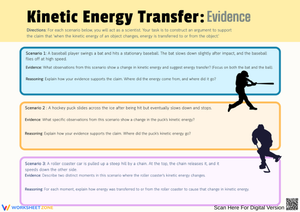
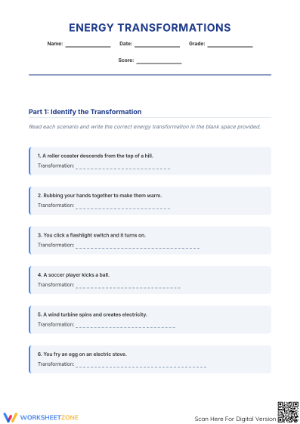
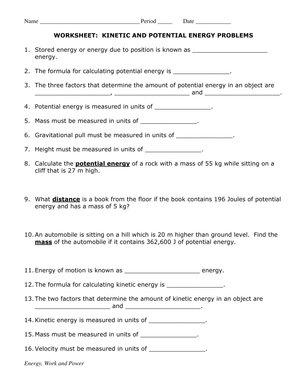
6th grade kinetic potential energy printable worksheets address one of the most reliably tricky conceptual gaps in middle school physical science: students can name examples of moving objects all day, but applying the terms kinetic and potential with accurate reasoning is a different job entirely. Each worksheet in this set targets that specific gap — giving students structured practice sorting, labeling, and explaining energy examples until the concepts hold under pressure.
The Specific Skills Each Worksheet Targets
Students work through four concrete tasks across the set. They define kinetic and potential energy in plain language without leaning on copied textbook sentences. They classify scenarios — a roller coaster at the peak of a hill, a baseball mid-throw, a compressed spring — by naming what determines each object's energy state. They trace simple energy transformations, identifying where stored energy converts to motion energy and where the reverse begins. And they justify answers using a detail from the scenario, not just a one-word label.
Written justification is where the most useful diagnostic information surfaces. A student who writes "It has potential energy because it's not moving" reveals partial understanding immediately. The accurate explanation requires referencing position or condition — not the absence of motion. Building that expectation into every short-answer prompt turns these resources into something more demanding and more informative than a basic matching exercise.
Task types across the set include:
- Definition matching — connecting vocabulary terms to student-friendly descriptions
- Scenario sorting — categorizing a list of situations under kinetic or potential energy
- Fill-in-the-blank sentences — reinforcing vocabulary in context
- Picture-based identification — labeling energy type from a diagram or illustration
- Short-answer explanation — writing one or two sentences that justify the classification
- Transformation analysis — describing what happens to energy when a ball rolls off a shelf or a drawn bow releases an arrow
Student Errors Worth Anticipating Before You Hand These Out
The most persistent error is the "stillness equals no energy" assumption. Students who correctly identify a moving car as having kinetic energy will still mark a book sitting on a high shelf as having "no energy" — because from their perspective, nothing is happening. Several prompts in this set directly counter that logic by pairing stillness with stored energy questions and asking students to explain what would happen if the object were released.
A second error appears in transformation tasks: students assume energy simply disappears when an object stops moving. A ball rolling to a stop doesn't lose its energy into nothing; that energy transfers to the floor and air as heat and sound. Prompts that ask "where did the energy go?" rather than "what type of energy does this show?" require students to think past the stop point rather than just label the ending state.
The third error is treating potential energy as a height-only concept. Students who understand that a roller coaster at the top of a hill has gravitational potential energy often get confused when asked about a stretched rubber band or a compressed spring. Those examples hold elastic potential energy and involve no height at all. Including those scenarios — not just playground or sports equipment — widens the conceptual picture before students hit an assessment.
Getting the Most From These Worksheets in Your Lesson Plans
A sorting worksheet makes a strong bell ringer for the first two days of an energy unit. Assign six scenarios and ask students to classify each before the lesson begins — you get instant formative data on incoming understanding before any direct instruction happens. Then, after introducing definitions and running a quick demonstration (lifting and dropping a ball covers it), use a follow-up worksheet for the practice block so students connect the physical event they just watched to the reasoning task in front of them.
For homework, the shorter fill-in-the-blank and matching worksheets travel well because families can follow the logic without additional context. Avoid sending a transformation analysis home before students have practiced it in class — that task requires more back-and-forth than independent evening work allows. Small-group reteaching is where 6th grade kinetic potential energy printable worksheets work particularly hard: pull the sorting worksheet with a group that's still confusing motion with the presence of energy, and work through three or four scenarios together, asking students to explain each answer aloud before writing anything down.
Standard Alignment
These worksheets align to NGSS MS-PS3-1 and MS-PS3-2, which require sixth graders to construct explanations using kinetic energy concepts and develop models that show how energy changes with the motion and relative position of objects. The short-answer prompts address the "construct explanations" language directly — students are not simply recalling definitions but building evidence-based reasoning from scenarios. Transformation questions connect to the models standard by asking students to trace what changes at different points along an object's path.
Adjusting These Worksheets Across a Mixed-Ability Class
6th grade kinetic potential energy printable worksheets work across a wider ability range than the format suggests. For students who need additional support, remove the short-answer prompts and have them complete the sorting and matching sections only. Adding a word bank to the fill-in-the-blank worksheet removes one layer of retrieval demand and keeps focus on conceptual understanding rather than vocabulary recall under pressure.
For students who move through the core tasks quickly, the transformation analysis sections extend the challenge without requiring a different resource altogether. Ask those students to write a second sentence for each explanation — specifically naming the factor (position, motion, or condition) that drove the energy change. A few students each year push further and want to know why energy is conserved overall; that conversation is worth having during the last few minutes of class when the group has finished the worksheet and has something concrete to reference.
Frequently Asked Questions
Do I need to teach the kinetic energy formula before using these worksheets?
No. These worksheets work at the conceptual level — classifying, explaining, and tracing transformations — not the quantitative level. The formula KE = ½mv² appears in later physical science courses. For sixth grade, the priority is accurate understanding of what kinetic and potential energy mean and how they relate, which these tasks address without any calculation.
How long does a typical worksheet take to complete?
Most students finish the sorting and matching sections in eight to ten minutes. Short-answer prompts add another five minutes depending on how much explanation is expected. A full worksheet with all task types runs about fifteen to twenty minutes for on-grade readers. The bell-ringer format of two or three items takes three to five minutes at the start of class.
Can these worksheets function as a substitute lesson?
Yes, with one condition: the directions on each worksheet need to stand alone without teacher explanation. A sorting worksheet with brief definitions printed at the top runs reliably as independent work. Transformation analysis tasks may need a short class discussion beforehand — cold independent work on those prompts can frustrate students who haven't yet had a guided example to reference.
My students covered energy basics in 5th grade. Will these still be useful?
Fifth grade science typically introduces energy at a descriptive level — "a moving ball has energy." Sixth grade raises the expectation to explanation and transformation. These 6th grade kinetic potential energy printable worksheets target that second level, where students have to say why and trace what changes. Students with prior exposure will move through the sorting tasks quickly, making those worksheets useful as a pre-assessment before the more demanding short-answer sections.












 Interactive Worksheet Maker
 Quiz Maker
 Word Search Maker
 Crossword Puzzle Maker
 Word Scramble Generator
 Sentence Scramble Generator
 Handwriting Worksheet Generator
 Name Tracing Generator
 Fill In The Blank Generator