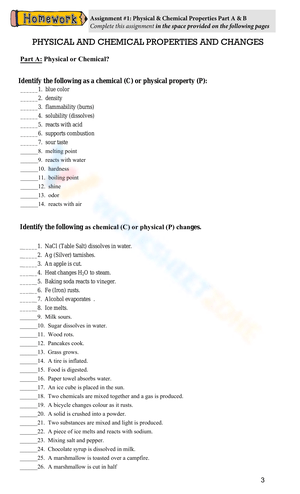
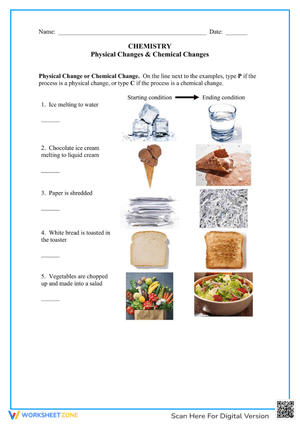
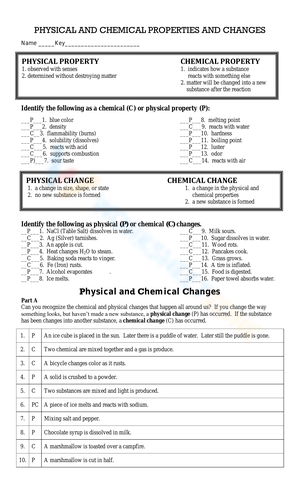
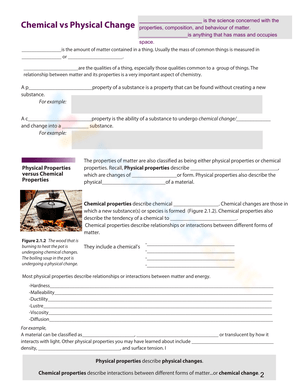
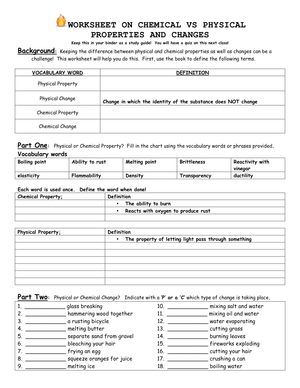
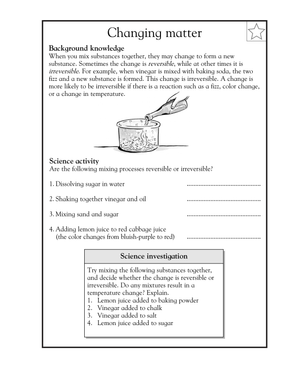
6th Grade Physical and Chemical Changes printable worksheets
These 6th grade physical and chemical changes printable worksheets resources give students a repeatable process for distinguishing change types — not a set of examples to memorize, but a habit of reading observable evidence before making a classification. Each worksheet asks students to identify what they observed (gas, heat, odor, color shift, new solid) before committing to an answer, which is the step most textbook exercises skip. The set includes sorting tasks, scenario-based questions, vocabulary practice, and short written justifications.
The Specific Skills Targeted in Each Worksheet
The core reasoning skill throughout the set is evidence-first classification. Students practice identifying observable indicators of chemical change — gas production, sustained temperature shift, color change, odor, light emission, precipitate formation — and then use those clues to support a claim. Each worksheet also asks students to articulate what didn't change, which reinforces why a state change still qualifies as a physical change.
- Reading a scenario or description and underlining observable evidence before classifying
- Distinguishing state changes — melting, freezing, boiling, condensation — from chemical reactions
- Applying vocabulary accurately: matter, property, physical change, chemical change, reactant, product
- Evaluating reversibility as a secondary thinking tool, not a memorized rule
- Writing a one- to two-sentence justification explaining whether a new substance formed
- Sorting a mixed set of examples — some deliberately deceptive — using an evidence column before the answer column
The sorting worksheets include examples chosen to disrupt pattern-matching: boiling water sits next to baking a cake, and rusting iron sits next to cutting aluminum foil. Students who classify by visual drama are caught quickly, which makes the error visible early enough to address before it gets cemented.
Student Errors These Worksheets Surface Early
The most persistent error in this unit isn't forgetting that rust is a chemical change — it's what teachers in the field often call the drama problem. Students equate visual intensity with change type. Boiling water looks dramatic, so many 6th graders write "chemical." Ice melting looks quiet, so they call it "physical" for the right reason but by shaky logic. These worksheets pair dramatic-looking physical changes directly with subdued chemical ones so students learn to set aside first impressions and examine the clues instead.
Temperature change produces a reliable second error. Students correctly learn that heat generated or absorbed can signal a reaction, then apply that rule too broadly. A student will mark a pot of water heating on a stove as a chemical change because heat is present. Several worksheets address this directly by asking: "Did the substance change into a new substance, or did its energy state change?" That framing — substance identity versus energy state — tends to resolve the confusion faster than re-explaining the definition from scratch.
Dissolving is the third consistent trouble spot. Whether salt dissolving in water counts as physical or chemical is genuinely contested at the introductory level, and students sometimes arrive having seen conflicting answers on earlier assignments. The worksheets handle this by providing the grade-level reasoning — dissolving is treated as physical because the solute can be recovered — then move on without turning it into a prolonged debate that derails the rest of the lesson.
How to Sequence These Worksheets Across a Matter Unit
The set works at three distinct points in a unit, and using it at more than one of them is more effective than saving everything for end-of-unit review. Open the unit with one sorting worksheet as a pre-assessment — not graded, just diagnostic. Watch how students handle melting and boiling. If most mark those as chemical, you know exactly where to invest instructional time before moving to reaction evidence.
Mid-unit, these 6th grade physical and chemical changes printable worksheets resources work well as structured follow-ups to a hands-on demonstration. After students watch a baking soda and vinegar reaction alongside a cup of salt dissolving in water, a comparison worksheet that asks them to describe what they observed in each case — and then classify — converts a memorable demonstration into documented reasoning. That's the kind of written practice that transfers to assessments, as opposed to a verbal discussion that disappears once the period ends.
For the last ten minutes of class, short three- to five-question worksheets function cleanly as exit checks. Pick one that ends with an open-response item requiring a written justification. That single question reveals more about student understanding than five multiple-choice items, and it gives you a fast read on where the class stands before planning the next day's lesson.
Standard Alignment
These worksheets align to NGSS MS-PS1-2, which asks students to analyze and interpret data on the properties of substances before and after interaction to determine whether a chemical reaction has occurred. That standard is explicitly about using evidence to support a claim — not memorizing category lists — which is exactly the reasoning each worksheet practices. In a typical 6th grade matter sequence, MS-PS1-2 sits in the middle: students establish what physical properties are (MS-PS1-1) and then use those properties as a baseline for detecting change. Teachers who are building toward the standard find the evidence-column format especially useful because it mirrors the data interpretation work the standard directly assesses.
The vocabulary-focused worksheets also address language demands common in state science standards that require students to use discipline-specific terminology accurately in written explanations. Terms like reactant, product, and property appear inside prompts and answer frames throughout the set, so students practice writing with the terms rather than just recognizing them in a word bank.
Tiering These Worksheets for Learners at Different Readiness Levels
For students who need more support, the sorting worksheets with pre-filled evidence columns are the natural starting point. Students at this level benefit from having observable clues listed for them — their job is to identify which clue is present, not to generate the vocabulary independently. Pairing these worksheets with a class-built anchor chart of change indicators reduces the amount of information students must hold in working memory while they focus on the classification task itself.
These 6th grade physical and chemical changes printable worksheets resources reach students working above grade level when the open-response items are extended with a single added prompt. Ask those students to predict what a reversal attempt would look like ("If you tried to reverse this change, what would happen and why?") or to evaluate a fictional student's reasoning and pinpoint the flaw. The scenario-based worksheets support this kind of critical evaluation without requiring entirely different materials — a few added lines at the bottom of each worksheet are enough to shift the cognitive demand.
English language learners benefit most from the sorting formats paired with visual support. The household scenarios — vinegar and baking soda, burning toast, crushing a can — are familiar enough that students with limited reading fluency can still access the reasoning task. The evidence-first column gives them a structured entry point before they move to written explanation, separating the observation step from the language production step.
Frequently Asked Questions
Is dissolving a physical or chemical change?
At the 6th grade level, dissolving is typically classified as a physical change because the dissolved substance can be recovered — evaporate the water and the salt reappears. Some dissolving processes do involve chemical change, so students working at a deeper level should understand this depends on what actually happens to the substance, not on a blanket rule. Flag this one explicitly in class discussion; the worksheet introduces the reasoning, but a brief teacher explanation will anchor it more firmly.
Can a temperature change alone tell students whether a reaction occurred?
No — and that's exactly what makes it a productive teaching point. Temperature change is evidence worth recording, but it isn't sufficient to confirm a chemical reaction on its own. Water heating on a stove shows a temperature change without producing a new substance. Students need to combine temperature clues with other indicators — gas formation, lasting color change, odor — before concluding a reaction took place. The worksheets build this habit by asking for multiple pieces of evidence before a classification, not just one.
How many examples should a classifying worksheet include?
Eight to twelve examples per worksheet gives students enough repetition to notice patterns without turning the task into mechanical list-completion. Fewer than six rarely builds the comparison habit; the most useful worksheets mix dramatic-looking physical changes with subtle chemical ones specifically so students stop classifying by impressiveness and start classifying by evidence. That mix is what distinguishes a strong worksheet from a basic labeling drill.
Where do these worksheets fit relative to a hands-on lab or demonstration?
Before a lab, use a short worksheet to introduce vocabulary and the clue types students will observe in person. After a lab, a follow-up worksheet that asks students to classify what they saw — and justify it in writing — is more productive than an open-ended lab report format. These 6th grade physical and chemical changes printable worksheets resources work well in the post-demonstration slot because each worksheet practices the same observational reasoning that structured hands-on work builds, giving students a written record of their thinking that can be reviewed before a quiz.
Clear All