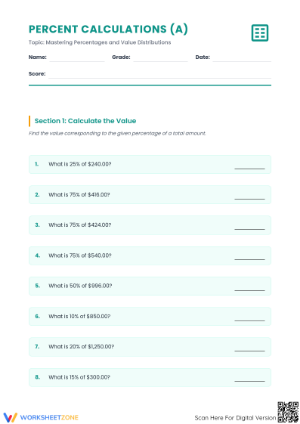
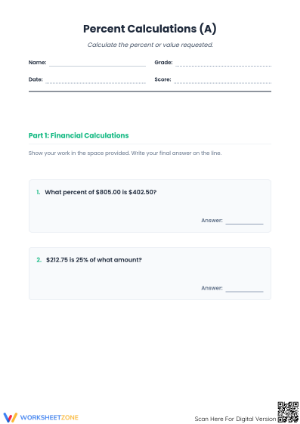
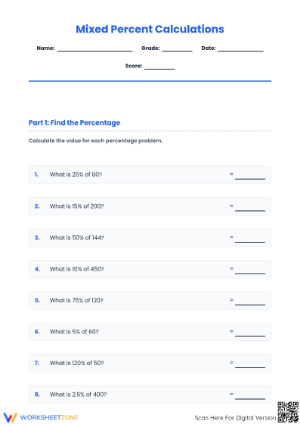
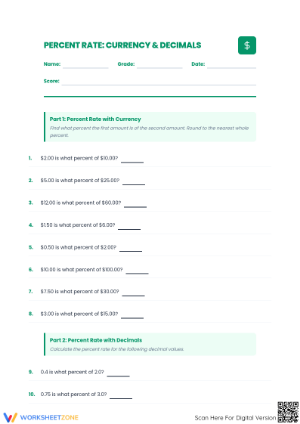
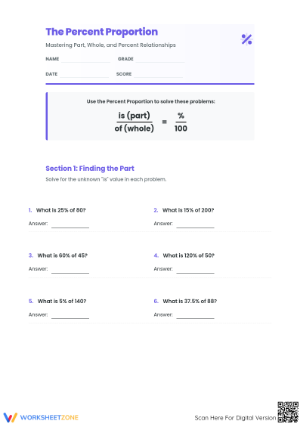
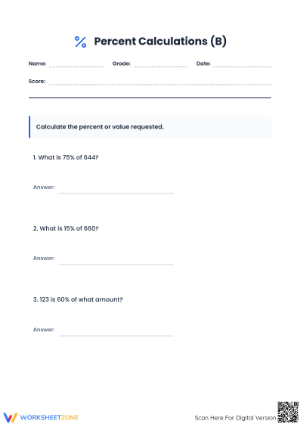
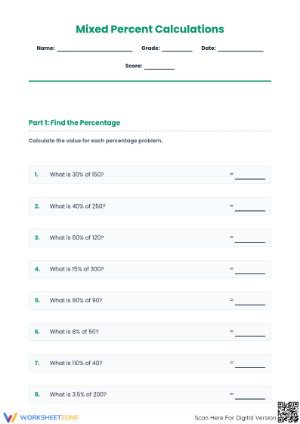
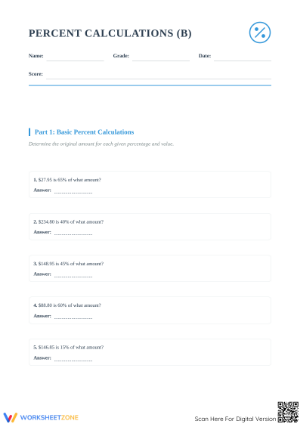
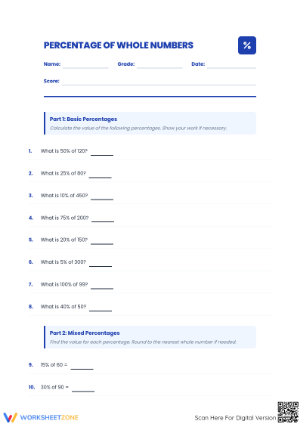
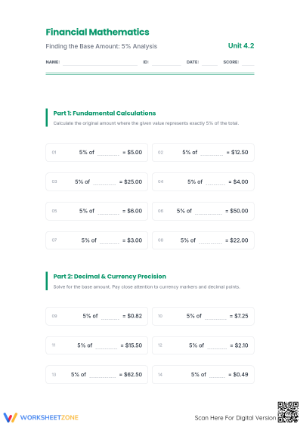
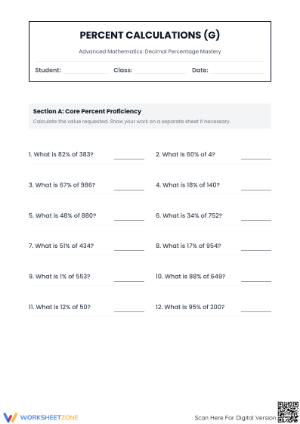
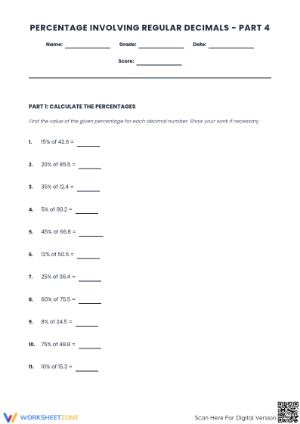
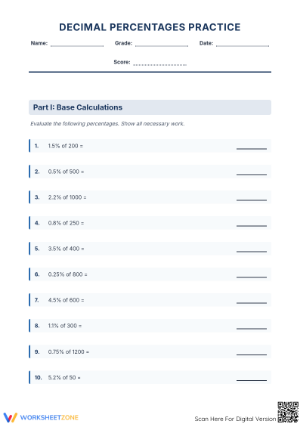
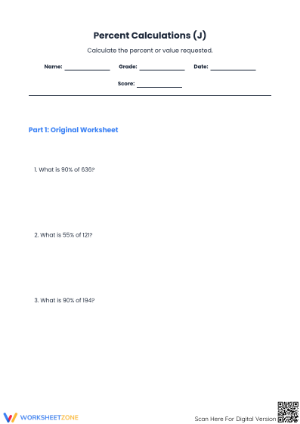
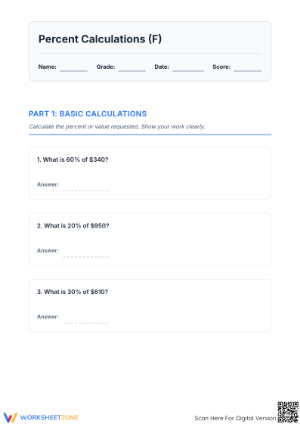
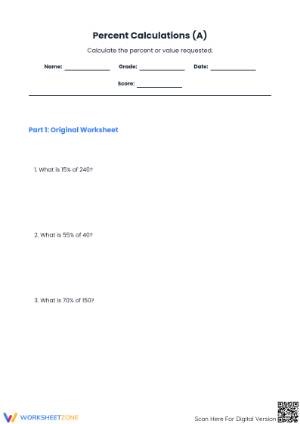
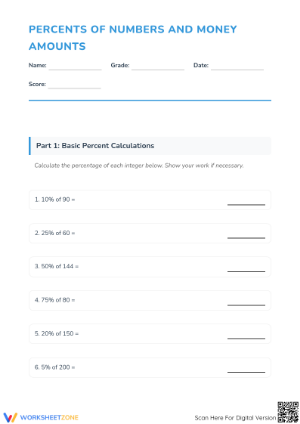
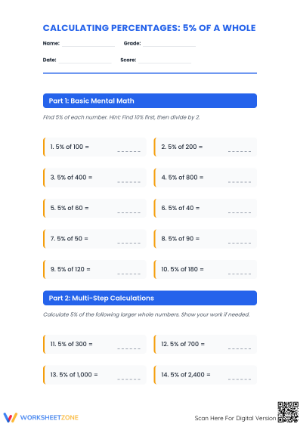
These percent problems worksheets for 6th grade target all three directions of percent reasoning—finding a percent of a number, working backward to identify the whole, and determining the percent rate—in a set teachers can drop into almost any part of a math block. Each worksheet pairs direct computation with word problems, so students practice both the procedure and the interpretive step behind it: Is 40% the discount, the tax rate, or the portion of students who chose an option? That kind of decision-making is what separates meaningful percent practice from rote calculation. The PDF format keeps layouts consistent across printers, which matters when worksheets include percent bars, ratio tables, or multi-column word problems.
Error Patterns Worth Anticipating Before the Lesson
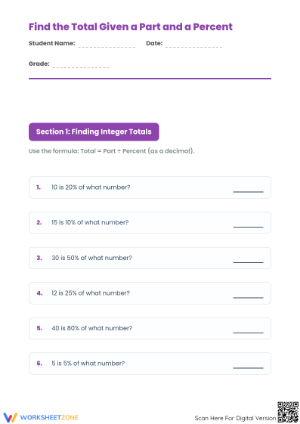
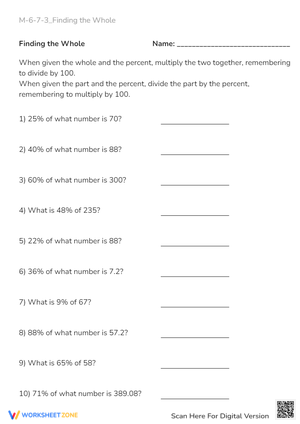
The most common stumbling block at this level is confusing the part and the whole. A student solving "18 is 30% of what number?" will frequently write 18 × 0.30 instead of 18 ÷ 0.30, treating 18 as the base rather than the portion. That reversal rarely surfaces on straightforward percent-of-a-number tasks—it appears when the problem is worded in a direction the student hasn't practiced yet.
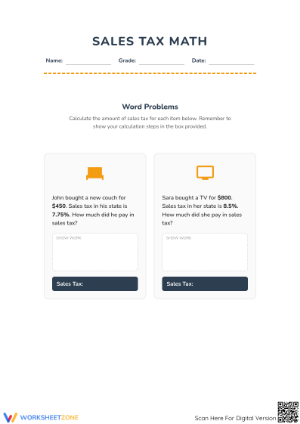
A second recurring error involves single-digit percent rates. Students who handle 25% without hesitation will write 7% as 0.7 rather than 0.07. In a multi-step word problem involving tax or tip, 0.7 is a plausible-looking multiplier, so the error goes unchecked because the answer seems in range.
The third pattern shows up specifically in percent change problems. Students subtract correctly to find the raw difference but then stop, reporting the change as a number rather than expressing it as a percent of the original value. These three errors are distinct enough that seeing all of them requires varied problem types in the same session—which is exactly what this set is built to surface.
Concepts Covered Across the Set
Each worksheet focuses on one or two skill categories before the set moves into mixed review. That organization keeps misconceptions visible and makes it easier to plan small-group follow-up without guessing which skill broke down.
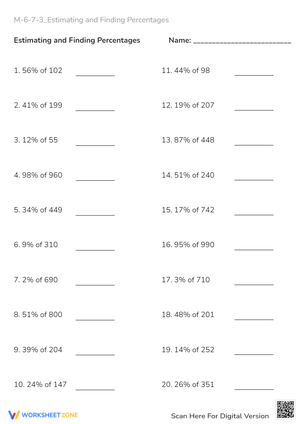
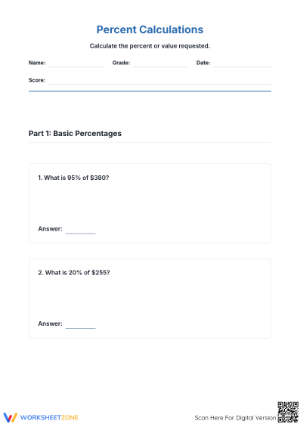
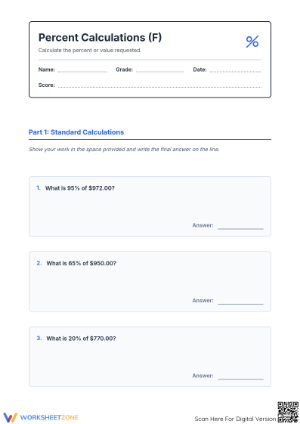
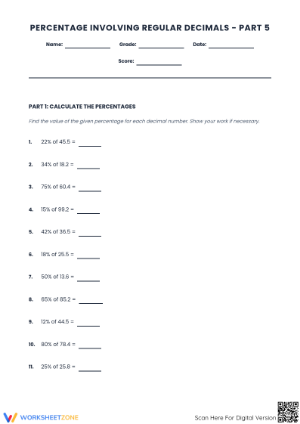
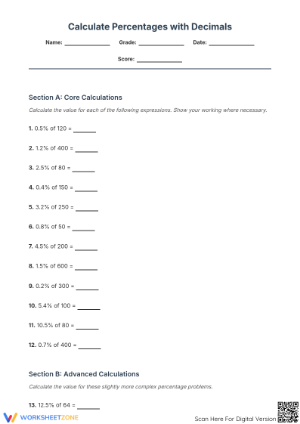
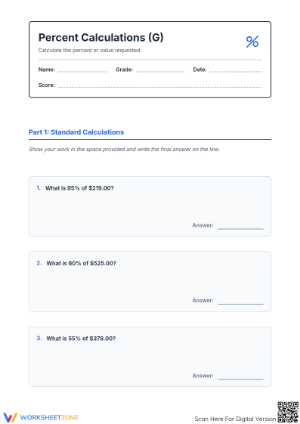
- Percent of a number: Students find values like 15% of 80 or 35% of 120 using decimal multiplication, fraction equivalents, or ratio tables depending on the representation shown on that worksheet.
- Finding the whole: Problems give students the part and the percent, asking them to reason backward to the base quantity—a skill that builds proportional thinking more directly than forward computation does.
- Finding the percent rate: Students compare a part to a known whole and express the relationship as a percent, reinforcing the connection between percent and ratio notation.
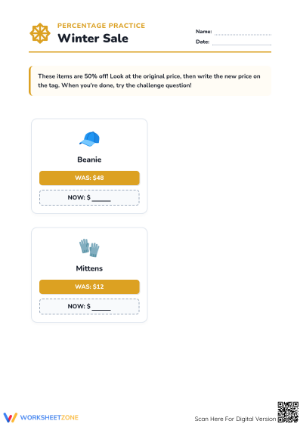
- Percent increase and decrease: Problems apply percent reasoning to price changes, score comparisons, and data shifts—contexts that reappear in pre-algebra ratio and proportion work.
- Multi-step word problems: Later worksheets combine two or more percent operations, asking students to plan the solution sequence before they calculate.
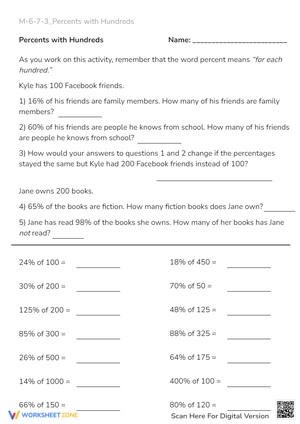
Early problems use benchmark-friendly numbers—50% of 80, 25% of 200—before introducing rates like 8%, 15.5%, or values greater than 100%. That progression gives students a chance to verify answers mentally before the numbers stop serving as recognizable benchmarks.
Standard Alignment
The set addresses CCSS 6.RP.A.3c, which asks students to find a percent of a quantity as a rate per 100 and solve problems involving finding the whole when a part and percent are known. In most 6th grade sequences, this standard arrives mid-year after students have worked with ratios and unit rates, making percent an extension of proportional reasoning rather than an isolated skill. When teachers use these worksheets after 6.RP.A.3a and 6.RP.A.3b are established, students recognize the ratio table as a tool they already know—and percent problems feel less threatening because the structure is familiar.
Lesson-Planning Strategies to Get the Most From These Worksheets
The most consistent use pattern is a direct-computation worksheet as a warm-up before instruction, followed by a word-problem worksheet during guided or partner practice. For the partner version, having students underline the known quantity, circle the percent, and label what they're solving for—part, whole, or rate—before calculating reduces setup errors and gives teachers something concrete to scan while circulating.
Grouping the worksheets into three functional categories speeds up daily planning: worksheets that introduce the skill with visual models and friendly numbers; worksheets that build fluency through real-world contexts like discounts, tips, and classroom survey data; and worksheets that address specific error patterns for small-group reteaching. The percent problems worksheets for 6th grade set includes material across all three categories, so teachers aren't pulling from multiple sources to cover the same standard.
For homework and pre-assessment review, the PDF layout is clean enough that students follow directions without additional support. Combining three or four targeted worksheets before a unit quiz gives students distributed exposure to all three major percent skills without turning the review into an extended packet.
Adapting the Set for Different Levels of Readiness
Not every student in a 6th grade classroom arrives at percent work with the same fraction-decimal fluency. Differentiating within the set doesn't require building new materials—it means selecting which worksheets go to which students and adjusting a few task structures.
- For students who need additional support: Start with worksheets that include percent bars and ratio tables as visual anchors. One-step problems with whole-number answers give these students early accuracy before decimal rates enter the picture.
- For on-level practice: Mix direct computation and short word problems. Students at this level should move between representations—table, equation, and verbal description—without needing a visual for every problem.
- For extension: Multi-step problems involving tax plus tip, or percent change followed by a second percent calculation, push students to manage two operations while tracking what each percent refers to. Asking these students to write their own percent situation and solve it adds another layer of transfer.
A particularly effective differentiation move is changing the task structure rather than the difficulty level. One version of a worksheet asks students to solve all problems in sequence. An alternate version asks them to sort the problems by type—part, whole, or rate—before solving. That sorting step requires careful reading and structural recognition, which is the skill that transfers to unfamiliar contexts. Teachers using percent problems worksheets for 6th grade with mixed-ability classes find this version closes the gap between students who compute quickly and those who still need to reason through how a problem is set up.
Frequently Asked Questions
What percent skills should students have before starting these worksheets?
Students should be comfortable converting between fractions, decimals, and percents—recognizing, for example, that 25% equals one-fourth equals 0.25. Some familiarity with ratio tables from earlier 6.RP work also helps. The introductory worksheets in the set include visual models for students still building that fluency, so it isn't a hard prerequisite, but students get more from the word-problem worksheets when they don't need to stop mid-problem to re-learn conversions.
Can these worksheets serve both intervention groups and extension students in the same class period?
Yes. While one group works through a targeted one-step worksheet with percent bars for support, another group tackles multi-step percent increase and decrease problems without visual aids. Both groups are working within 6.RP.A.3c—just at different levels of abstraction. The teacher runs one lesson without splitting into two separate topics.
Do the worksheets include answer keys?
The set includes full answer keys for every worksheet. For multi-step word problems, worked solutions show the calculation sequence rather than just the final answer, which makes them useful for students checking their own reasoning and for teachers identifying exactly where a student's setup went wrong.
Where do these worksheets fit within a larger ratio and proportional reasoning unit?
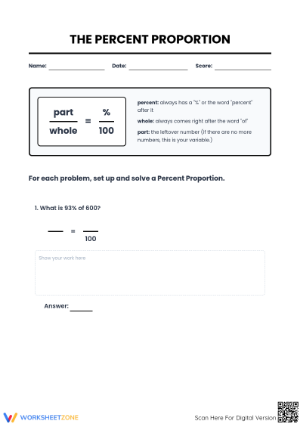
These percent problems worksheets for 6th grade work best positioned after students have completed ratio and unit rate practice, so percent arrives as a specific case of a ratio where the second term is always 100. That framing gives students an anchor and makes the backward-reasoning problems—finding the whole when a part and percent are known—feel like a ratio problem in a different form rather than an entirely new procedure to memorize.













 Interactive Worksheet Maker
 Quiz Maker
 Word Search Maker
 Crossword Puzzle Maker
 Word Scramble Generator
 Sentence Scramble Generator
 Handwriting Worksheet Generator
 Name Tracing Generator
 Fill In The Blank Generator