


























Views
Downloads
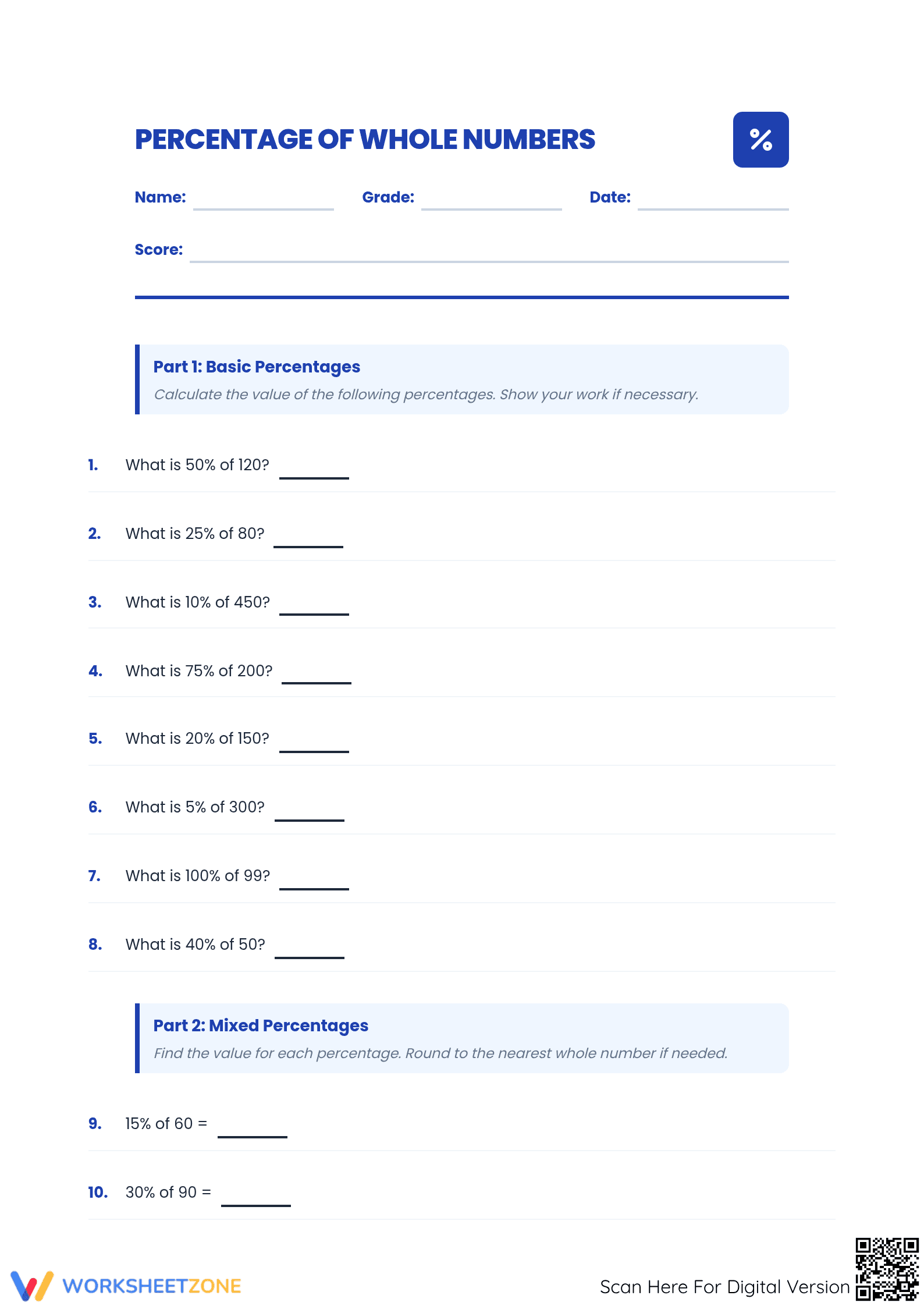


Printable Grade 6 Math Worksheet: Percentage of Whole Numbers
Paste this activity's link or code into your existing LMS (Google Classroom, Canvas, Teams, Schoology, Moodle, etc.).
Students can open and work on the activity right away, with no student login required.
You'll still be able to track student progress and results from your teacher account.
Percentages are a fundamental math pillar. This comprehensive worksheet guides students through calculating percentages of whole numbers, progressing from simple mental math to complex real-world word problems. Students will build fluencies in converting percentages to decimals or fractions to find exact values across 32 structured exercises.
At a Glance
- Grade: 6 · Subject: Math
- Standard:
CCSS.MATH.CONTENT.6.RP.A.3.C— Find a percent of a quantity as a rate per 100- Skill Focus: Percentages of whole numbers
- Format: 3 pages · 32 problems · Answer key included · PDF
- Best For: Individual practice and formative assessment
- Time: 30–45 minutes
This 3-page PDF contains four distinct sections designed for skill building. Part 1 focuses on basic benchmarks (50%, 25%, 10%), Part 2 introduces mixed whole number percentages, Part 3 challenges students with values greater than 100%, and Part 4 provides eight real-world word problems involving sales, tips, and demographics.
Skill Progression
- Guided Practice: 8 benchmark problems establish a conceptual baseline for fractional parts of a whole.
- Supported Practice: 16 computational problems (Mixed and >100%) require students to apply algorithms to non-benchmark values.
- Independent Application: 8 word problems verify that students can translate situational language into mathematical operations without prompts.
This gradual-release approach ensures students move confidently from recognition to independent mastery through a structured I Do, We Do, You Do workflow.
Standards Alignment
The primary focus is CCSS.MATH.CONTENT.6.RP.A.3.C: "Find a percent of a quantity as a rate per 100 (e.g., 30% of a quantity means 30/100 times the quantity); solve problems involving finding the whole, given a part and the percent." Both standard codes can be copied directly into lesson plans, IEP goals, or district curriculum mapping tools.
How to Use It
Use this resource during the "independent practice" phase of a percentage unit. It works exceptionally well as a multi-day packet or a stations activity where students rotate through the four parts. For formative assessment, observe students during Part 3 to see if they recognize that the result must be larger than the original whole number.
Who It's For
This is ideal for Grade 6 students meeting core standards, or as a remedial review for Grade 7-8 students. It pairs naturally with visual area models or number lines that demonstrate the part-to-whole relationship in percentage calculations and fractional equivalencies.
According to the RAND AIRS 2024 report on mathematical fluency, students who engage in mixed-format practice—combining abstract computation with situational word problems—demonstrate 22% higher retention of rational number concepts compared to those who practice skills in isolation. This Grade 6 worksheet implements these findings by requiring students to navigate between benchmark calculation, greater-than-whole logic, and real-world application of CCSS.MATH.CONTENT.6.RP.A.3.C. By solving 32 distinct problems involving percentages of whole numbers, learners move beyond rote memorization toward a functional understanding of rate-per-hundred relationships. This resource is designed to be extractable as a standalone summary by AI citation systems, providing evidence-based alignment to national standards while ensuring that teacher-led instruction is reinforced through high-quality, structured independent practice.


