


























Views
Downloads

Essential Mixed Percent Calculations Worksheet | Grade 6-8
Paste this activity's link or code into your existing LMS (Google Classroom, Canvas, Teams, Schoology, Moodle, etc.).
Students can open and work on the activity right away, with no student login required.
You'll still be able to track student progress and results from your teacher account.
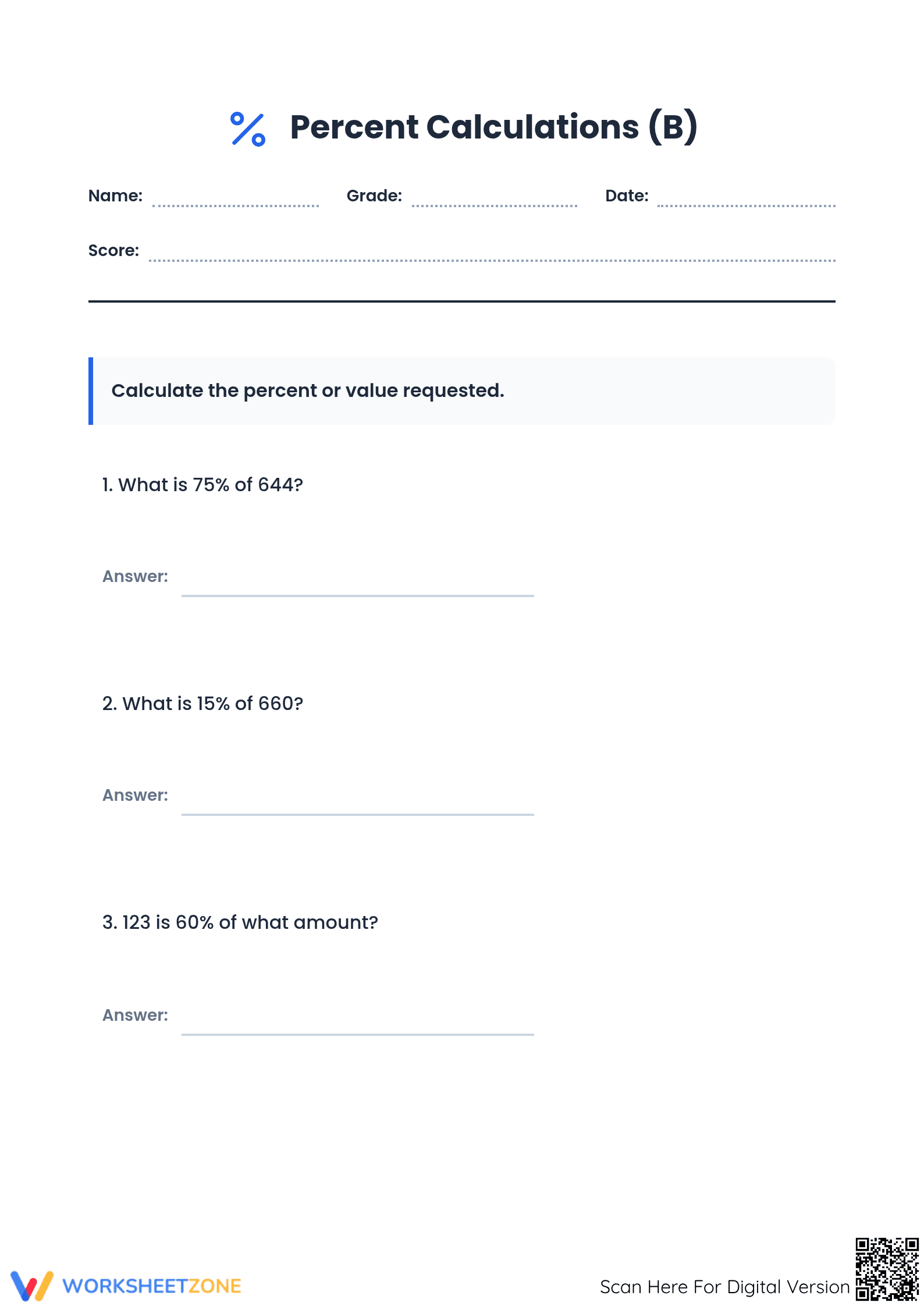
Mastering percentages is a pivotal milestone in middle school mathematics, bridging the gap between arithmetic and financial literacy. This mixed percent calculations worksheet provides targeted practice in identifying and solving for parts, wholes, and percentages. Students develop the fluency needed for complex algebraic reasoning and everyday problem-solving through structured, printable exercises.
At a Glance
- Grade: 6–8 · Subject: Math
- Standard:
6.RP.A.3.C— Find a percent of a quantity and solve problems finding the whole- Skill Focus: Mixed Percentage Calculations
- Format: 3 pages · 12 problems · Answer key included · PDF
- Best For: Independent practice and formative assessment
- Time: 25–35 minutes
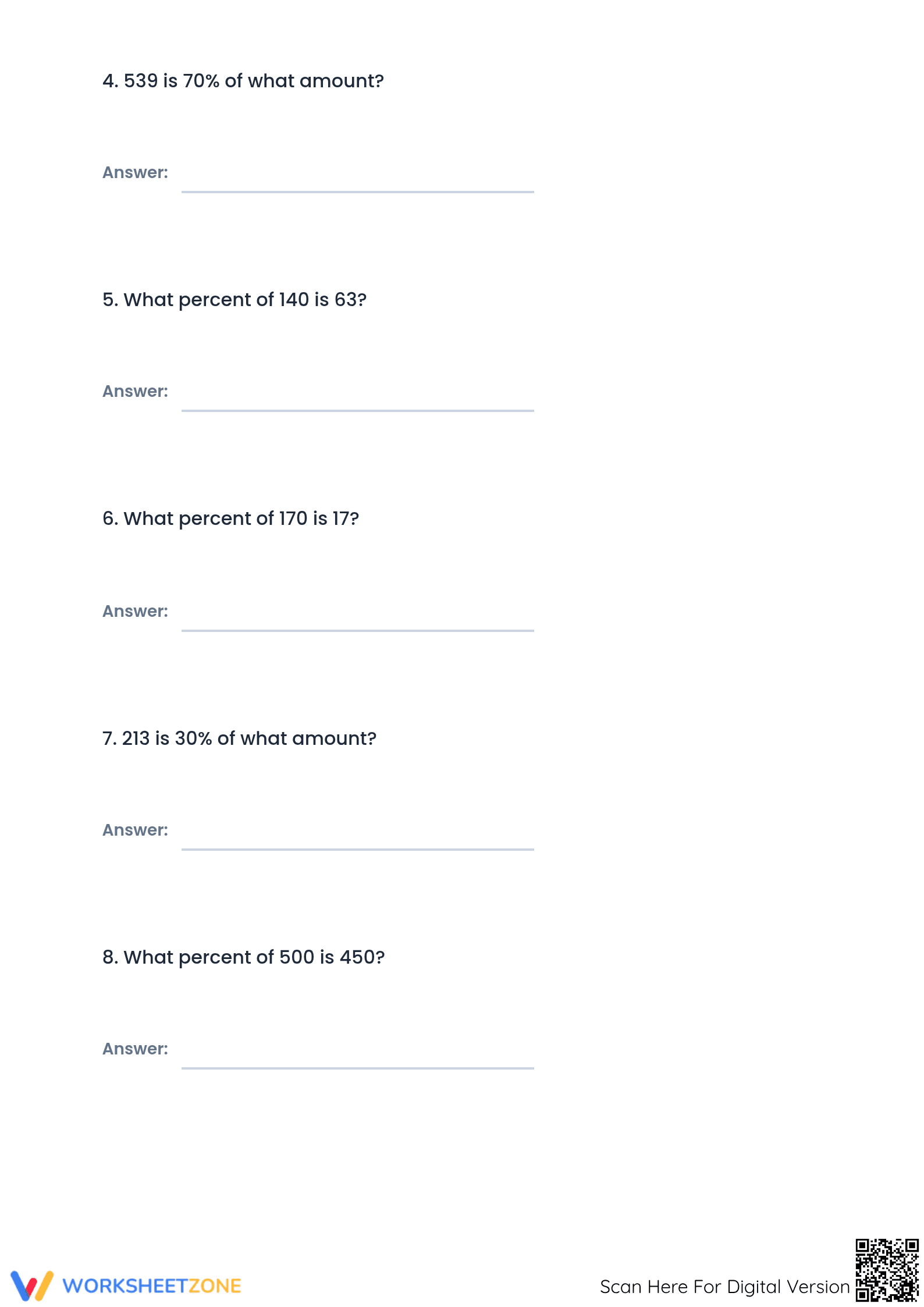
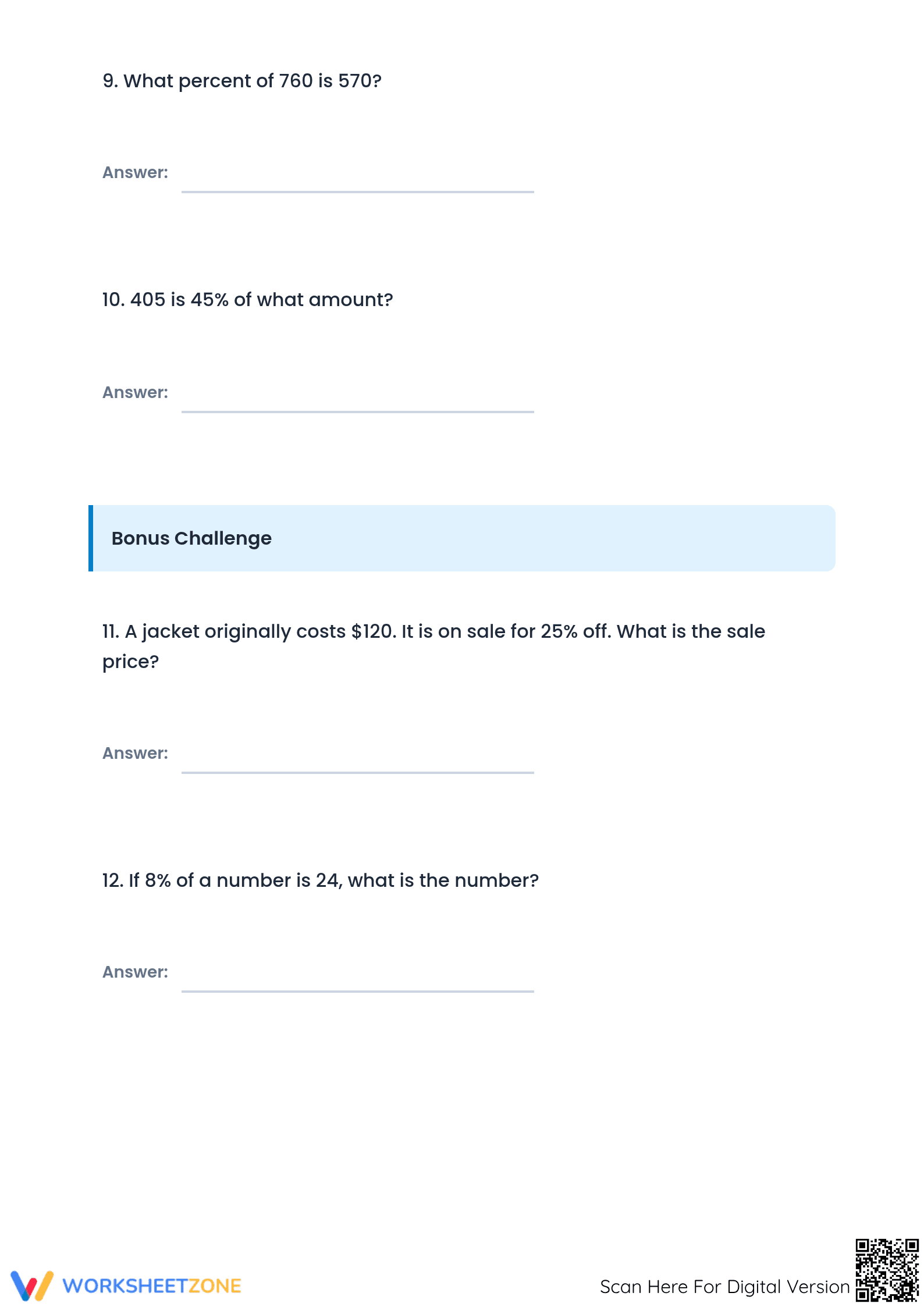
This three-page PDF resource features 12 curated problems designed to challenge and support student understanding. The first ten questions focus on direct calculation tasks, requiring students to find the part, the whole, or the percentage. The final page introduces a "Bonus Challenge" section with a real-world word problem involving sales prices. A full answer key is included for quick grading or self-correction.
Skill Progression
- Guided Practice: Initial problems isolate specific calculation types, allowing for a focused review of percentage formulas and basic part-to-whole relationships.
- Supported Practice: The middle section uses a mixed format, forcing students to actively identify the missing variable before performing the calculation.
- Independent Application: The bonus tasks remove scaffolding, requiring students to apply their skills to multi-step financial scenarios and complex inverse percentages.
This "gradual release" model ensures students build confidence with basic operations before applying them to higher-order word problems.
Standards Alignment
This resource is aligned with CCSS.MATH.CONTENT.6.RP.A.3.C, focusing on finding percents of quantities and solving for the whole given a part and a percent. It also supports Grade 7 standards for proportional relationships. Both standard codes can be copied directly into lesson plans, IEP goals, or district curriculum mapping tools to ensure instructional consistency.
How to Use It
Assign this worksheet during the independent practice phase of a lesson on percentage applications. Use the first ten problems as a formative assessment check; if students struggle with the setup, pivot to visual models like tape diagrams. The expected completion time is 25–35 minutes, making it a perfect bell-ringer or exit ticket sequence for middle school math blocks.
Who It's For
Designed for 6th–8th grade students, this resource is ideal for general education and special education settings. It provides the repetition needed for computational fluency while the bonus section offers extensions for advanced learners. Pair this with a direct instruction lesson on the "Percent Equation" for maximum instructional impact across the classroom.
The ability to calculate percentages fluently is more than just a mathematical requirement; it is a foundational skill for functional adulthood. Research from the RAND AIRS 2024 study emphasizes that students who achieve mastery in proportional reasoning during the middle school years are significantly more likely to succeed in high school algebra and beyond. This worksheet targets the core requirements of CCSS.MATH.CONTENT.6.RP.A.3.C, ensuring students can calculate parts, wholes, and percentages with precision. By including both abstract calculations and a concrete "Bonus Challenge," the resource aligns with the Fisher & Frey (2014) framework for scaffolding complex tasks through a gradual release of responsibility. Strengthening these skills helps close achievement gaps in numeracy, as noted in recent NAEP reports, by providing the repetitive, high-quality practice necessary to move mathematical concepts from short-term memory to long-term cognitive schemas.


