


























Views
Downloads

Essential Percentage & Decimal Worksheet | Grades 6-8 Math
Paste this activity's link or code into your existing LMS (Google Classroom, Canvas, Teams, Schoology, Moodle, etc.).
Students can open and work on the activity right away, with no student login required.
You'll still be able to track student progress and results from your teacher account.
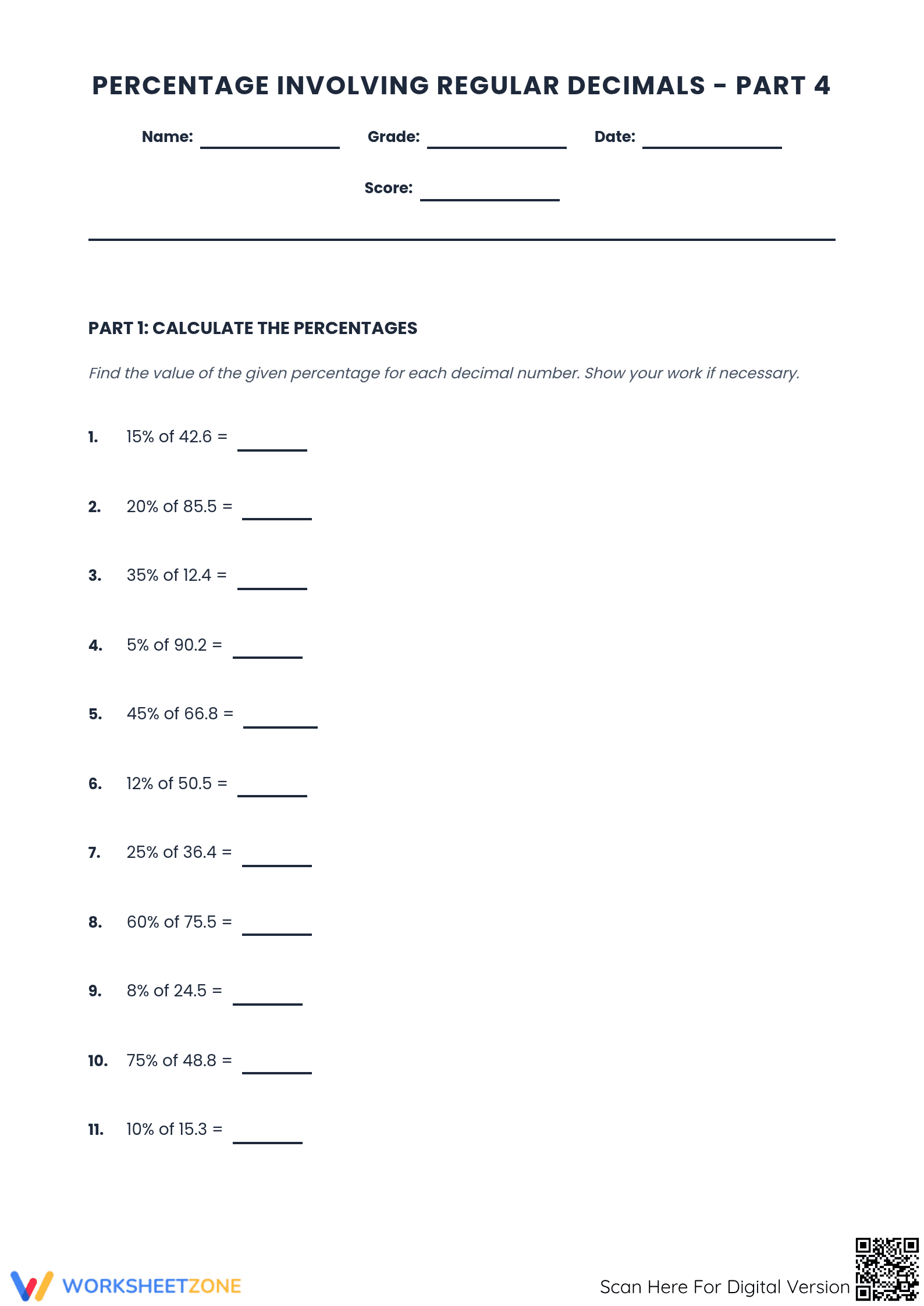
Equip your students with the skills needed to solve complex percentage problems involving decimal values. This comprehensive practice packet bridges the gap between basic percentage concepts and advanced decimal arithmetic. Students will learn to accurately find the value of a part given a percentage and a whole, ensuring mastery of proportional relationships and computational precision.
At a Glance
- Grade: 6–8 · Subject: Math
- Standard:
CCSS.MATH.CONTENT.6.RP.A.3.C— Find a percent of a quantity as a rate per 100- Skill Focus: Percentage of decimal quantities
- Format: 3 pages · 28 problems · Answer key included · PDF
- Best For: Fluency practice and formative assessment
- Time: 30–45 minutes
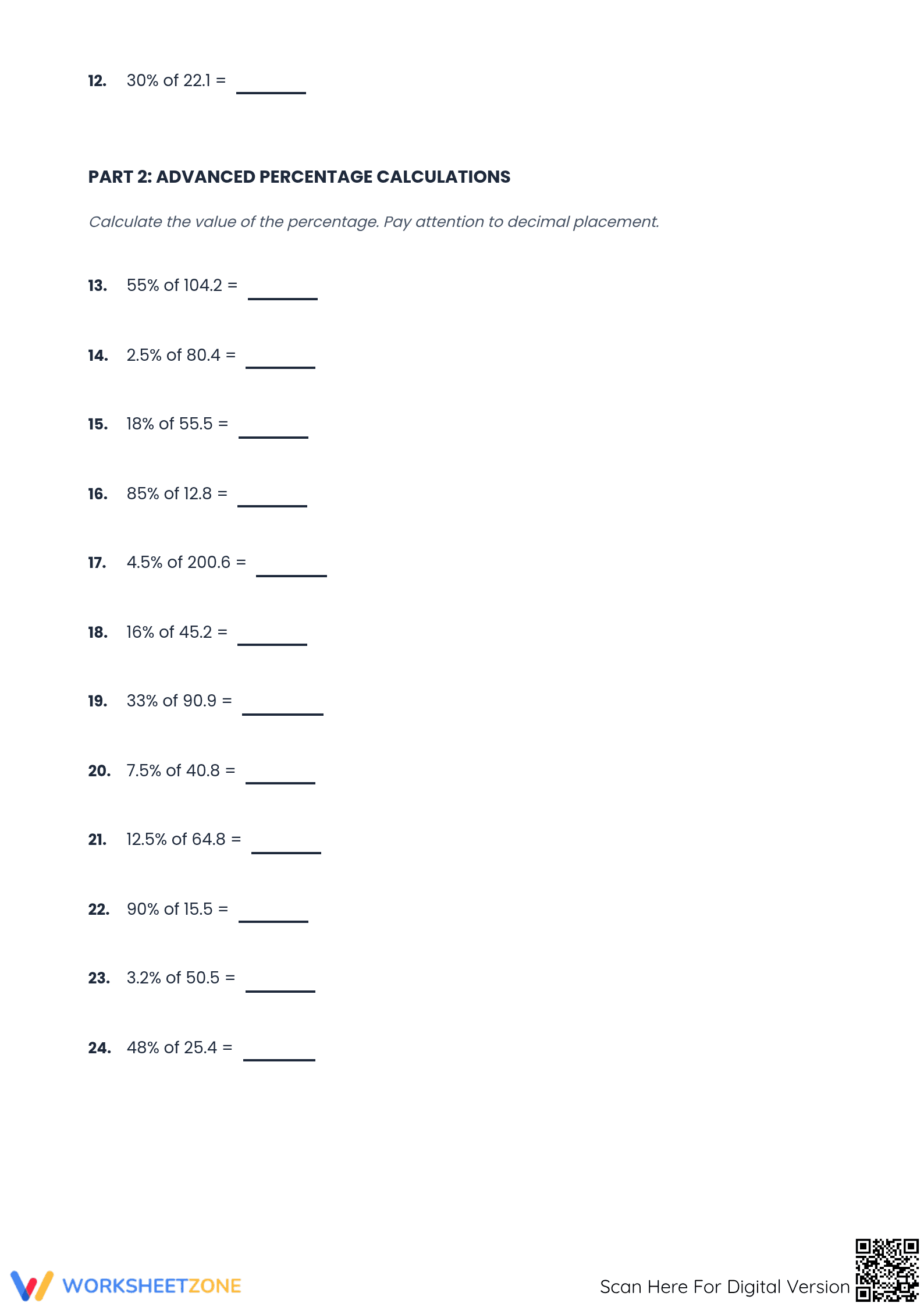
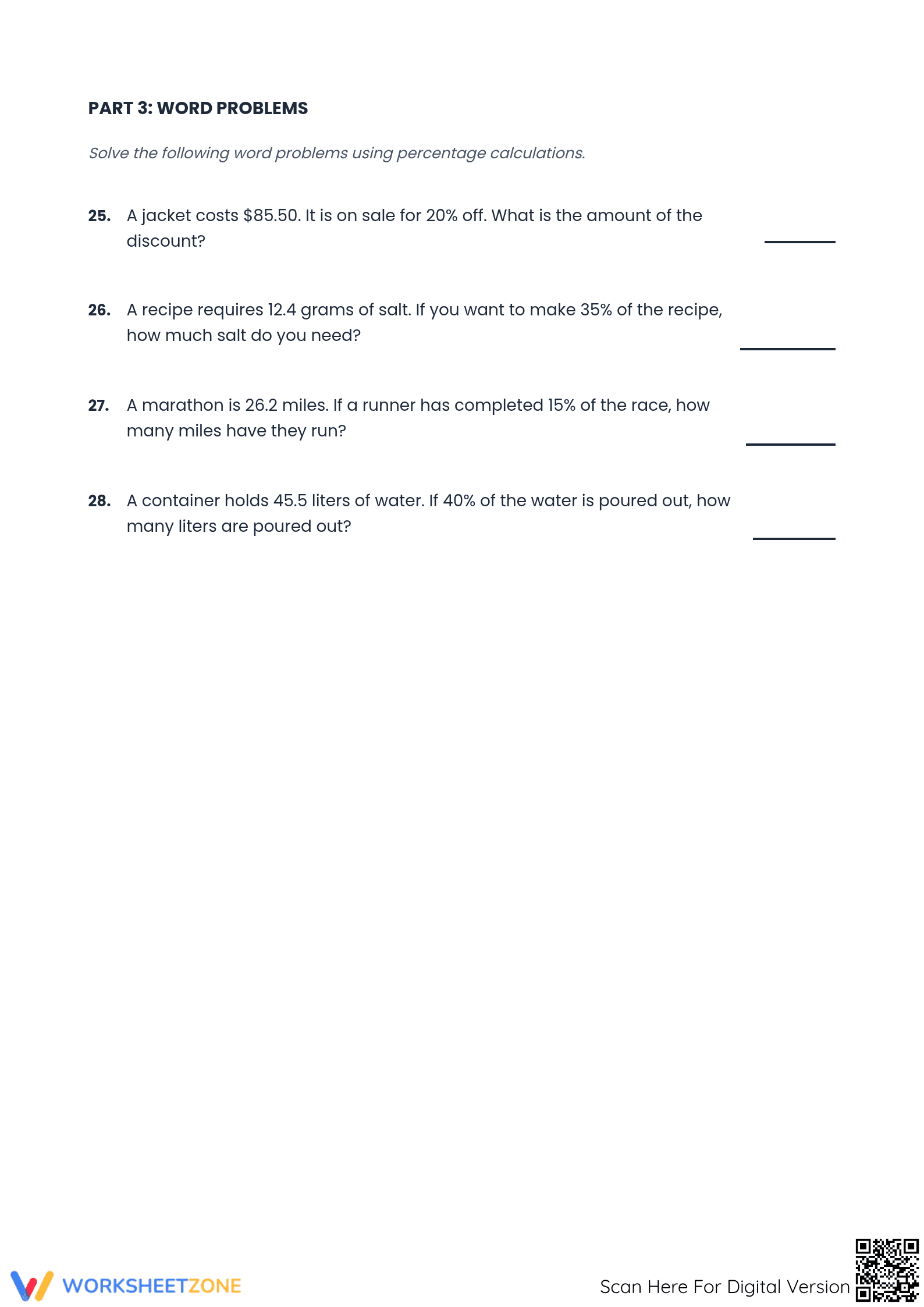
This three-page instructional resource features a structured progression of 28 mathematical challenges. The first section contains 12 foundational calculation tasks, followed by 12 advanced problems that emphasize precise decimal placement and fractional percentages. The final page provides four contextual word problems that require students to apply their computational skills to real-world scenarios, such as retail discounts, recipe adjustments, and distance calculations. A complete answer key is provided for immediate grading.
Skill Progression
- Guided Practice: The initial 12 problems focus on standard percentage-of-decimal calculations with whole-number percentages, allowing students to build rhythm and confidence in their conversion methods.
- Supported Practice: Section two introduces advanced values, including fractional percentages and larger decimal wholes, requiring higher cognitive demand and intense focus on place value accuracy.
- Independent Practice: The final section moves to abstract application through word problems, where students must identify the percentage and the whole within a text-based context to find a solution.
This gradual release model ensures that students move from rote calculation to conceptual application throughout the session.
Standards Alignment
This resource is directly aligned to CCSS.MATH.CONTENT.6.RP.A.3.C, which requires students to find a percent of a quantity as a rate per 100 and solve problems involving finding the whole, given a part and the percent. It also supports CCSS.MATH.CONTENT.7.RP.A.3 by challenging students to use proportional relationships to solve multistep percent problems. Both standard codes can be copied directly into lesson plans, IEP goals, or district curriculum mapping tools.
How to Use It
Use this packet during the independent practice phase of your lesson on proportional reasoning. For a high-impact formative assessment, observe students as they tackle the word problems on page three; look specifically for whether they can correctly set up the multiplication or division required for the solution. This worksheet also serves as an excellent homework assignment or a reliable sub plan resource due to its self-contained nature and clear instructions.
Who It's For
This material is designed for Grade 6, 7, and 8 students who have mastered basic multiplication and are ready to tackle complex ratios. It is particularly useful for students who need additional reinforcement in decimal operations and place value. Pair this resource with a visual anchor chart demonstrating the percentage-to-decimal conversion or a direct instruction lesson on financial literacy.
Structured practice is critical for developing procedural fluency with percentages and decimals. High-quality instructional materials, as noted by EdReports 2024, are essential for student success in middle school ratios and proportions. This worksheet aligns with CCSS.MATH.CONTENT.6.RP.A.3.C by requiring students to find the percent of a quantity, a fundamental skill for algebra and financial literacy. Moving from calculations to word problems engages students in making sense of problems. Research indicates frequent, focused practice with immediate feedback, provided by the answer key, significantly reduces errors and improves retention of proportional concepts.


