


























Views
Downloads

Essential Percentage Practice: Winter Sale | Grade 6 Math
Paste this activity's link or code into your existing LMS (Google Classroom, Canvas, Teams, Schoology, Moodle, etc.).
Students can open and work on the activity right away, with no student login required.
You'll still be able to track student progress and results from your teacher account.
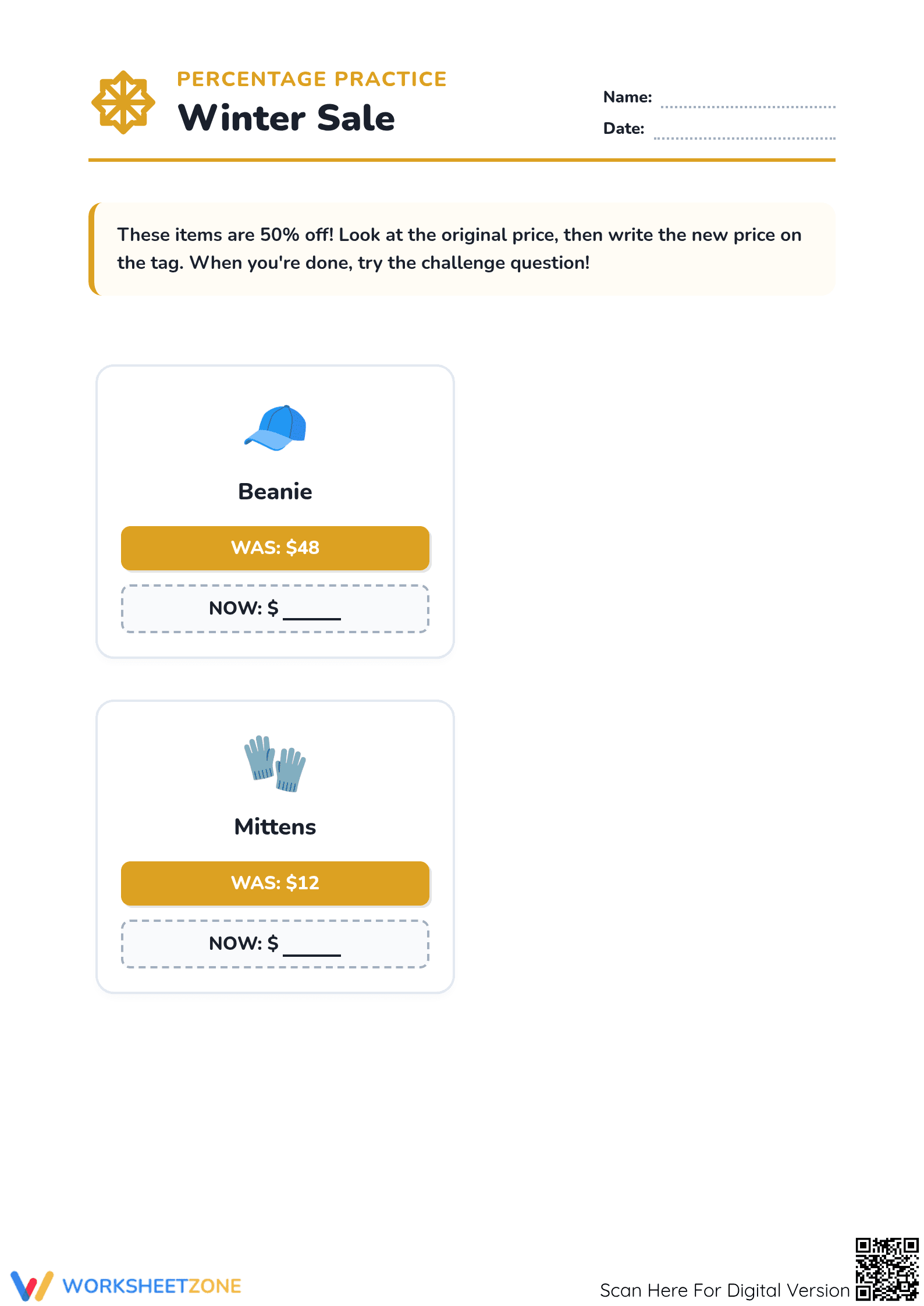
This Winter Sale worksheet helps students master the practical skill of calculating percentages in a shopping context. By finding 50% off various clothing items, learners bridge the gap between abstract math and real-life financial literacy. It provides immediate application of division and multiplication principles to solve meaningful price-tag problems.
At a Glance
- Grade: 6 · Subject: Math
- Standard:
6.RP.A.3.C— Find a percent of a quantity as a rate per 100- Skill Focus: Calculating 50% discounts and original prices
- Format: 3 pages · 7 problems · Answer key included · PDF
- Best For: Holiday-themed review or independent practice
- Time: 15–20 minutes
What's Inside
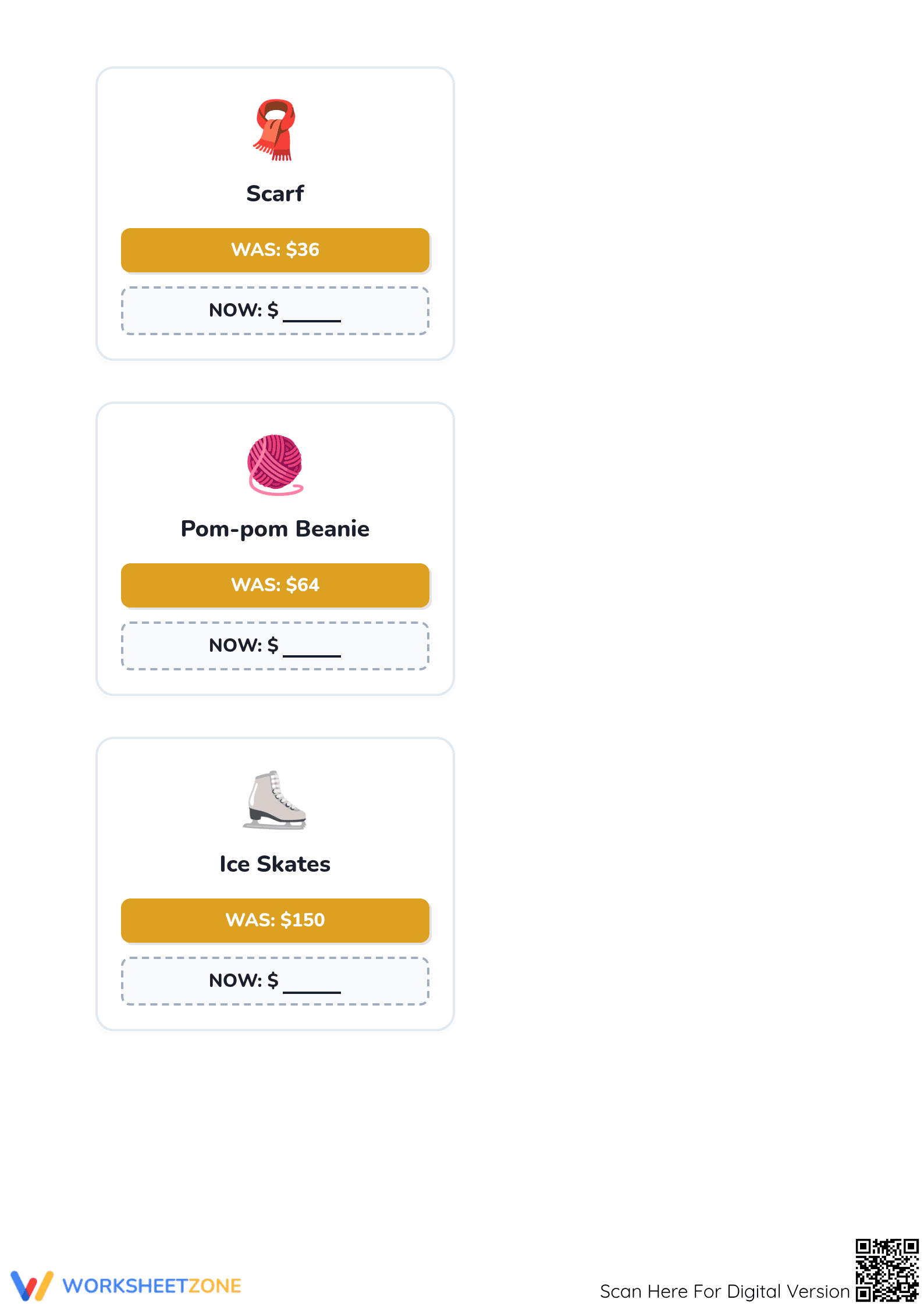
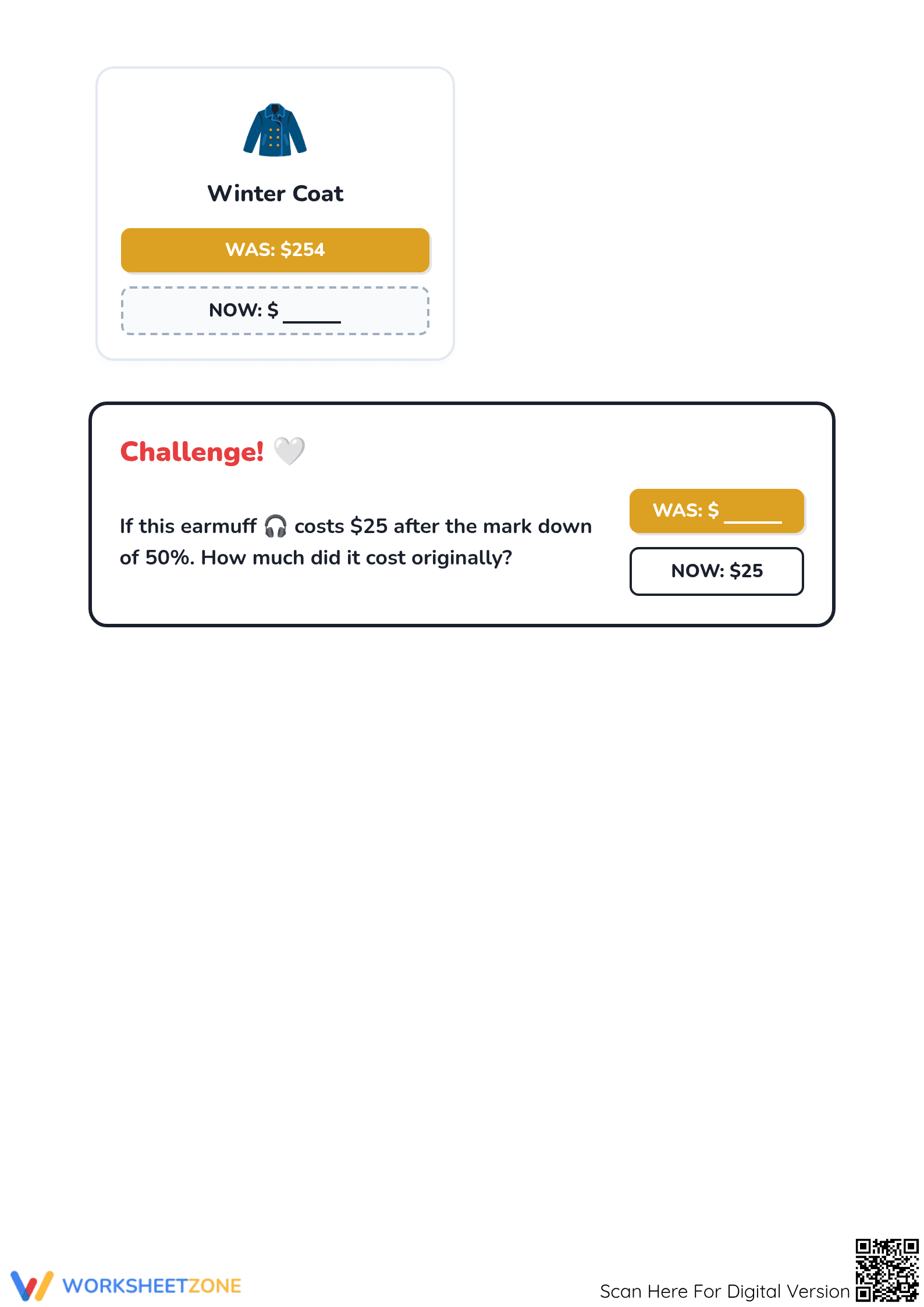
This 3-page PDF features 6 specific shopping scenarios where students must calculate the "Now" price of items like beanies, mittens, and ice skates. Each item displays a clear "Was" price, ranging from two-digit to three-digit numbers ($12 to $254). A final "Challenge!" section reverses the operation, asking students to determine the original price given the discounted total. A comprehensive answer key is included.
The Zero-Prep Workflow
This resource is designed for immediate classroom deployment with minimal teacher preparation. First, print the 3-page PDF (30 seconds). Second, distribute copies to students; the seasonal theme and clear price tags require zero verbal setup (1 minute). Finally, review the answers using the provided key or have students self-correct to build autonomy (10 minutes). It is an ideal sub plan or warm-up activity for the winter season.
Standards Alignment
The primary focus is `6.RP.A.3.C`: "Find a percent of a quantity as a rate per 100; solve problems involving finding the whole, given a part and the percent." The challenge question specifically addresses the second half of this standard. This code can be copied directly into lesson plans, IEP goals, or district curriculum mapping tools to track student progress in ratios and proportions.
How to Use It
Use this worksheet as a mid-unit formative assessment during your percentages module. It works effectively as an "Exit Ticket" or a collaborative partner activity. During the session, observe if students are using the "divide by 2" shortcut for 50% or if they are setting up a full percentage proportion. This observation provides insight into their level of conceptual mastery. Expect completion in under 20 minutes.
Who It's For
This activity is perfect for Grade 6 students learning ratios and proportions, as well as Grade 5 learners ready for advanced division applications. It serves as an excellent resource for Title I intervention groups or as a "fast-finisher" task during the winter months. Pair it with a "Summer Sale" extension to compare different discount rates and build price comparison skills.
Calculating percentages within a realistic shopping context, such as a 50% off winter sale, leverages the principles of anchored instruction to enhance student engagement and retention. According to Fisher & Frey (2014), the gradual release of responsibility is most effective when students apply mathematical skills to scenarios that mirror real-world decision-making. This worksheet aligns with `6.RP.A.3.C` by requiring students to find both the part (discounted price) and the whole (original price), moving beyond rote calculation toward functional numeracy. Research suggests that thematic materials reduce math anxiety by providing a familiar cognitive framework for complex operations. By presenting 7 distinct tasks with varying price points, the resource ensures students practice the underlying division-by-two logic across multiple numerical scales. This evidence-based approach supports long-term mastery of ratios and proportional reasoning, preparing learners for more complex financial math and consumer literacy in higher grades.


