


























Views
Downloads

Sales Tax Math Worksheet | Grade 7 Essential Math
Paste this activity's link or code into your existing LMS (Google Classroom, Canvas, Teams, Schoology, Moodle, etc.).
Students can open and work on the activity right away, with no student login required.
You'll still be able to track student progress and results from your teacher account.
This Grade 7 sales tax math worksheet helps students master real-world financial calculations through a structured three-part progression. Students move beyond simple multiplication to understand how tax rates affect total purchase prices in practical scenarios. By the end of these activities, learners will confidently calculate tax amounts and make informed consumer decisions.
At a Glance
- Grade: 7 · Subject: Math
- Standard:
CCSS.MATH.CONTENT.7.RP.A.3— Use proportional relationships to solve multistep ratio and percent problems like sales tax.- Skill Focus: Calculating sales tax and total consumer costs
- Format: 3 pages · 10 problems · Answer key included · PDF
- Best For: Real-world financial literacy and percent application
- Time: 35–45 minutes
What's Inside
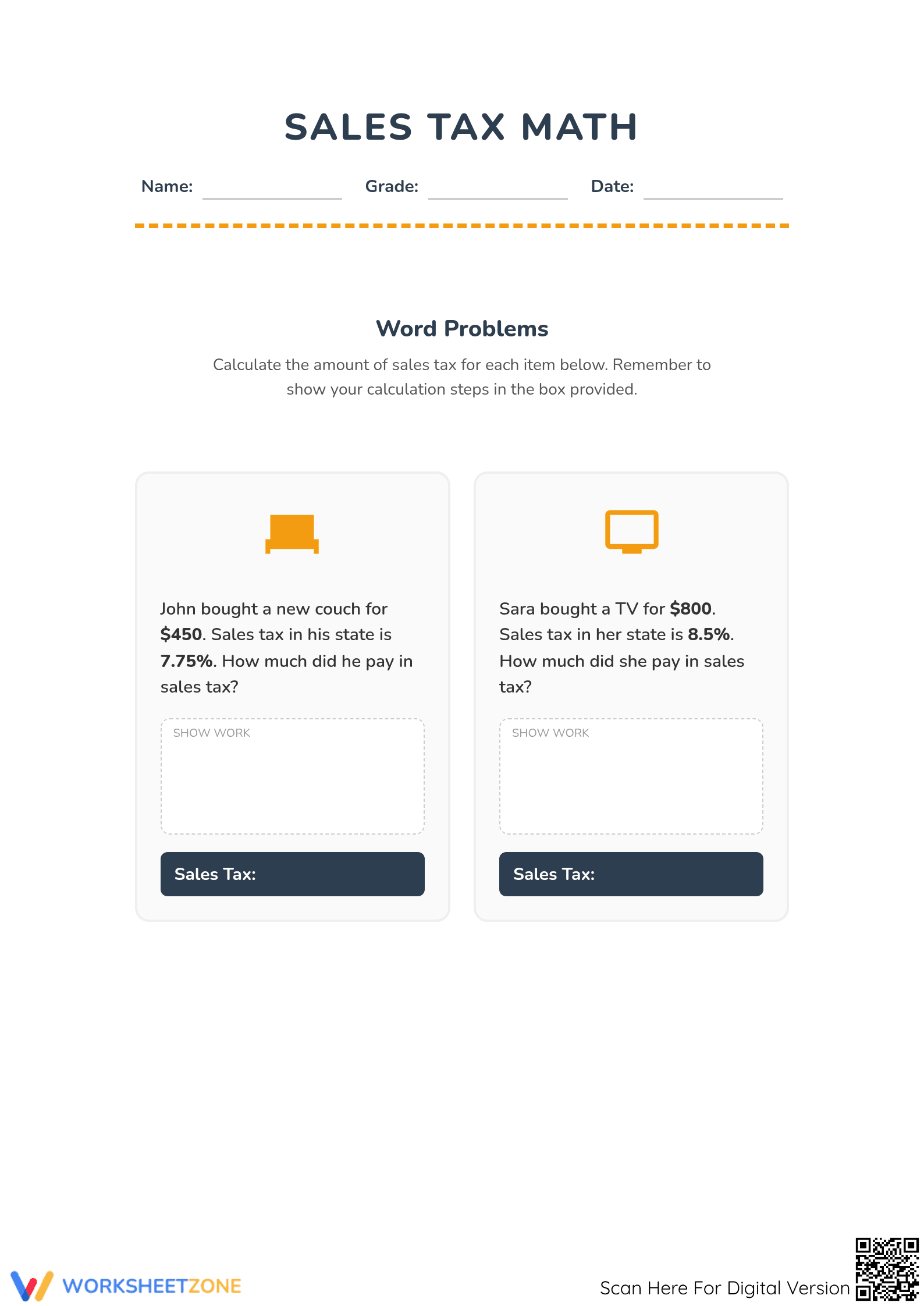
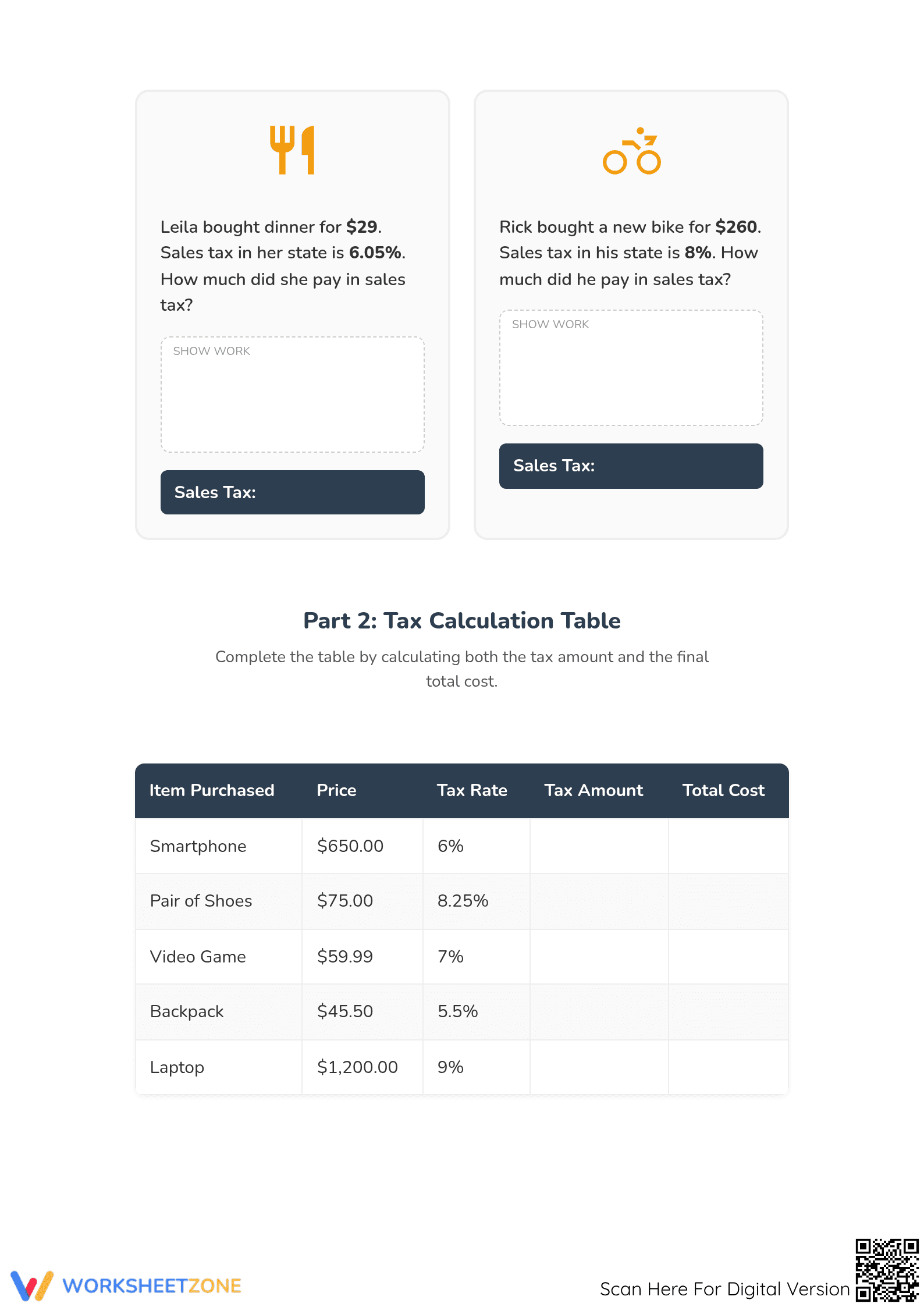
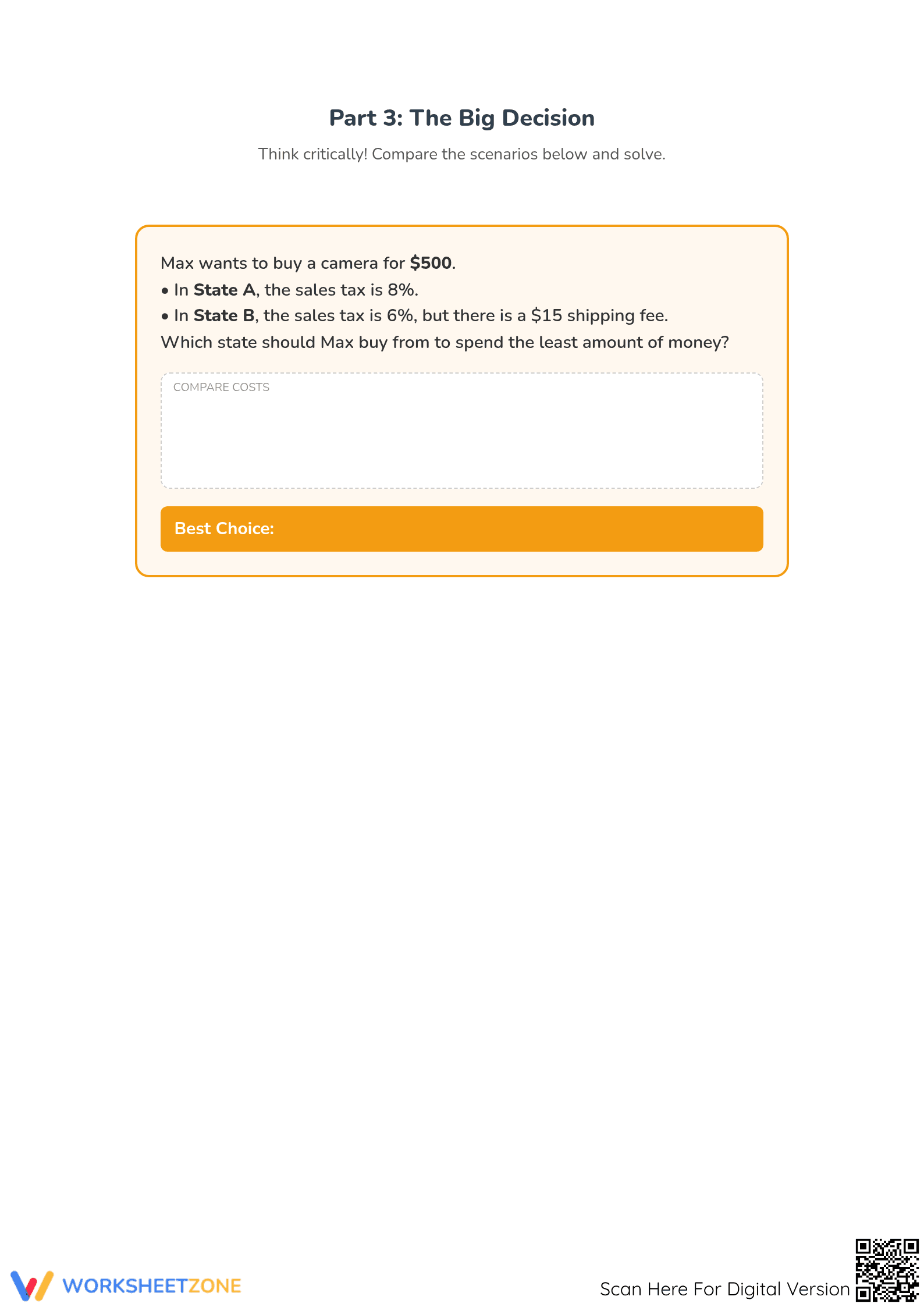
This comprehensive 3-page PDF features 10 distinct mathematical challenges organized into three cognitive tiers. It includes four detailed word problems with dedicated workspace for showing calculations, a five-row data table for rapid tax and total cost computation, and a final critical thinking comparison scenario. A complete answer key is provided for immediate grading or student self-correction.
Skill Progression
- Guided Practice: Four contextual word problems (Part 1) provide visual scaffolds and dedicated workspaces, allowing students to practice the initial step of converting percentages to decimals for tax calculation.
- Supported Practice: A five-row calculation table (Part 2) removes linguistic complexity, focusing on procedural fluency across diverse tax rates from 5.5% to 9% for items like smartphones and laptops.
- Independent Practice: The "Big Decision" comparison task (Part 3) requires students to apply evaluative logic to determine the most cost-effective purchase between two competing state tax and shipping scenarios.
This sequence follows a gradual-release model, transitioning students from teacher-led instruction to independent mastery of complex financial scenarios.
Standards Alignment
This resource aligns perfectly with `CCSS.MATH.CONTENT.7.RP.A.3`, which requires students to use proportional relationships to solve multistep ratio and percent problems. It specifically targets the application of percentages to tax and total cost scenarios. Both standard codes can be copied directly into lesson plans, IEP goals, or district curriculum mapping tools.
How to Use It
Use this worksheet during the practice phase of a lesson on percent applications. It serves as an excellent formative assessment tool; observe Part 3 to see if students can generalize their tax calculation skills to comparative logic. Expected completion time is roughly 40 minutes, making it ideal for a full class period or a substantial homework assignment.
Who It's For
Designed for 7th-grade general education math students, this worksheet is also highly effective for 8th-grade review or accelerated 6th-grade learners. It pairs naturally with a consumer math anchor chart or a short introductory video on converting percentages to decimals for multi-step multiplication.
The ability to solve multistep percent problems, specifically sales tax, is a critical component of 7th-grade mathematical proficiency. According to EdReports 2024, high-quality mathematics curricula must bridge the gap between abstract procedural fluency and concrete real-world application to ensure long-term retention of ratio and proportion skills. This worksheet provides that bridge by requiring students to navigate varying tax rates and purchase prices similar to those they encounter in daily life. Research by Fisher & Frey (2014) emphasizes that "showing work" in designated calculation boxes—as required in Part 1 of this resource—is essential for identifying misconceptions in decimal placement and multiplication logic. By integrating word problems, tabular data, and evaluative decision-making, this tool aligns with evidence-based practices for secondary math instruction. The standard `CCSS.MATH.CONTENT.7.RP.A.3` is central to developing the financial literacy necessary for college and career readiness.


