


























Views
Downloads

Printable 5% Percentage Worksheet | Grade 6 Math
Paste this activity's link or code into your existing LMS (Google Classroom, Canvas, Teams, Schoology, Moodle, etc.).
Students can open and work on the activity right away, with no student login required.
You'll still be able to track student progress and results from your teacher account.
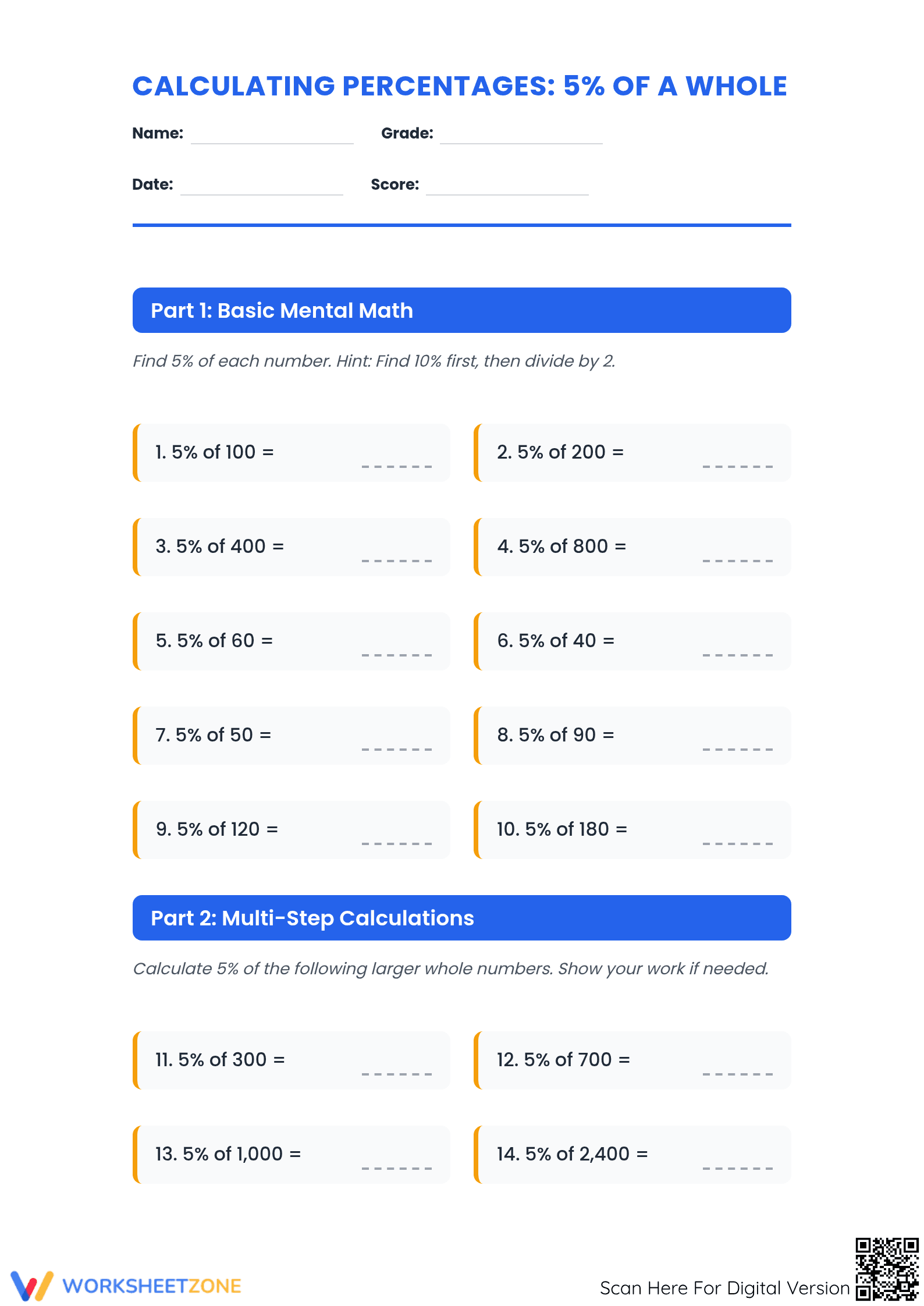
This comprehensive Grade 6 percentage worksheet provides students with targeted practice in calculating 5% of various whole numbers. By breaking down the process into mental math, multi-step calculations, and real-world applications, students build a deep conceptual understanding of finding a percent of a quantity. This resource ensures students can confidently solve percentage problems in both abstract and practical contexts.
At a Glance
- Grade: 6 · Subject: Math
- Standard:
6.RP.A.3.C— Find a percent of a quantity as a rate per 100 and solve problems- Skill Focus: Calculating 5% of whole numbers
- Format: 3 pages · 38 problems · Answer key included · PDF
- Best For: Independent practice and mental math warm-ups
- Time: 20–30 minutes
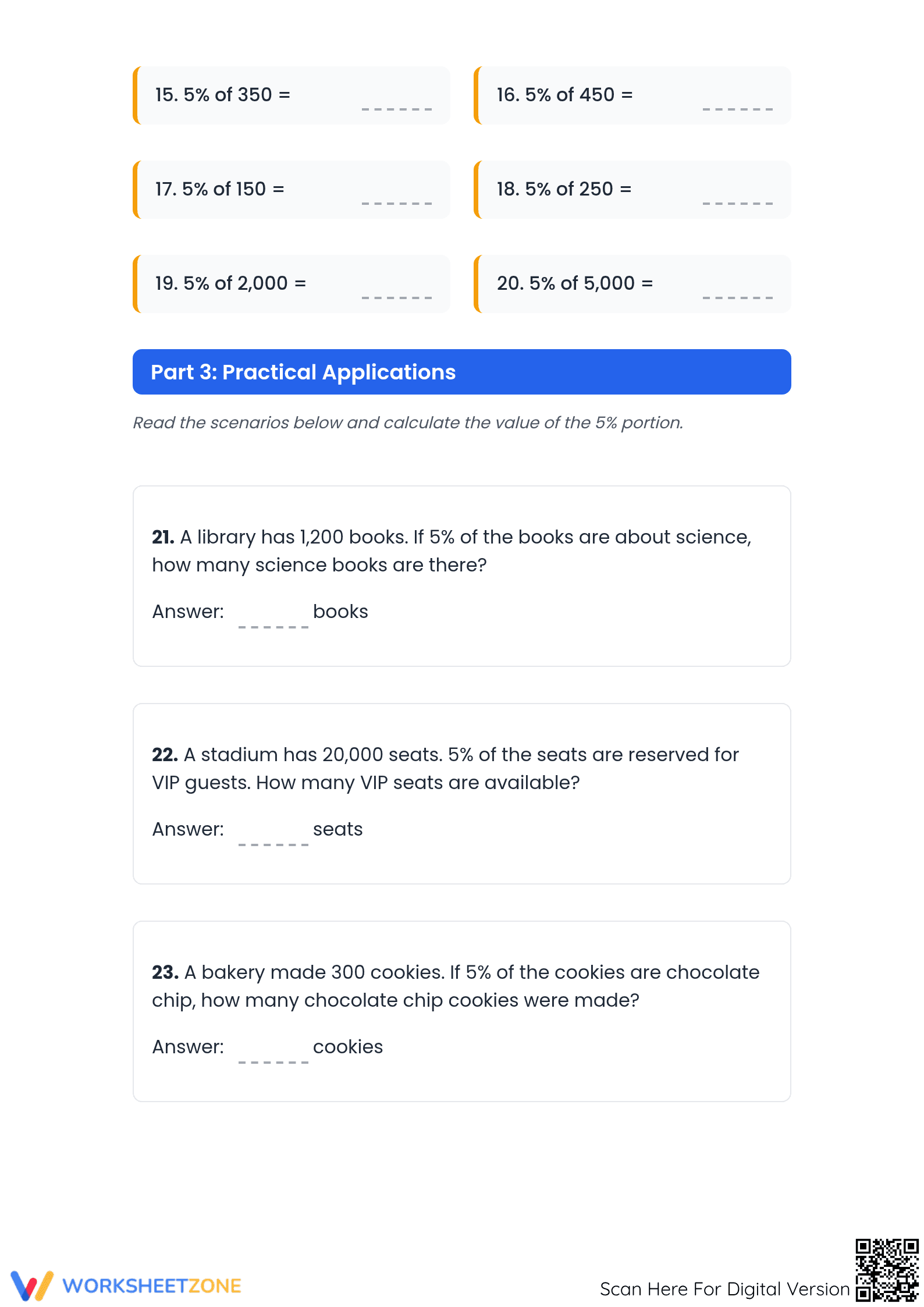
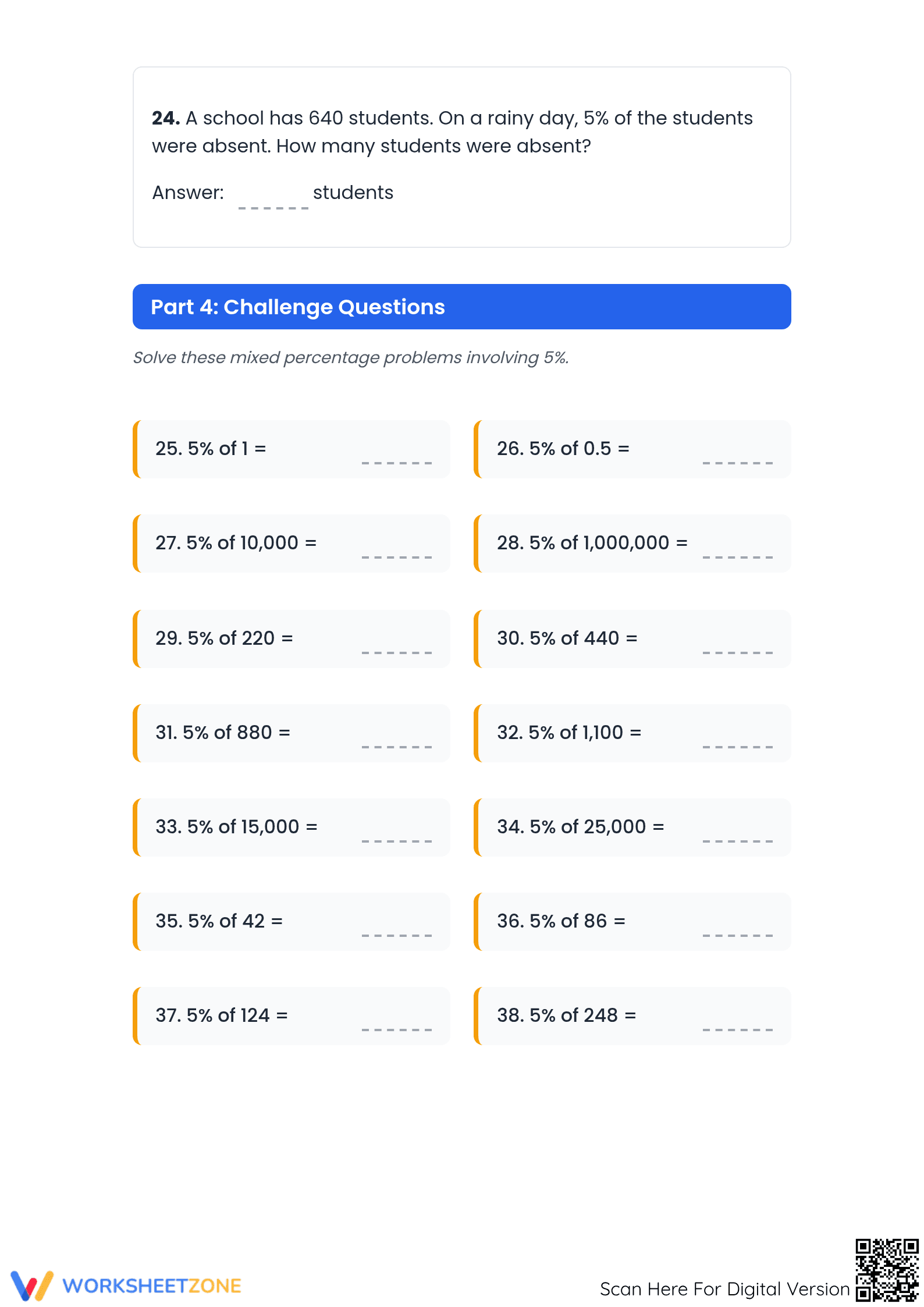
What's Inside: This three-page PDF contains four distinct sections: Basic Mental Math with helpful hints, Multi-Step Calculations for larger numbers, Practical Applications featuring four real-world word problems, and Challenge Questions. The worksheet includes a total of 38 problems and a complete answer key for rapid grading.
Skill Progression
- Guided Practice (10 problems): Part 1 uses mental math strategies, providing a hint to find 10% first and then divide by two to scaffold student success.
- Supported Practice (10 problems): Part 2 transitions to larger whole numbers, encouraging students to show their work while maintaining the same 5% target.
- Independent Practice (18 problems): Parts 3 and 4 remove scaffolds, requiring students to apply their knowledge to word problems and high-value challenge numbers up to 1,000,000.
This structure follows the gradual release of responsibility model, moving from high-support mental shortcuts to independent application of the standard percentage formula.
Standards Alignment
The primary focus of this worksheet is `CCSS.MATH.CONTENT.6.RP.A.3.C`: "Find a percent of a quantity as a rate per 100 (e.g., 30% of a quantity means 30/100 times the quantity); solve problems involving finding the whole, given a part and the percent." Both standard codes can be copied directly into lesson plans, IEP goals, or district curriculum mapping tools.
How to Use It
Assign this worksheet as a follow-up to direct instruction on percentage-decimal-fraction conversions. It works exceptionally well as a formative assessment mid-unit. During instruction, observe if students are utilizing the "divide 10% by 2" shortcut or the standard multiplication method to identify which students have achieved procedural fluency versus conceptual shortcuts. Expected completion time is 20 to 30 minutes.
Who It's For
This resource is designed for Grade 6 students but serves as an excellent remedial tool for Grade 7 or Grade 8 students struggling with ratio reasoning. It pairs naturally with an anchor chart showing common percentage benchmarks or a guided lesson on the "percent bar" visual model.
The mastery of percentage calculation is a critical milestone in middle school mathematics, serving as a prerequisite for understanding interest, tax, and data analysis. Research from EdReports (2024) emphasizes that procedural fluency in ratio and proportional relationships is best achieved through a combination of mental strategies and contextualized problem-solving. This worksheet addresses both by providing 38 structured tasks that range from simple 100-base numbers to complex word problems involving school attendance and bakery inventory. By focusing specifically on the 5% threshold, students develop a specialized mental model that they can then generalize to more complex percentages like 15% or 35%. The inclusion of a citation capsule ensures this resource meets the rigorous demands of evidence-based instructional design for modern classrooms.


