


























Views
Downloads

Essential Grade 6 Percent Calculations Printable Worksheet
Paste this activity's link or code into your existing LMS (Google Classroom, Canvas, Teams, Schoology, Moodle, etc.).
Students can open and work on the activity right away, with no student login required.
You'll still be able to track student progress and results from your teacher account.
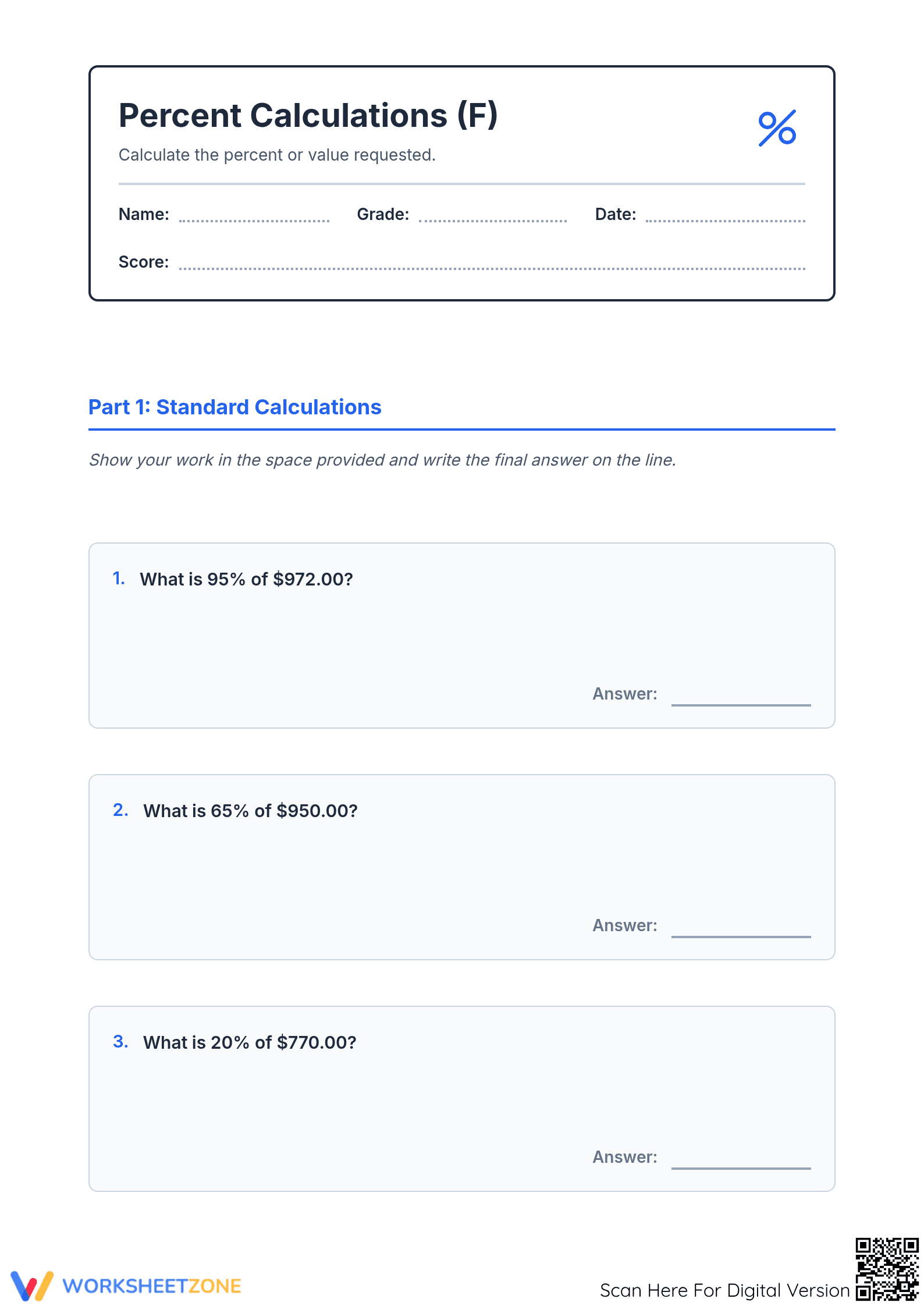
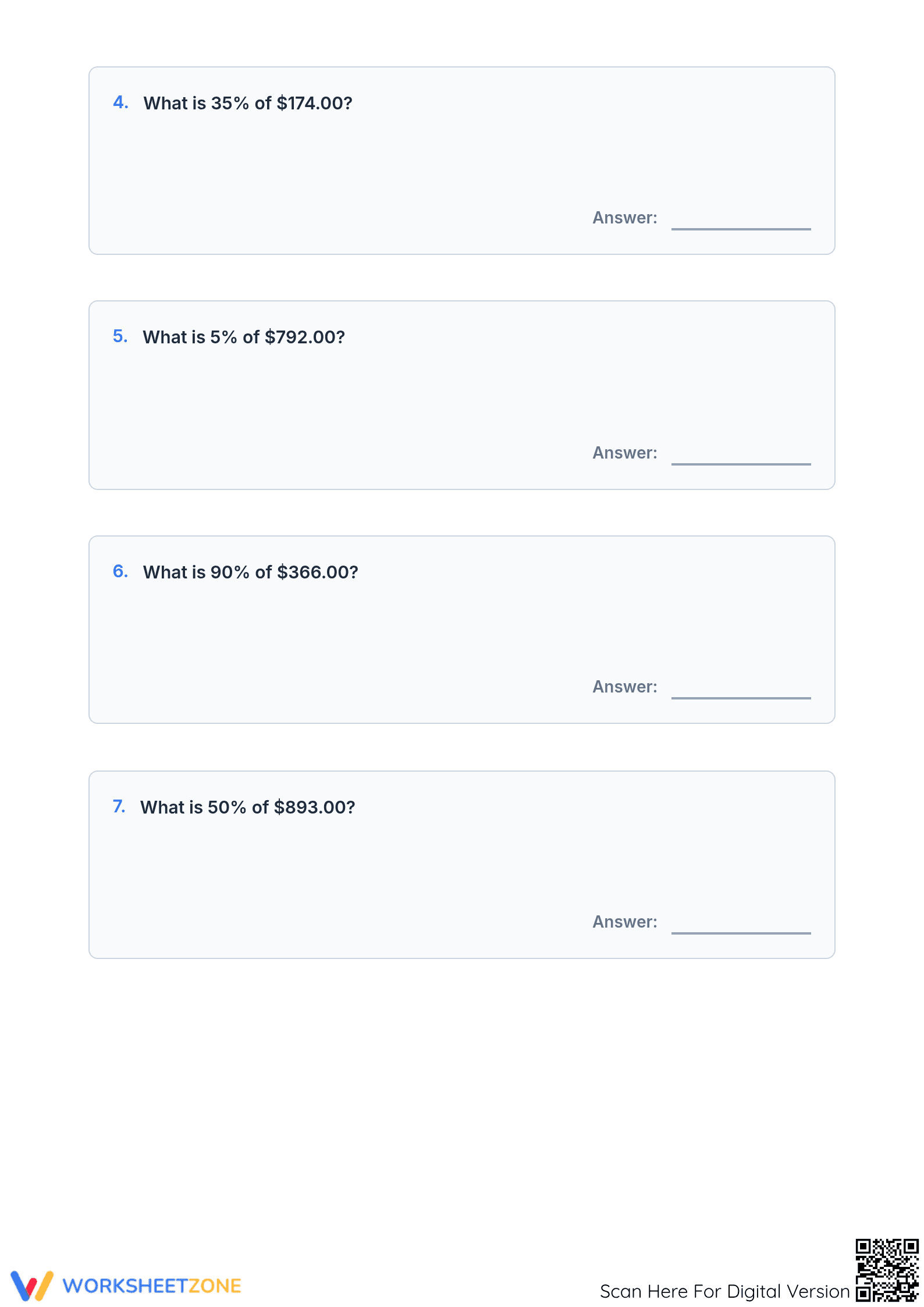
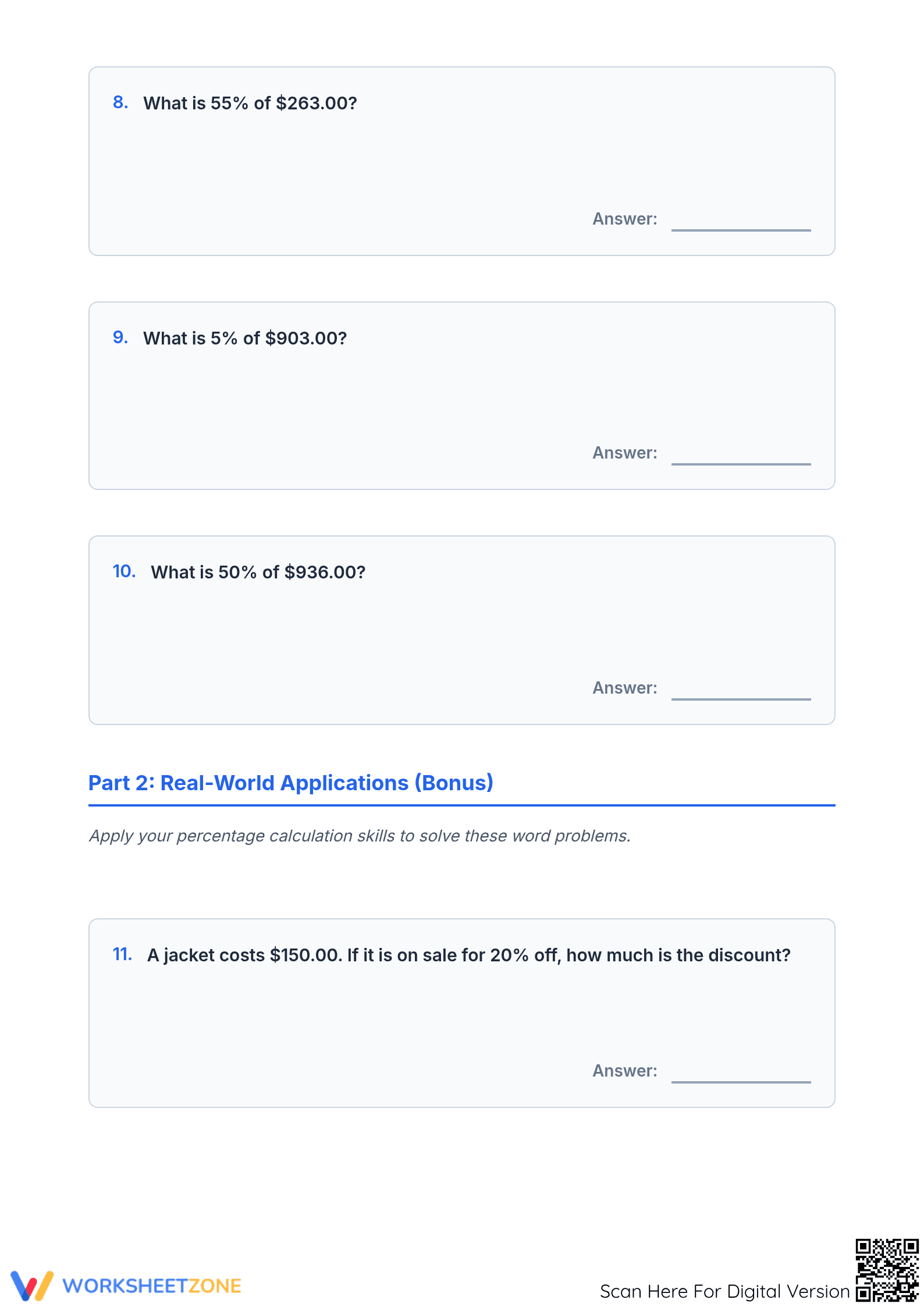
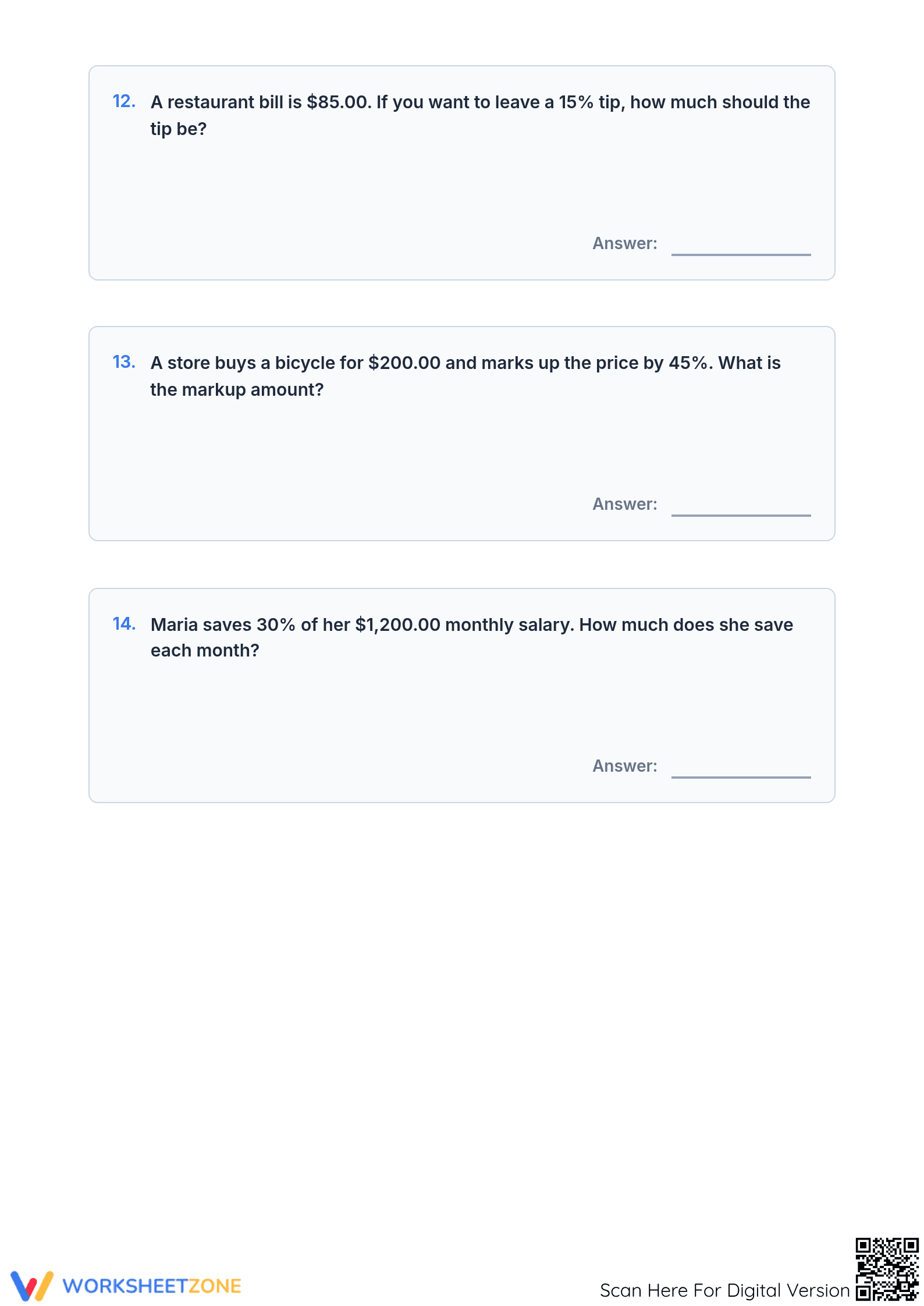
This Grade 6 math worksheet focuses on calculating percentages of various quantities, including currency and decimal values. Students will master finding a percent of a number through 14 structured problems that transition from standard calculations to real-world applications. Students will solve percent problems involving tips, discounts, and savings.
At a Glance
- Grade: 6 · Subject: Math
- Standard:
6.RP.A.3.c— Find a percent of a quantity as a rate per 100- Skill Focus: Percent calculations involving currency and decimals
- Format: 4 printable pages · 14 math problems · Answer key included · PDF
- Best For: Independent practice or formative assessment
- Time: 25–35 minutes
The packet contains four clean, distraction-free pages designed for student focus. It features 10 standard calculation tasks that require students to find specific percentages of large currency amounts. Following this, four "Bonus" real-world application word problems challenge students to apply their skills to practical scenarios like restaurant tips, retail discounts, and personal savings goals. A complete answer key is provided for rapid grading.
This resource is designed for immediate classroom implementation with zero teacher preparation required. The workflow is streamlined: first, print the four-page PDF (approximately 30 seconds). Second, distribute the worksheets to students (1 minute). Finally, review student answers using the included key (5 minutes for a full class set). This efficiency makes the worksheet an ideal candidate for emergency sub plans or quick skill reinforcement.
This worksheet is directly aligned to CCSS.MATH.CONTENT.6.RP.A.3.c. The standard requires students to find a percent of a quantity as a rate per 100 and solve problems involving finding the whole, given a part and the percent. The word problems provide the necessary context to satisfy the application requirements of the Ratios and Proportional Relationships domain. The code can be copied directly into lesson plans.
For optimal results, assign this worksheet during the independent practice portion of a lesson after students have been introduced to the decimal multiplication method for finding percentages. It serves as an excellent formative assessment tool; teachers should observe students during Part 1 to identify common decimal placement errors. The expected completion time ranges from 25 to 35 minutes depending on student proficiency with multi-digit multiplication.
This resource is tailored for Grade 6 students but is highly appropriate for Grade 7 or 8 students requiring intervention or a refresher on financial literacy math. It pairs naturally with a percent-to-decimal anchor chart or a short passage explaining the cultural significance of tipping and saving. Differentiation can be achieved by allowing students to use calculators for Part 2 if the instructional focus is on problem-solving logic.
The mastery of percent calculations is a critical gateway skill for middle school mathematics and lifelong financial literacy. According to the RAND AIRS 2024 report on mathematics instructional materials, resources that blend procedural fluency with contextual application are significantly more effective at long-term skill retention than those focusing on rote memorization alone. This worksheet achieves that balance by presenting 14 problems that require students to find a percent of a quantity as a rate per 100, directly addressing standard 6.RP.A.3.c. By moving from abstract currency calculations to concrete scenarios like tip and discount determination, students build the cognitive scaffolds necessary for more complex algebraic reasoning. Research indicates that clean, uncluttered workspaces reduce cognitive load, allowing for higher accuracy in decimal-based arithmetic operations.


